New Zealand is one of the easier long-haul trips from Dubai on paper. There is no embassy queue, no passport handover and no interview. Depending on your passport you either fill in a short NZeTA request on your phone, or you apply for a visitor visa online and get an eVisa by email. The hard part is not the form. It is knowing which of the two you need, what it really costs in dirhams, and how to show your UAE life to an officer in Wellington or Mumbai who has never seen a UAE payslip.
Most pages that rank for this search are written by visa agents in Dubai. Some still quote the old NZD 246 visitor visa fee, some say every applicant must give biometrics at VFS, and none of the ones I read mention that Kuwaiti passports lost visa-free travel to New Zealand last week. So for this guide I went back to Immigration New Zealand (INZ) on 18 November 2026: its operational manual, which is the rulebook its officers use, its fee table, its news notices and the Kuwait circular. I also read a real refusal of a Dubai resident and pulled out what went wrong. If you are planning a combined trip, our Australia visa from UAE guide covers the other half.
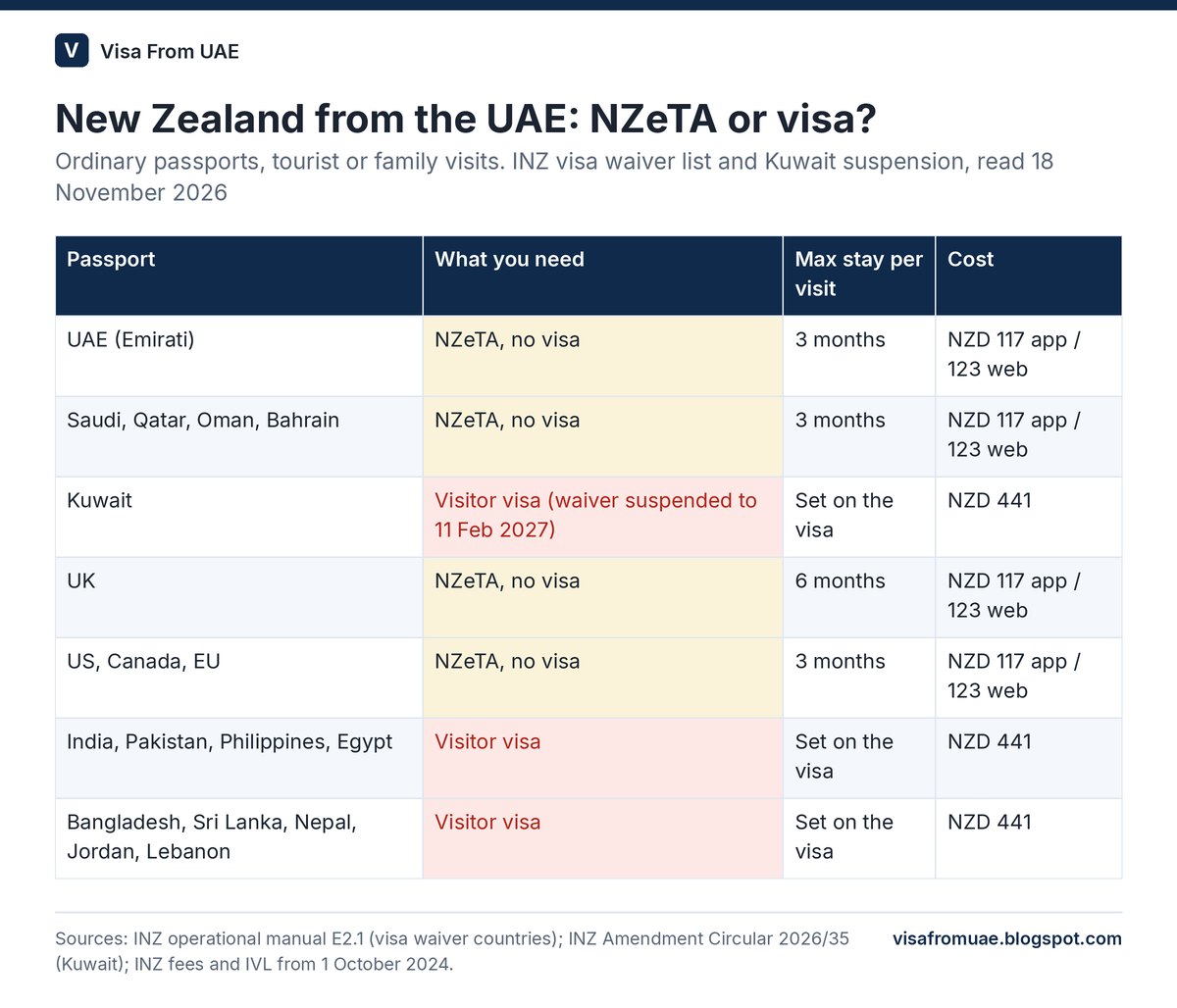
Short answer: New Zealand decides by passport, not by UAE residence. Emiratis, and Saudi, Qatari, Omani and Bahraini passport holders, do not need a visa. They need an NZeTA, which costs NZD 117 in the official app or NZD 123 on the website, including the NZD 100 visitor levy (about AED 236 to 248). Kuwaiti passports need a visa until at least 11 February 2027. Indian, Pakistani, Filipino, Egyptian, Bangladeshi, Sri Lankan, Nepali, Jordanian and Lebanese passport holders need a visitor visa: NZD 441 all in (about AED 891), applied for online through Immigration Online. You must show NZD 1,000 for each month of your stay, or NZD 400 a month if your accommodation is prepaid, plus a way to leave.
NZeTA or visa? Your passport decides
New Zealand has a visa waiver list. If your passport is on it, you do not need a visa for a visit of up to three months, but you do need an NZeTA (New Zealand Electronic Travel Authority) before you fly. If your passport is not on it, you need a visitor visa. A UAE residence visa, a Golden Visa, or a valid US, UK or Schengen visa in your passport does not change which side you are on.
The list in the INZ operational manual (section E2.1) has around 60 countries. For people living in the UAE, these are the groups that matter.
Emiratis and most GCC passports: NZeTA
The United Arab Emirates, Saudi Arabia, Qatar, Oman and Bahrain are all on the waiver list. You request an NZeTA, pay the visitor levy with it, and fly. The waiver covers holidays, family visits and business meetings for up to three months per visit. It does not cover medical treatment, so if the purpose of your trip is a consultation or an operation, apply for a visitor visa instead.
Kuwaiti passports: visa required, for now
This is new. INZ suspended Kuwait's visa waiver from 11:59pm on 12 November 2026 to 11:59pm on 11 February 2027, under a special direction signed by the Minister of Immigration on 4 November. Fragomen, the immigration law firm, says the reason is uncertainty about Kuwait's citizenship revocation programme and whether some travellers can return to Kuwait. During the suspension a Kuwaiti passport holder needs a visitor visa, and an NZeTA alone will not do. Fragomen says INZ is contacting Kuwaitis who already hold an NZeTA. The government has said it will announce any extension before the end date, so check again in late January if you are planning a February trip.
UK, US, Canadian and EU passports
All on the waiver list, all need an NZeTA. British citizens get up to six months per visit, everyone else three. Portuguese citizens need the right to live permanently in Portugal, and Greek passports must have been issued from 2006 on.
South Asian, Filipino and most Arab passports: visitor visa
India, Pakistan, the Philippines, Egypt, Bangladesh, Sri Lanka, Nepal, Jordan and Lebanon are not on the waiver list, and between them they cover most of the UAE's expat population. If that is your passport, you apply for a visitor visa, and the rest of this guide is mostly for you.
What it costs in AED
New Zealand charges three things, and agency pages often show only one of them:
- The application fee. NZD 300 for a visitor visa. The NZeTA costs NZD 17 in the official NZeTA app and NZD 23 on the website.
- The immigration levy. NZD 41 on a visitor visa, which makes the visa charge NZD 341. This has been the rate since 1 October 2024, when it went up from NZD 211.
- The International Visitor Conservation and Tourism Levy (IVL). NZD 100 per person, up from NZD 35 on the same date. Almost every visitor pays it, with the NZeTA or with the visa.
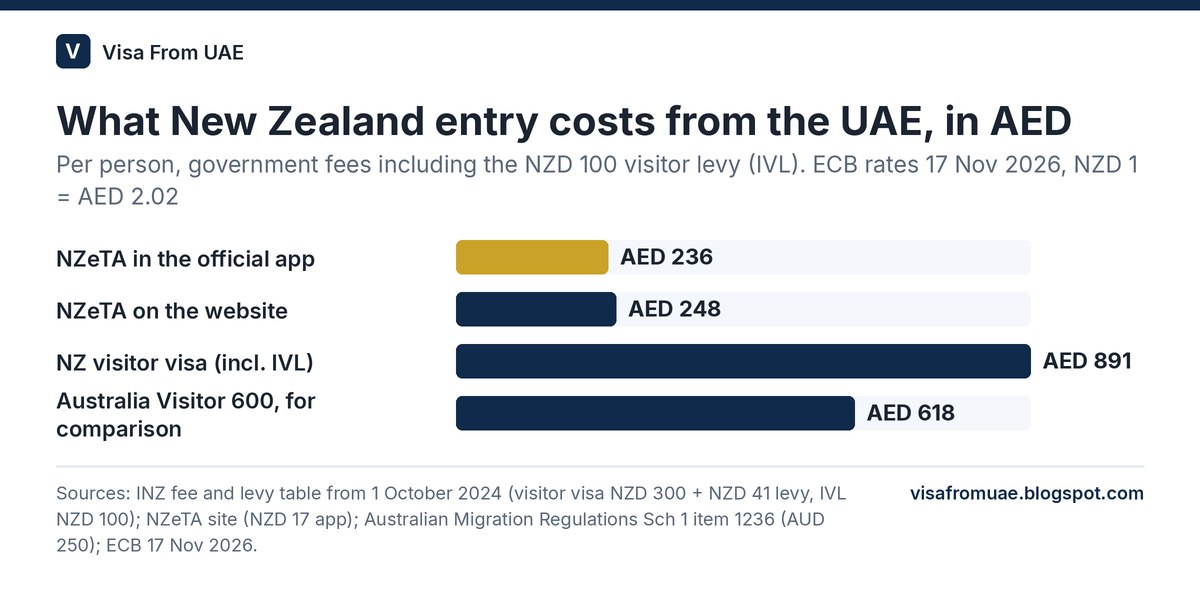
So the totals are NZD 117 or 123 for an NZeTA and NZD 441 for a visitor visa. INZ itself used the NZD 441 figure in March 2026 when it announced a cheaper fee for Pacific nationals, so this is still the current amount for everyone else. Any page quoting NZD 246 or NZD 211 is describing the fee before October 2024.
At the European Central Bank rates for 17 November 2026 (NZD 1 = about AED 2.02):
| What | NZD | About AED |
|---|---|---|
| NZeTA, official app | 17 + 100 IVL = 117 | 236 |
| NZeTA, website | 23 + 100 IVL = 123 | 248 |
| Visitor visa | 300 + 41 levy + 100 IVL = 441 | 891 |
A family of four on Indian passports therefore pays about AED 3,560 in government fees before a single flight is booked. Every traveller, children included, pays the fee and the levy. Your card may add a foreign currency fee, as the payment is in New Zealand dollars.
The NZeTA: for GCC, UK, US and EU passports
If your passport is on the waiver list, the process is short:
- Use the official NZeTA app or the INZ website. The app is cheaper by NZD 6. Many lookalike sites charge two or three times the price for the same request, so check that the address ends in immigration.govt.nz.
- Have your passport and a card ready. You scan the passport, take a photo of your face and answer a few character and health questions.
- Apply at least 72 hours before you fly. Tourism New Zealand says most requests are processed within 72 hours, and some take longer.
- Travel on the same passport. The NZeTA is linked to the passport you used and lasts up to two years. If you renew your passport, request a new NZeTA.
An NZeTA is permission to board a flight, not a promise of entry. At Auckland or Christchurch the border officer can still ask for your return ticket, where you are staying and how you will pay for the trip. Bring the same kind of evidence a visa applicant would, even if nobody asks.
The visitor visa: who applies and how
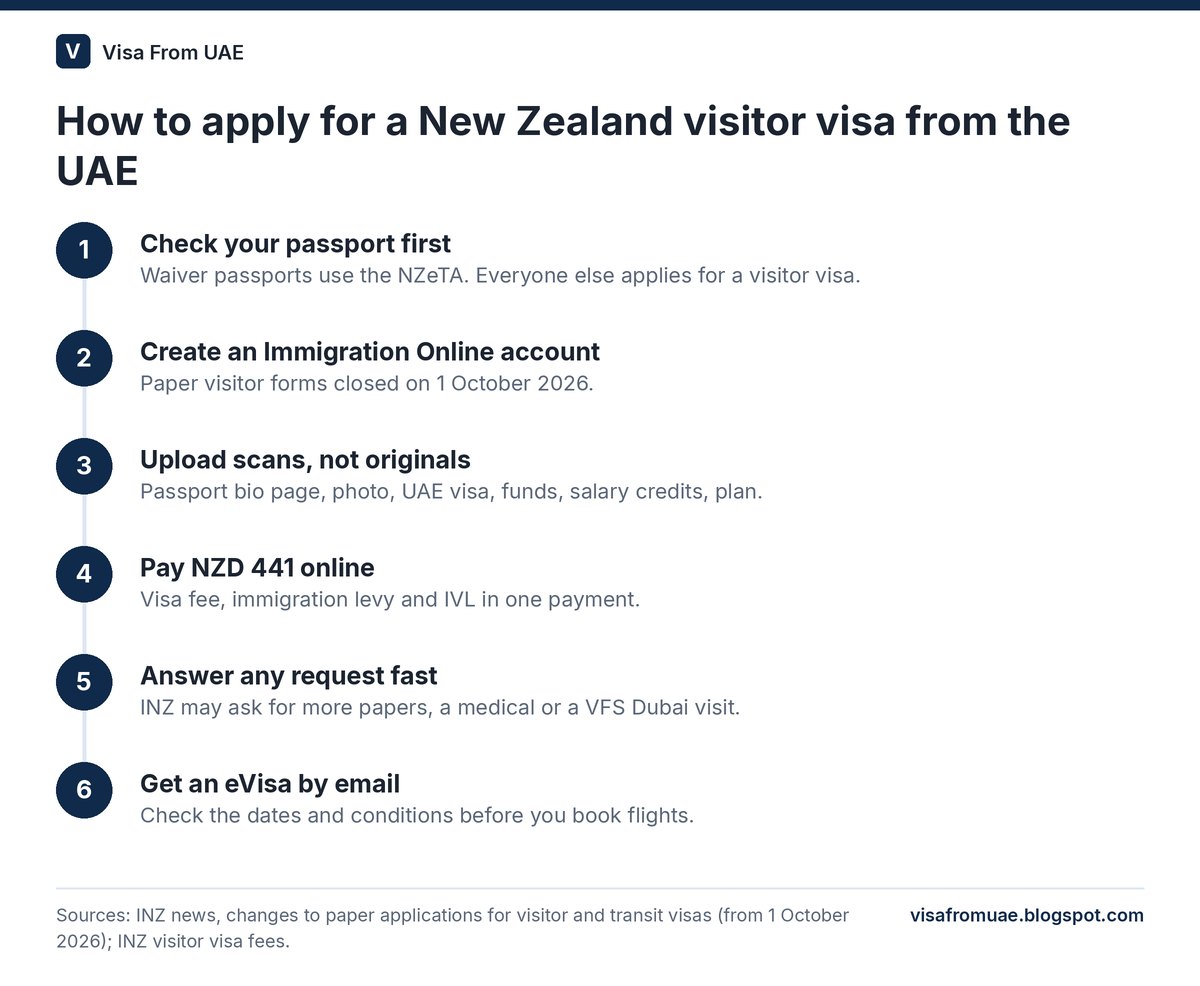
Since 1 October 2026, general visitor visas and transit visas can only be applied for through INZ's new Immigration Online system. The old paper forms are closed, and INZ said paper files lodged before that date would carry on being processed as normal. This is good news for UAE residents: you do not post your passport to anyone, so you can keep travelling for work while you wait.
INZ's manual (V2.1) lists what every visitor must meet:
- A genuine reason to visit. Holiday, sightseeing, family or friends, a short business visit or amateur sport. Not work, and not study beyond a short course of up to three months.
- Bona fides. The officer must be satisfied that you will leave when your visa ends.
- Health and character. A medical is not normally needed for stays under 12 months, and a chest X-ray is not normally needed under six months, but INZ can ask for either.
- Money. NZD 1,000 a month or NZD 400 a month with prepaid accommodation, or a sponsor.
- A way out. A return or onward ticket, or proof you can buy one.
Where do biometrics fit in? INZ lists a visa application centre in Dubai, run by VFS Global at Wafi Mall. Some agents say every visitor applicant goes there. That is not how the online process works: you upload scans, and you only visit the centre if INZ asks you to, for example for biometrics or to show an original document. If that request comes, it comes in writing through your Immigration Online account. Do not pay anyone for an appointment you have not been asked to attend.
The money rule, in dirhams
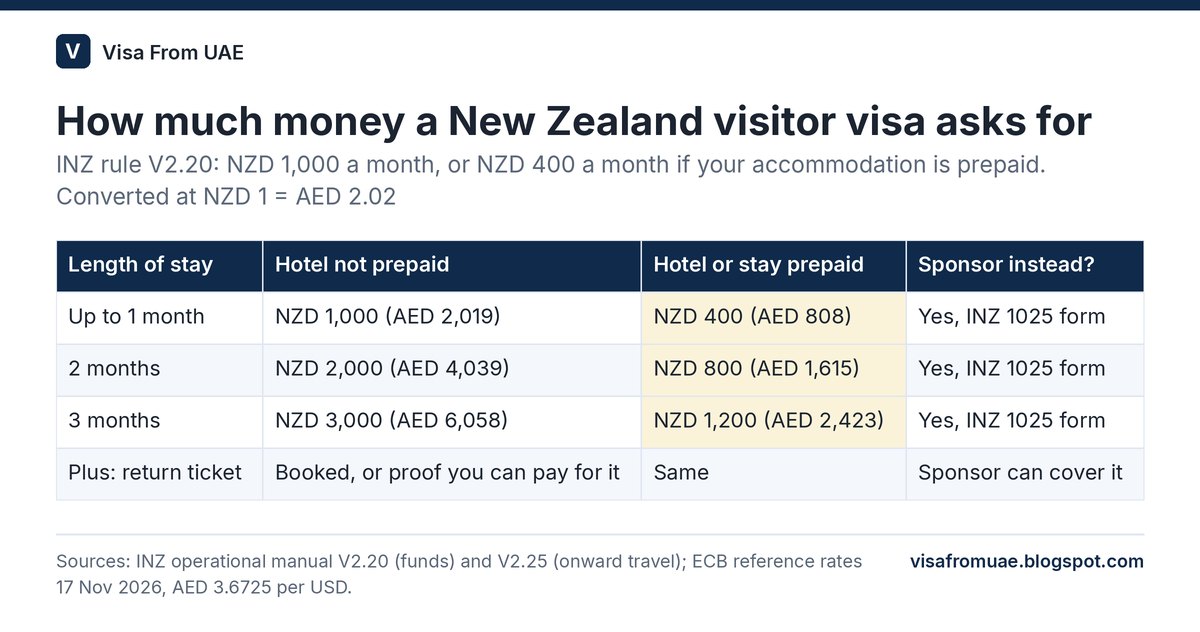
The funds rule is short. Section V2.20 of the INZ manual says visitors must have funds "genuinely available" for the length of their stay of at least NZD 1,000 per month for living costs and accommodation, or NZD 400 per month if the accommodation has been prepaid. A sponsor in New Zealand who meets INZ's sponsor rules can replace this, using the sponsorship form INZ 1025.
What counts as evidence: bank statements for an account you can use from New Zealand, credit or debit cards with enough available credit, cash, travellers' cheques, bank drafts, or a letter from your employer if the trip is for business. A UAE credit card with a decent limit is accepted evidence under the rule, which many applicants do not know. Add a screenshot or statement that shows the available limit.
Two things people get wrong:
- Prepaid means paid. The NZD 400 rate applies when the accommodation is already paid for, such as a prepaid hotel voucher or receipt. A free-cancellation booking that you have not paid for is not prepaid. If you stay with family, your host can sponsor you on form INZ 1025 instead.
- The rule is a floor. Meeting NZD 1,000 a month does not get you a visa on its own. The officer also checks where the money came from, which is the next section.
Why UAE residents get refused (and how to avoid it)
New Zealand has no formal appeal for an offshore visitor visa refusal. If you are declined, you apply again with a new fee. So it pays to read how officers think before you apply.
A real case: the Dubai hotel chef
In September 2023 Newstalk ZB reported on Rahul Longia, a 29 year old chef who had worked at a Marriott hotel in Dubai for five years. He applied for a visitor visa to spend his month of leave with his sister and her husband in New Zealand. INZ declined it. Its letter said: "It is noted that you are single, and no evidence has been provided to confirm that you have any family member outside of New Zealand who is dependent on you." It also said that no income tax records from the UAE had been provided, and that no deposits were found on his bank statements to confirm employment income.
Look at those two points from a Dubai point of view. The UAE has no personal income tax, so there are no tax records to give. And many hotel and hospitality workers are paid through a separate salary card, so their personal bank account shows no monthly salary credit at all. Both points are fixable on paper, but only if you see them coming. Here is what I would add for anyone in the same position:
- Say in a cover letter that the UAE has no personal income tax, so tax returns do not exist, and offer what does exist instead.
- Prove the salary another way. A salary certificate on letterhead with your joining date and monthly pay, your employment contract, and statements from whichever account the salary lands in. If your pay goes to a salary card (WPS), print that statement too, not only your savings account.
- Show leave approval and a return date. A leave letter or NOC from your employer that says you are expected back on a set date.
What the officer weighs
The bona fides test is in section E5.10 of the manual. The officer must consider your evidence of genuine intent, your past immigration history (overstays, breached conditions), and your personal circumstances: family ties at home and in New Zealand, your financial and work commitments, and anything that might discourage you from going back. Notice the wording: the manual talks about your ability to return to your country of citizenship. For a UAE resident, that means you should show two things. First, your life in the UAE: job, lease, residence visa valid well beyond the trip. Second, that you could go home to your own country if you had to.
From the cases I read, these are the patterns that cause trouble:
- A residence visa that expires soon after the trip. If your UAE visa runs out a month after you come back, the officer sees someone with no clear reason to return. Renew first if you can, or explain the renewal.
- A sudden deposit. A large amount appearing a week before you apply, with no history behind it, looks like borrowed money. Explain it with a document (a bonus letter, a sale receipt) or leave it out.
- Close family in New Zealand and few ties anywhere else. This is what sank the chef's application. If you are single and visiting family, put more effort into proving your job and your plans after the trip.
- Not declaring a past refusal. Every past refusal for any country must be declared. INZ treats false or misleading information much more seriously than the refusal itself.
How long it takes
INZ publishes visitor visa processing times on its website and updates them every month. When Esquire India checked in September 2026, INZ showed 80 per cent of visitor visas decided within two weeks. That is a target for most applications, not a promise, and INZ warns of high application volumes over the New Zealand summer. If you want to travel over Christmas or New Year, apply early and do not buy non-refundable tickets until the eVisa arrives.
For an NZeTA, allow 72 hours. Most come back the same day.
Single or multiple entry, and how long you can stay
A general visitor visa allows up to nine months in New Zealand in an 18 month period. A multiple journey visitor visa is aimed at people with good reasons to visit regularly, and lets you stay up to six months in each 12 month period. INZ can make a multiple journey visa valid for up to three years (four for US citizens, five for Chinese citizens), as long as your passport is valid. If you plan to visit family every year, ask for multiple entry in the application and say why.
Your passport should be valid for at least three months after the date you plan to leave New Zealand.
Transit through Auckland
If you are only passing through New Zealand, for example to Fiji or another Pacific island, the rules are different again. Under section N2.1 of the manual, you need a transit visa unless one of these applies:
- Your passport is on the visa waiver list and you hold a transit or traveller NZeTA.
- Your passport is on the transit visa waiver list and you hold a transit NZeTA. That list includes the Philippines, China, Indonesia and Thailand, but not India or Pakistan.
- Your final destination is Australia, you hold a valid Australian visa, and you have a transit NZeTA.
- You are travelling from Australia and hold a transit NZeTA.
So an Indian resident of Dubai flying Dubai to Auckland to Fiji needs a New Zealand transit visa, while a Filipino resident on the same route needs only a transit NZeTA. Check this before you book any itinerary that changes planes in New Zealand.
Combining New Zealand with Australia
Many UAE residents fly Dubai to Sydney or Melbourne and add a week in New Zealand. The two countries do not share a visa. An Australian visitor visa or ETA does not let you into New Zealand, and a New Zealand visa does not cover Australia. You need two separate permissions, and for Indian, Pakistani or Filipino passport holders that means two separate applications: Australia's Visitor (subclass 600), currently AUD 250 (about AED 618), and New Zealand's visitor visa at NZD 441 (about AED 891).
Two tips. Apply for both at the same time and use the same set of documents, because inconsistent dates or amounts between the two files are easy to spot. And if your passport is not on the New Zealand waiver list but you hold an Australian permanent resident visa, you are treated as visa waiver and use an NZeTA instead. Our Australia visa from UAE guide has the Australian side in full.
Documents for a visitor visa from the UAE
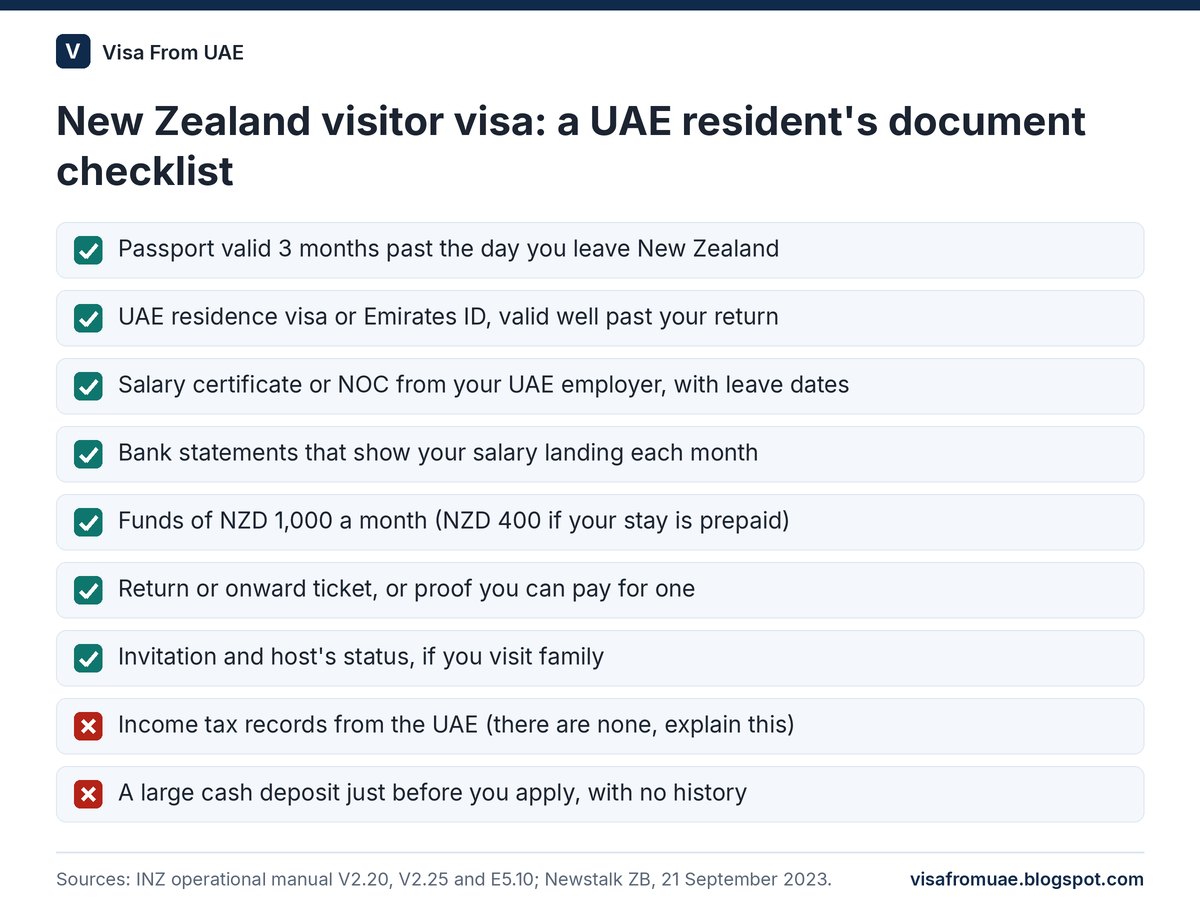
INZ does not publish a fixed checklist for every nationality. It asks you to show that you meet the requirements above. This is the set I would upload as a UAE resident:
- Passport bio page, valid at least three months beyond your departure from New Zealand, plus old visas and travel stamps if you have travelled widely.
- Photo that meets INZ's online photo rules.
- UAE residence visa and Emirates ID, valid well past your return date.
- Employment proof: salary certificate or NOC with your position, joining date, salary and approved leave dates. Business owners: trade licence and company bank statements.
- Bank statements for the last few months showing your salary coming in and enough money for the trip. Add a credit card statement showing the available limit if you are relying on it.
- Travel plan: a simple day-by-day outline, and flight and hotel bookings (or a statement that you will book after the visa).
- Proof of onward travel: a return ticket, or evidence that you can pay for one.
- If visiting family: an invitation from your host, a copy of their New Zealand passport or visa, their address, and the sponsorship form INZ 1025 if they are covering your costs.
- Cover letter explaining anything unusual: no tax records because the UAE has none, a salary card, a past refusal, a large deposit.
- English translations of any document not in English. Arabic tenancy contracts and salary letters need translating.
At the border
Whether you came on an NZeTA or a visa, a border officer makes the final decision on entry. Keep your return ticket, accommodation details and a bank card on your phone or on paper. New Zealand is also very strict about biosecurity: declare any food, plant material or outdoor gear (hiking boots, tents) on your arrival declaration. Undeclared items are a common reason for on-the-spot fines.
Frequently asked questions
Do UAE residents need a visa for New Zealand?
It depends on your passport. Emiratis, and Saudi, Qatari, Omani, Bahraini, UK, US, Canadian and EU passport holders, need only an NZeTA. Kuwaiti passport holders need a visa until at least 11 February 2027. Indian, Pakistani, Filipino, Egyptian, Bangladeshi, Sri Lankan, Nepali, Jordanian and Lebanese passport holders need a visitor visa, even with a UAE Golden Visa.
How much is a New Zealand visa from Dubai in AED?
The visitor visa is NZD 441 including the visitor levy, which is about AED 891 at November 2026 rates. An NZeTA is NZD 117 in the app (about AED 236) or NZD 123 on the website (about AED 248).
Is there a New Zealand embassy in the UAE?
Yes, in Abu Dhabi, but it does not process visas. Applications are made online to INZ, and the VFS Global centre at Wafi Mall in Dubai is used only when INZ asks for biometrics or documents in person.
How much bank balance do I need for a New Zealand visitor visa?
INZ asks for NZD 1,000 for each month of your stay (about AED 2,019), or NZD 400 a month (about AED 808) if your accommodation is already paid. A sponsor in New Zealand can cover this instead. The officer also checks that the money is genuinely yours and comes from a regular source.
Can I use my Australian visa to visit New Zealand?
No. Australia and New Zealand issue separate visas. The only link is that Australian permanent residents are treated as visa waiver travellers and use an NZeTA, and that some travellers heading to Australia can transit New Zealand on a transit NZeTA.
Can I appeal a New Zealand visitor visa refusal?
There is no formal appeal for a visitor visa refused outside New Zealand. You can apply again with a new fee. Read the refusal letter carefully and answer each point it raises with new evidence, or the result is likely to be the same.
Do I need to go to VFS Dubai for a New Zealand visa?
Not by default. The visitor visa is applied for online and your passport stays with you. Go to VFS only if INZ asks you to in writing, for example for biometrics.
More trips from the UAE
- Australia visa from UAE: Visitor 600, ETA or eVisitor by passport
- Singapore visa from UAE, a common stopover on the way
- Canada visitor visa refused from the UAE: reasons decoded
- UK visit visa bank balance for UAE residents
Sources
- INZ operational manual E2.1: People to whom a visa waiver applies (visa waiver country list, effective 3 November 2025)
- INZ Amendment Circular 2026/35: Kuwait visa waiver suspended 12 November 2026 to 11 February 2027 and Fragomen alert on the reasons
- INZ: Increase to visa charges from 1 October (IVL NZD 35 to NZD 100) and the fee and levy table (visitor visa NZD 300 + NZD 41 levy)
- INZ: Visitor visa fees temporarily reduced for Pacific nationals (total for other visitors NZD 441)
- INZ: NZeTA request (NZD 17 in the app, plus IVL)
- INZ: Changes to paper applications for visitor and transit visas (online only from 1 October 2026)
- INZ manual V2.1 Visitor visa requirements, V2.5 Length of stay, V2.15 Multiple journey visas, V2.20 Funds or sponsorship and V2.25 Onward travel
- INZ manual E5.10: Determining whether an applicant is a bona fide applicant
- INZ manual N2.1 Who must apply for a transit visa and N2.5 Transit visa waiver list
- INZ: Visa application centres outside New Zealand (Dubai, VFS Global, Wafi Mall)
- Newstalk ZB, 21 September 2023: INZ declines visitor visa for hotel chef from Dubai
- Esquire India, September 2026: INZ processing guide and medical thresholds for visitors
- European Central Bank reference rates, 17 November 2026 (USD 1.0989, NZD 1.9985 and AUD 1.6316 per EUR); AED pegged at 3.6725 per USD
Rules were read on 18 November 2026. New Zealand can change its visa waiver list at short notice (the Kuwait suspension took effect eight days after it was signed), so check INZ before you book. The decision to grant a visa or let you in belongs to the New Zealand authorities. This guide is general information, not legal or immigration advice. See our Disclaimer.
Last updated: November 18, 2026