Thailand is one of the easiest long weekends you can take from Dubai or Abu Dhabi. The flight is about six hours, fares drop sharply outside the school holidays, and for years the visa question had a short answer: most passports got 60 days free on arrival. That answer is out of date. On 15 September 2026 Thailand ended the 60 day scheme and moved to a new system with a 30 day visa exemption for 60 countries and territories, a 15 day list, and a much shorter visa on arrival list.
A lot of UAE pages still say 60 days. Some agency pages still quote a USD 40 fee for the e-Visa, which is not what you pay from the UAE. So for this guide I went back to the Thai government sources on 16 November 2026: the Ministry of Foreign Affairs summary of the 2026 revision that the Royal Thai Consulate-General in Dubai posts on its visa page, the e-Visa notes from both the Embassy in Abu Dhabi and the Consulate in Dubai, the Abu Dhabi embassy's fee announcement in dirhams, the Tourism Authority of Thailand notices on the change and on proof of funds, and the Indian Embassy in Bangkok's checklist. Where the press got something wrong earlier in the year, I say so below. If you are comparing destinations for a short break, our guides to Georgia and Turkey cover two other popular options.
Short answer: Since 15 September 2026, Emirati, GCC, Indian, Filipino, British, American and EU passport holders can visit Thailand visa-free for up to 30 days (it used to be 60). Everyone must fill the free Thailand Digital Arrival Card (TDAC) online within 3 days before arrival. If your passport is not on the list, for example Pakistani, Egyptian, Bangladeshi, Sri Lankan, Nepali or Nigerian, you apply from the UAE on thaievisa.go.th. A single entry tourist e-Visa costs AED 400 at the Abu Dhabi and Dubai missions, allows up to 60 days per entry, and the fee is not refunded if you are refused. Your UAE residence visa does not make you visa exempt.
Do you need a visa for Thailand from the UAE?
It depends only on your passport. This is different from places like Georgia or Turkey, where a UAE residence permit or another country's visa can change your answer. Thailand has no residence based exemption. A Pakistani engineer who has lived in Dubai for fifteen years needs a visa. An Indian student who arrived in Sharjah last month does not.
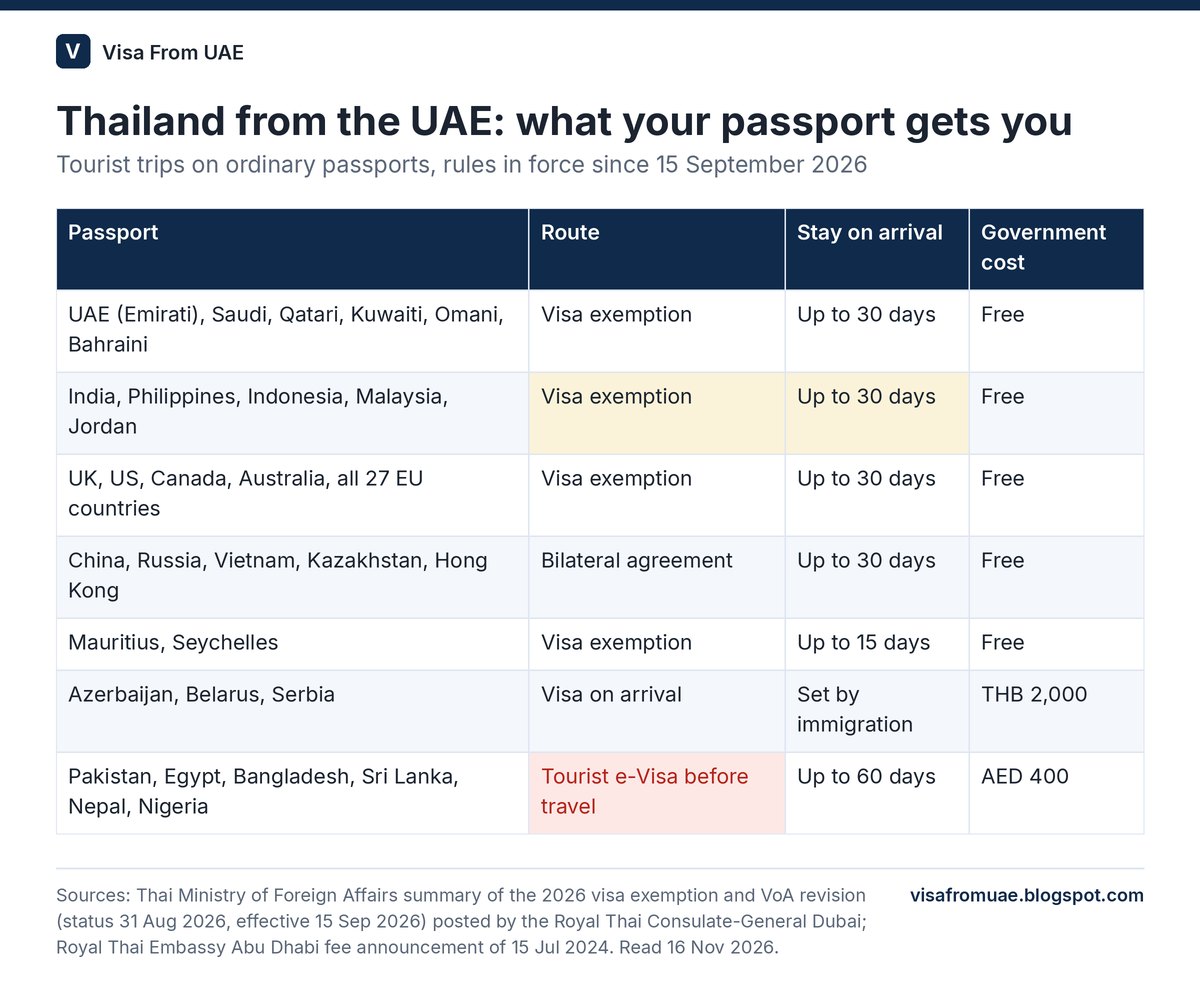
The Ministry of Foreign Affairs summary, marked "status as of 31 August 2026" and "effective from 15 September 2026", sorts ordinary passports into five groups:
- 30 day visa exemption, 60 countries and territories. Includes the UAE, Saudi Arabia, Qatar, Kuwait, Oman, Bahrain, India, the Philippines, Indonesia, Malaysia, Jordan, Türkiye, Georgia, Ukraine, Israel, the UK, the US, Canada, Australia, New Zealand, Japan, Singapore, South Africa, the Maldives, Bhutan, Fiji, Kyrgyzstan, Taiwan, Switzerland, Norway, Iceland, Liechtenstein and all 27 EU countries.
- Bilateral agreements. Separate treaties give 14 days to Cambodia and Myanmar (Myanmar at international airports only), 30 days to China, Hong Kong, Kazakhstan, Laos, Macao, Mongolia, Russia, Timor-Leste and Vietnam, and 90 days to Argentina, Brazil, Chile, Peru and South Korea.
- 15 day visa exemption. Mauritius and Seychelles only.
- Visa on arrival. Azerbaijan, Belarus and Serbia only, at designated checkpoints, for THB 2,000.
- Everyone else needs a visa before travel. For UAE residents that means an e-Visa through the official portal.
For the expat communities that make up most of the UAE, that works out like this. Indian, Filipino, Indonesian, Malaysian and Jordanian passports are visa exempt. Pakistani, Bangladeshi, Egyptian, Sri Lankan, Nepali, Nigerian, Lebanese, Syrian, Iranian, Iraqi, Sudanese, Kenyan and Ethiopian passports are not on any list, so they need an e-Visa. If you hold a passport I have not named, check it against the list on the Dubai consulate's visa exemption page before you book.
Emirati citizens
The Dubai consulate's page says it plainly: holders of a valid UAE passport can enter for tourism and short term business for "a period not exceeding 30 days". There is no form to fill before you go except the TDAC.
UAE passports without nationality
Holders of a UAE passport that does not carry UAE nationality are not covered by the exemption and need a visa. The Dubai consulate has a separate guide for them. On the e-Visa portal you set the passport country to United Arab Emirates and the nationality to "Person of Unspecified Nationality (XXX)". Get that field wrong and the application can be rejected, with no refund.
What changed on 15 September 2026
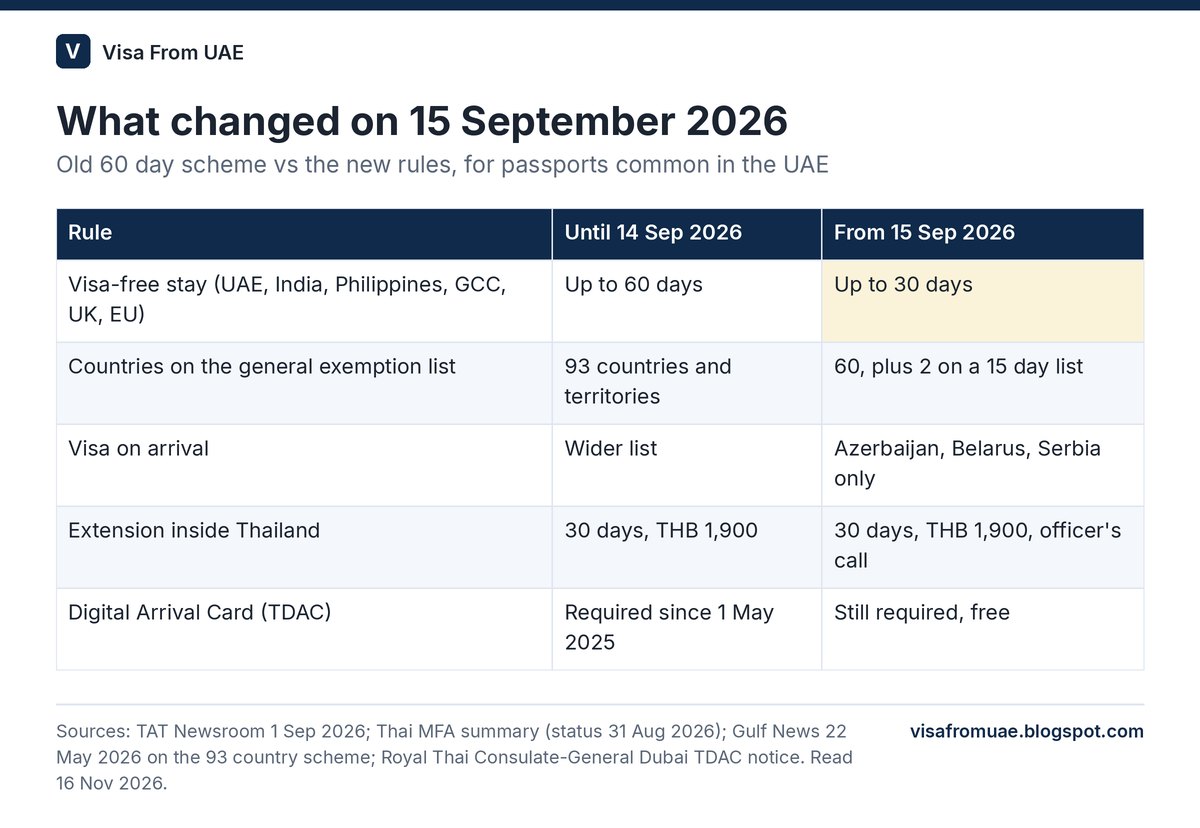
In July 2024 Thailand widened its visa-free scheme to 93 countries and territories and raised the stay to 60 days. Two years later the Cabinet decided to roll it back. Interior Ministry announcements were published in the Royal Gazette on 31 August 2026, and the Tourism Authority of Thailand announced on 1 September that the new 30 day and 15 day categories would start on 15 September, replacing the 60 day scheme on the same day.
Three things matter most if you live in the UAE:
- Your free stay is now half as long. A family that used to fly in for a five or six week summer stay on the 60 day stamp now gets 30 days, plus an extension if immigration agrees.
- Land crossings are limited. TAT says travellers on the 30 day exemption may "generally enter" by land no more than twice per calendar year. Malaysian, Bruneian, Indonesian and Singaporean nationals are excluded from that limit. This matters if you plan a Thailand, Malaysia and back trip by road or rail.
- Nothing is retroactive. Thai officials said the change would not affect travellers already inside Thailand (Gulf News, 22 May 2026), so people who entered before 15 September keep the stay stamped in their passport.
Early reports got India wrong
When the Cabinet first approved the plan in May, the draft that the press reported had 54 countries on the 30 day list and put India on the visa on arrival list, with the Maldives on a 15 day list. Gulf News ran that version on 22 May 2026 and a lot of WhatsApp forwards in the UAE still repeat it. The final list is different. The Ministry of Foreign Affairs summary puts India and the Maldives in the 30 day exemption group, leaves only Mauritius and Seychelles on the 15 day list, and cuts visa on arrival down to Azerbaijan, Belarus and Serbia. So if you hold an Indian passport, you do not need to queue for a visa on arrival or pay THB 2,000. You walk through on the exemption, just like an Emirati or a Brit.
How long you can stay, and how to stay longer
Here is how the time limits work in practice for a tourist trip:
| Route | Stay on arrival | Extension inside Thailand | Maximum in one trip |
|---|---|---|---|
| 30 day visa exemption | Up to 30 days | Once, up to 30 days, THB 1,900, at the officer's discretion | About 60 days |
| Tourist visa (TR), single entry | Up to 60 days | Up to 30 days at an immigration office | About 90 days |
| Tourist visa, multiple entry (6 months) | Up to 60 days per entry | Up to 30 days per entry | Several trips in 6 months |
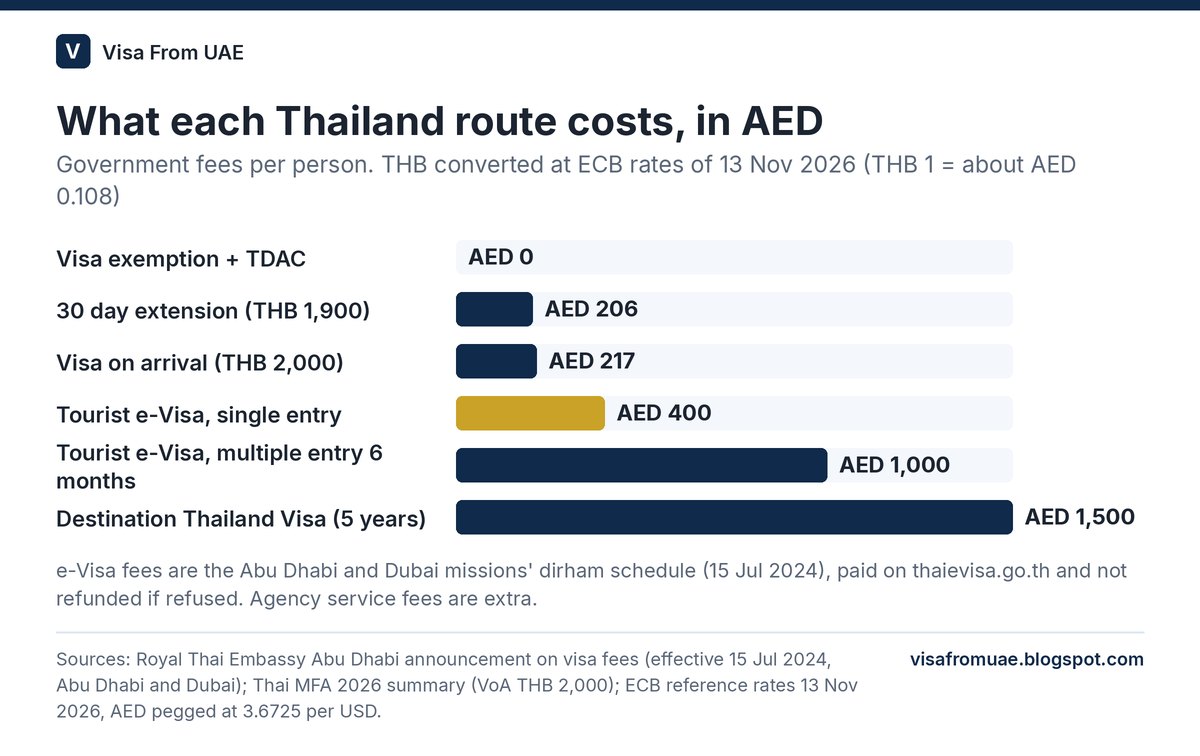
Khaleej Times quoted Thai officials saying visitors can renew the 30 day stay once for another 30 days "at the discretion of an immigration officer". The fee for an extension of stay is THB 1,900, about AED 206, paid at an immigration office in Thailand. It is an application, not a right. If you already know you want more than 30 days, the safer plan for most people is the tourist visa, which gives up to 60 days on arrival. Thai embassies describe the single entry TR visa as valid for three months from issue, with a stay of up to 60 days from entry and a possible 30 day extension.
Do not overstay. Both UAE missions warn that overstaying "can lead to fines, detention, or deportation", and an overstay record will follow you into every future application.
The Thai e-Visa from the UAE: fees in AED
Since 1 January 2025 neither the Embassy in Abu Dhabi nor the Consulate-General in Dubai accepts visa applications in person. Everything goes through thaievisa.go.th, and you pay the fee on that site. The fee schedule both missions link to is the Royal Thai Embassy Abu Dhabi announcement of 15 July 2024, which covers Abu Dhabi and Dubai and is priced in dirhams:
| Visa | Fee |
|---|---|
| Transit visa | AED 200 per entry |
| Tourist visa, single entry | AED 400 |
| Tourist visa, multiple entries within 6 months | AED 1,000 |
| Non-immigrant visa, single entry | AED 800 |
| Non-immigrant visa, multiple entries within 1 year | AED 1,500 |
| Destination Thailand Visa (multiple entries for 5 years) | AED 1,500 |
The announcement's first note says it in three words: fees are "non-refundable". The Dubai consulate adds that an e-Visa is non-refundable and non-transferable, and that if you are rejected you must apply again and pay again.
Why do some UAE guides say USD 40, or about AED 147? Because the e-Visa portal is used by Thai missions worldwide and each one charges its own local fee. EUR 40 is what the Thai embassy in Helsinki charges for a single entry tourist visa, for example. If you apply through the Abu Dhabi or Dubai mission, the dirham schedule above is what applies. India's missions also raised their own fees from 27 April 2026, which caused more confusion in the Gulf press, but that revision covers applications made in India, not here.
Agencies in Dubai typically advertise Thailand visa packages from about AED 600 for single entry. That is their service fee on top of, or including, the AED 400 government fee. The Dubai consulate says it "has not authorized any agencies or travel agents" to process applications on anyone's behalf, and that the visa fee must be paid through the official portal only. You can use an agent to help with the paperwork, but the application is still yours and so is the risk of a rejection.
How to apply for a Thai e-Visa from Dubai or Abu Dhabi
You must be physically in the UAE when you apply. Both missions say applications made while the applicant is in Thailand or any other country "will not be considered and will be rejected". So do not apply from a stopover in Mumbai or Karachi.
- Create an account on thaievisa.go.th. One account can file for your family.
- Check eligibility and pick the visa. For a holiday, that is the Tourist Visa, single or multiple entry.
- Choose the mission. The Royal Thai Embassy is in Abu Dhabi, and the Royal Thai Consulate-General in Dubai serves Dubai and the Northern Emirates. Pick the one for where you live.
- Upload your documents (list below).
- Pay online. Check every spelling and number first. The Dubai consulate says it "can not modify any information after the application has been submitted".
- Watch your email. The mission may ask for more documents or even call you for an interview in person.
- Download and print the approval. Abu Dhabi says to present a printed copy to the airline and to Thai immigration, and to keep a digital copy too.
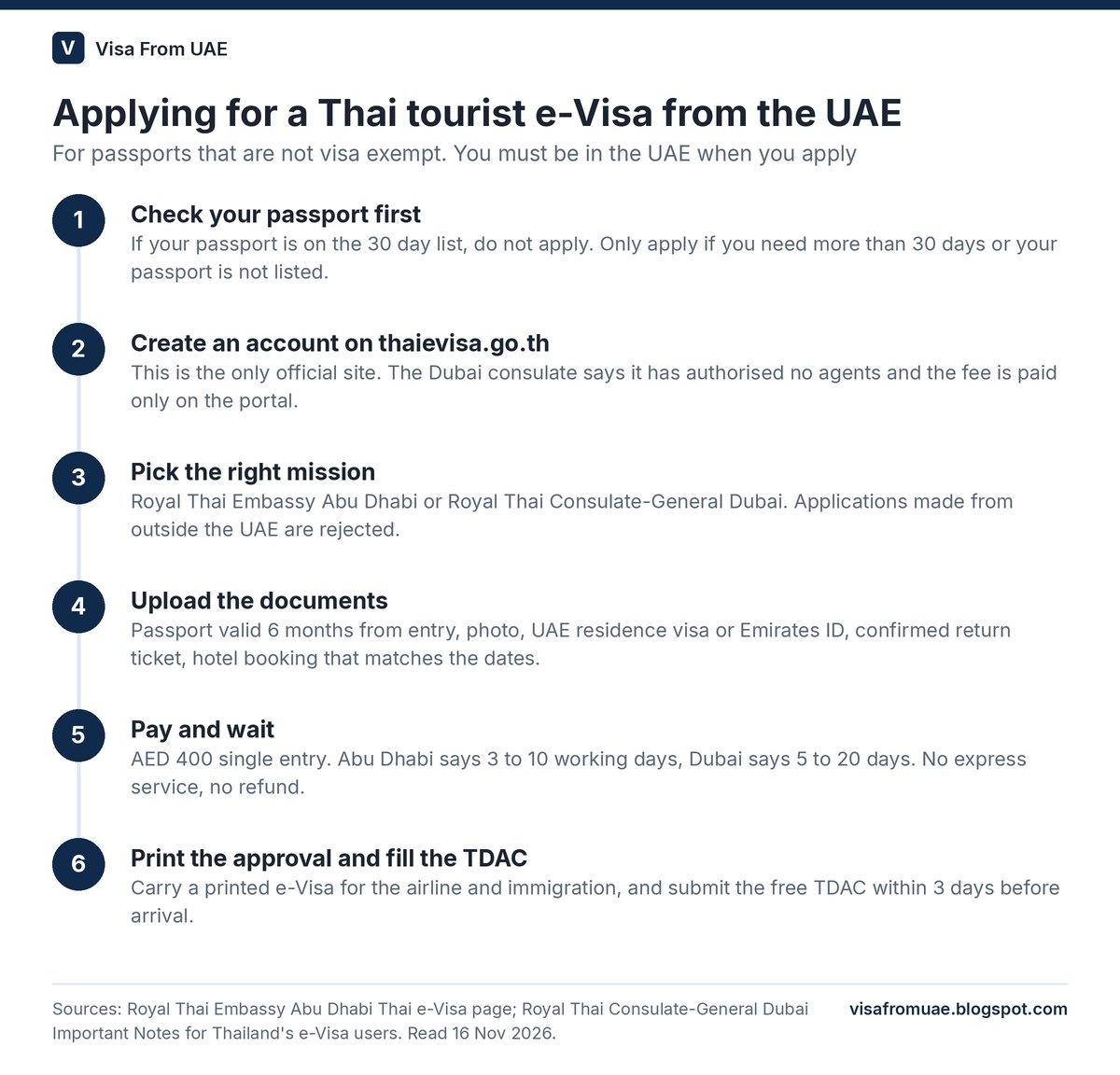
Documents the UAE missions ask for
- Passport valid at least six months from the date you enter Thailand.
- Recent photo that meets the portal's rules.
- Proof you are in the UAE: a valid UAE residence visa or Emirates ID.
- Confirmed round trip ticket. The Dubai consulate adds a detail many people miss: the itinerary must be "issued from the airlines only" and "agency bookings or email bookings will not be accepted". Abu Dhabi's page asks for confirmed round trip tickets without that line, but a ticket issued by the airline is the safe choice at either mission.
- Proof of accommodation, such as a hotel booking or an invitation letter, matching your flight dates.
- Anything else listed for your visa category on the portal. Both missions point you to the "Visa Category" section of thaievisa.go.th for the full list, and they can ask for more.
Both missions warn that false documents lead to rejection and can lead to a ban on entering Thailand. A borrowed hotel booking that you cancel the day after approval is the kind of thing that can catch up with you at the border, because the officer can ask where you are staying.
How long it takes
The two missions publish different times. Abu Dhabi says processing "might take up to 3 - 10 working days, excluding the date of submission and payment". Dubai says "up to 5-20 days" and recommends applying "at least 20-30 days before departure". Neither offers an express service, and both close on Thai and UAE public holidays. If you plan a trip around the UAE National Day weekend, apply at least a month ahead.
At the airport: TDAC, money and tickets
Getting on the plane is the first check. Getting through immigration in Bangkok or Phuket is the second.
The Thailand Digital Arrival Card
Since 1 May 2025 every non-Thai traveller must fill the TDAC online at tdac.immigration.go.th before arrival, by air, land or sea, visa or no visa. The Dubai consulate says it is free and can be submitted in the 3 days before your travel date. You get an acknowledgement email to show at the counter. The TDAC "is not a visa, nor does it replace a visa", so a Pakistani passport holder still needs the e-Visa as well. Plenty of copycat sites charge for the TDAC. The real one costs nothing.
Proof of funds
On 6 July 2026 TAT reminded visitors that immigration can ask to see money. It stressed this "does not introduce a new measure". The rule dates from 1980, and the amounts were last set in 2000. According to the TAT table, holders of a tourist visa or a non-immigrant visa need THB 20,000 per person or THB 40,000 per family, while transit visa, visa on arrival and "certain visa-exempt cases" need THB 10,000 per person or THB 20,000 per family. Children under 12 are not counted. You can show Thai baht, the same value in another currency, or "documents evidencing payment".
The Embassy of India in Bangkok goes further. Its 11 point advisory, reported by Khaleej Times and Gulf News on 4 July 2026, tells travellers on visa waiver or visa on arrival to carry "at least THB 20,000" per person in cash. At ECB rates of 13 November 2026 that is about AED 2,170 per person, or about AED 4,330 for a family. Most officers will never ask, but having that amount in cash or easy to show is the simplest way to avoid an argument, whatever your passport.
Onward ticket and hotel
Carry your return ticket and hotel booking. The Abu Dhabi embassy tells e-Visa holders to carry their "passport, printed e-visa, proof of accommodation, and return ticket" to the checkpoint. If you are visa exempt, your return flight should fall inside the 30 days, because officers can refuse entry to someone with no sign of leaving on time.
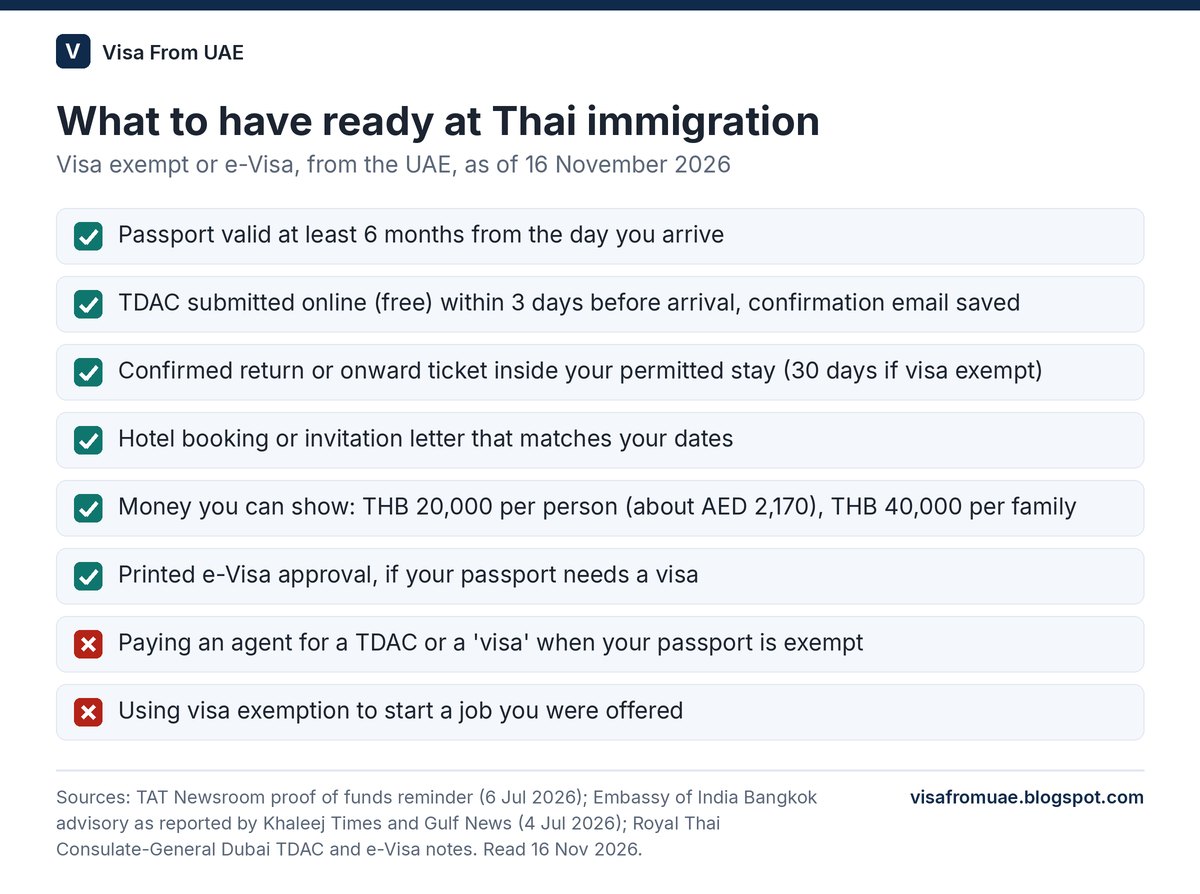
Worked examples for UAE residents
An Indian family of four from Dubai, 10 days in Phuket. No visa. Each person fills a TDAC within 3 days before the flight, including the children. Carry return tickets, the hotel booking and about THB 40,000, or AED 4,330, in cash or a form you can show. Government cost: nil.
A Pakistani couple from Sharjah, 2 weeks in Bangkok and Krabi. Two single entry tourist e-Visas through the Dubai consulate: AED 800 in total, paid on thaievisa.go.th. Apply about a month before travel with airline-issued tickets, hotel bookings, Emirates IDs and passports valid for six months from arrival. Fill the TDACs before flying. If one application is refused, that AED 400 is gone.
A Filipino nurse from Abu Dhabi who wants 6 weeks. The exemption gives 30 days. She can apply for an extension in Thailand (THB 1,900, about AED 206, not guaranteed) or, if she wants certainty, apply from the UAE for a single entry tourist visa (AED 400) which gives up to 60 days.
An Egyptian manager in Dubai who visits Thailand every couple of months. A multiple entry tourist visa for AED 1,000 covers trips within 6 months, each up to 60 days. Three separate single entry visas would cost AED 1,200 and three rounds of paperwork.
What you read online vs what the rules say
- "UAE residents get 60 days visa-free." Not since 15 September 2026. The general exemption is now 30 days. Several UAE agency pages still show 60.
- "Indians need a visa on arrival." This came from the May 2026 draft. The final list puts India in the 30 day exemption.
- "The e-Visa costs USD 40." That is roughly what some missions abroad charge. From the UAE, the single entry tourist visa is AED 400.
- "A UAE residence visa lets you skip the Thai visa." No. Only your passport counts. Residence matters only for proving you can apply here.
- "You can apply for the e-Visa from anywhere." Not through the UAE missions. You must be in the UAE when you apply, or the application is rejected.
- "The TDAC is a visa" or "the TDAC costs money." It is a free arrival form and does not replace a visa.
Frequently asked questions
Can I extend my 30 days visa-free stay in Thailand?
Usually once, by up to 30 days, at an immigration office in Thailand for THB 1,900. Approval is up to the officer. If you know you need more time, a tourist visa from the UAE is the safer route.
Is the Thailand visa on arrival available for UAE residents?
Only if you hold a passport from Azerbaijan, Belarus or Serbia. For everyone else, visa on arrival is not an option since 15 September 2026. Either you are visa exempt or you apply for an e-Visa before you travel.
How much is a Thailand tourist visa from Dubai?
AED 400 for single entry and AED 1,000 for multiple entries within 6 months, paid online on thaievisa.go.th, under the fee schedule the Abu Dhabi embassy published for both UAE missions from 15 July 2024. Agency prices are higher because they include a service fee.
How long does a Thai e-Visa take in the UAE?
Abu Dhabi says 3 to 10 working days and Dubai says 5 to 20 days, with no express option. Apply three to four weeks before travel.
Do children need the TDAC?
The Dubai consulate says the TDAC is mandatory for "all non-Thai visitors", so yes, fill one for every traveller. It is free.
I am already in Thailand on a 60 day stamp from before 15 September. Do I have to leave after 30 days?
No. Thai officials said the change is not retroactive, so you can stay until the date stamped in your passport. If in doubt, check with an immigration office before that date.
Does a refused Thai e-Visa affect my other visas?
Other countries may ask whether you have ever been refused a visa, and you should answer honestly. A refusal caused by a typo or a missing document is easy to explain. Fix the issue and apply again with a new fee.
More trips from the UAE
- Georgia visa from the UAE: visa-free rules for residents
- Turkey visa for UAE residents: eVisa rules by passport
- China visa from the UAE: fees, 30 day visa-free list and transit
- Japan visit visa from the UAE
- UAE return permit if you stay out more than 6 months
- All Visa from UAE guides
Sources
- Royal Thai Consulate-General Dubai: Visa Exemption/Visa on Arrival, with the Ministry of Foreign Affairs summary of the 2026 revision (status 31 August 2026, effective 15 September 2026)
- TAT Newsroom: Thailand introduces new 30-day and 15-day visa exemption rules from 15 September (1 September 2026)
- Royal Thai Embassy Abu Dhabi: Thai e-Visa
- Royal Thai Consulate-General Dubai: Important notes for Thailand's e-Visa users and applicants
- Royal Thai Embassy Abu Dhabi: Visa fee announcement for Abu Dhabi and Dubai (effective 15 July 2024)
- Royal Thai Consulate-General Dubai: Guidelines for UAE passport holders without nationality
- Royal Thai Consulate-General Dubai: Thailand Digital Arrival Card (TDAC)
- TAT Newsroom: Thailand entry reminder on proof of funds for foreign visitors (6 July 2026)
- Khaleej Times: Thailand shortens visa-free stays, Indian embassy advisory (4 July 2026)
- Gulf News: India issues advisory after Thailand visa rule change (4 July 2026)
- Gulf News: report on the May 2026 draft (22 May 2026), used here only to show what changed in the final list
- Royal Thai Embassy Helsinki: Tourist visa (TR) validity, stay and fee example
- European Central Bank reference rates, 13 November 2026 (THB 37.483 and USD 1.1052 per EUR); AED pegged at 3.6725 per USD
Rules were read on 16 November 2026. Thailand changes entry rules often, so check the Thai mission pages above before you book. The decision to issue a visa or let you in belongs to the Thai mission and the immigration officer. This guide is general information, not legal or immigration advice. See our Disclaimer.
Last updated: November 16, 2026