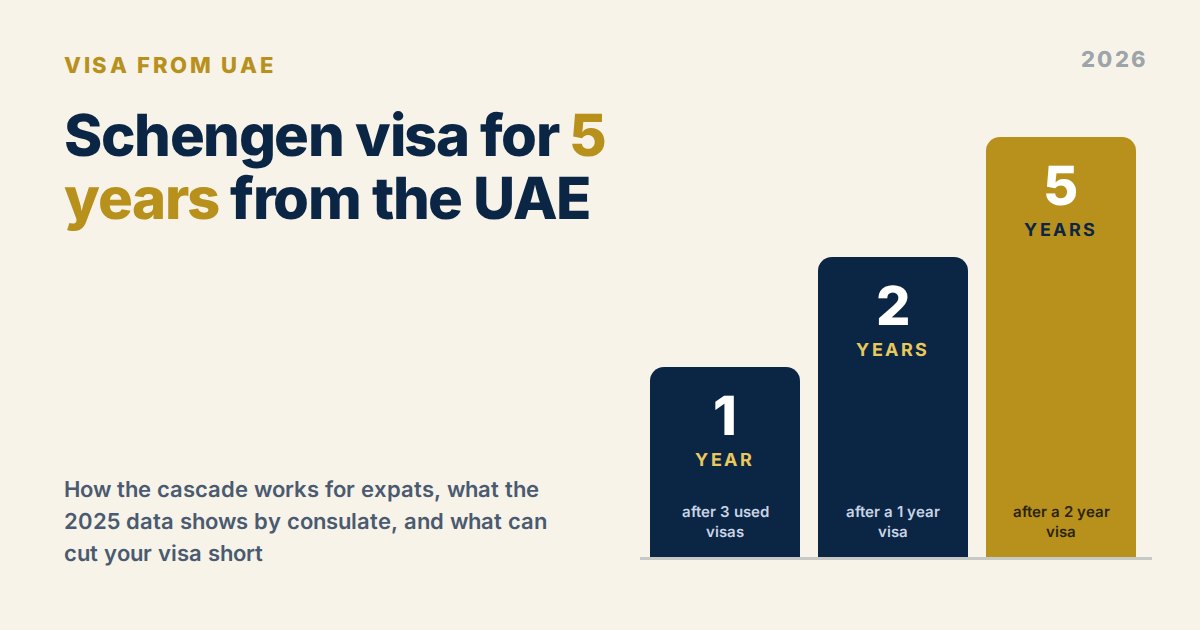
If you live in Dubai or Abu Dhabi and fly to Europe a few times a year, you have probably met someone who got a five year Schengen visa and someone else who keeps getting 30 day stickers. Both may have applied at the same visa centre, with the same salary and the same kind of passport. The difference is usually not luck. It is a rule in the EU Visa Code called the cascade, and how far up it you have already climbed.
For this guide I read Article 24 of the Visa Code as amended in 2019, the Danish Immigration Service's list of country specific cascade rules (updated 26 May 2026), the EU delegation's note on India's cascade, and the German Missions in the UAE visa pages, all on 15 November 2026. I then pulled the European Commission's consulate statistics for 2019 and 2022 to 2025 and worked out, office by office, how often each Schengen consulate in the UAE gives a multiple entry visa. Nobody else we found has published those numbers for the UAE. I also went through the agency guides and news pieces that rank for this topic, and a few of them get the most important point for expats wrong. If you are new to all this, read our Schengen visa guide for UAE residents first.
Short answer: Yes, UAE residents can get a five year multiple entry Schengen visa, but usually only by climbing the standard cascade in Article 24(2) of the Visa Code: three properly used visas in two years can lead to a one year visa, a used one year visa to a two year visa, and a used two year visa (within three years) to a five year visa. There is no UAE specific cascade. The more generous rules for Indians, Saudis and other nationalities only cover people living in their own country, so most expats here are on the standard ladder. Your passport, and at the German consulate your UAE residence permit, must stay valid at least three months past the visa, and the fee is the same EUR 90 (about AED 365) whatever length you get.
What the Schengen cascade is
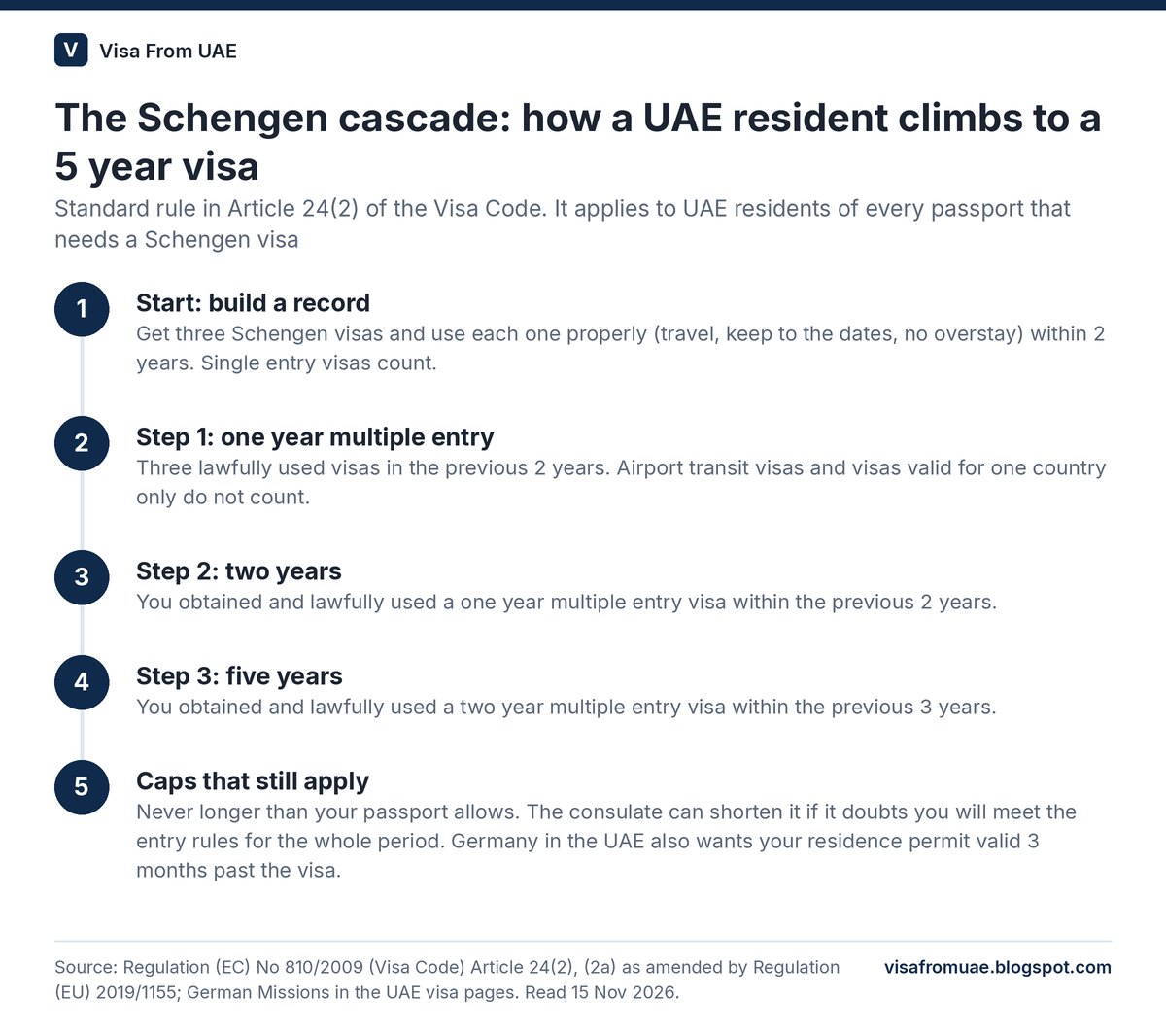
Before February 2020, how long your Schengen visa lasted was mostly up to the consulate. Some gave long visas to regular travellers and many did not. Regulation (EU) 2019/1155 changed the Visa Code and added a ladder that consulates have to follow when you meet the conditions. Article 24(2) now says that, provided you meet the entry conditions, multiple entry visas "shall be issued" for these periods:
- One year, if you have obtained and lawfully used three visas within the previous two years.
- Two years, if you have obtained and lawfully used a previous multiple entry visa valid for one year within the previous two years.
- Five years, if you have obtained and lawfully used a previous multiple entry visa valid for two years within the previous three years.
The same paragraph adds that airport transit visas and visas with limited territorial validity (the ones valid for just one country) do not count. And the whole ladder sits under one cap: the visa will not run past the validity of your travel document.
"Shall be issued" is stronger wording than most agency pages admit. Once you meet a step, a longer visa is the default, not a favour. But the next paragraph, Article 24(2a), lets the consulate shorten the visa in an individual case "where there is reasonable doubt that the entry conditions will be met for the entire period". That is the clause behind most of the "I qualified but still got one year" stories.
Is there a special cascade for UAE residents?
No. This is the part that confuses people most, and it is where several guides are wrong or vague.
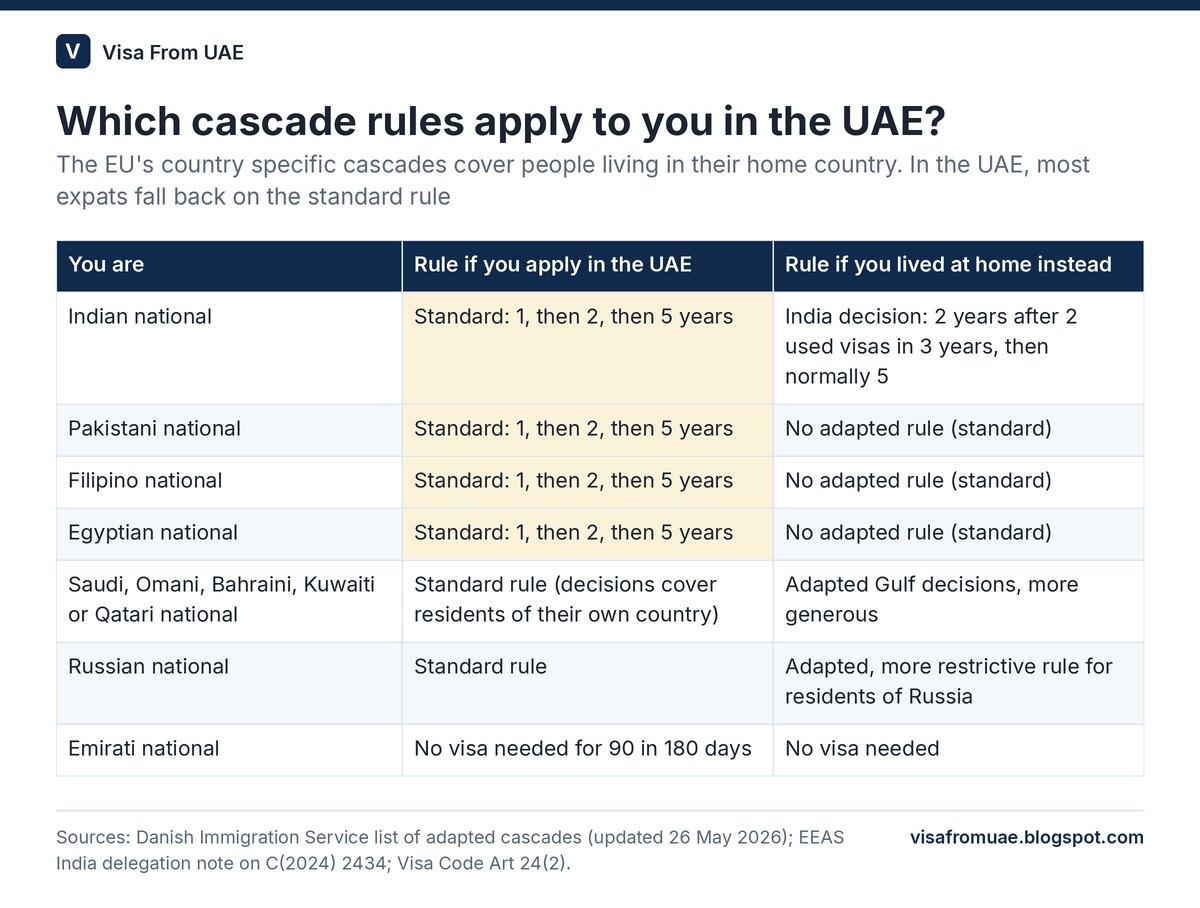
The Visa Code lets the Commission adapt the cascade for a specific country, more generous or stricter, through what it calls implementing decisions (Article 24(2b) and (2d)). The Danish Immigration Service keeps a plain list of every adapted cascade. In its version updated on 26 May 2026 the list covers Omani nationals residing in Oman, Iranian nationals residing in Iran, all nationals applying from Algeria, Qatari nationals residing in Qatar, Kuwaiti nationals residing in and applying in Kuwait, Saudi nationals residing in Saudi Arabia, Bahraini nationals residing in Bahrain, Indian nationals residing in India, all nationals applying from Ghana, US permanent residents applying in the United States, and nationals of Türkiye, Indonesia, Russia, Belize and Thailand residing in their own countries.
The UAE is not on it. Notice the wording, too. Almost every decision covers people residing in the country, not everyone holding that passport. Gulf News made the same point in July 2025 when it wrote that the cascade changes are "not yet available to all UAE residents regardless of nationality."
So the rule that applies to you depends on where you live and apply, not only on your passport.
Indian passport holders in the UAE
India's cascade, adopted by the Commission on 18 April 2024, is generous: a two year multiple entry visa after two visas used in the previous three years, and that "will normally be followed by a five-year visa, if the passport has sufficient validity remaining," as the EU delegation in India puts it. Many Indian news sites ran it as "Indians can now get five year Schengen visas," and that line still gets shared in Dubai groups.
The EU's own summary describes the scheme as being for "Indian nationals residing in India who apply for Schengen (short-stay) visas in India." If you live in Dubai and apply at a visa centre in the UAE, you are on the standard ladder. You need three used visas for a one year visa, not two for a two year one.
Saudi, Omani, Bahraini, Qatari and Kuwaiti nationals living in the UAE
The Gulf decisions of 2023 and 2024 are among the most generous in the system. Saudi, Omani and Bahraini nationals living at home can be issued five year visas from early on. But each decision on the Danish list covers nationals residing in their own country. A Saudi national who lives and works in Dubai and applies here is, on the text, under the standard rule. If you are in this group and spend part of the year at home, ask the consulate in your home country which rule it applies before you choose where to lodge.
Pakistani, Filipino, Egyptian and other expats
There is no adapted cascade for Pakistan, the Philippines, Egypt, Bangladesh, Sri Lanka or Nepal. You are on the standard ladder whether you apply in the UAE or at home. The good news is that the standard ladder is the same at every consulate in the UAE, so nobody here gets a better deal because of their passport, apart from the Gulf and Russian points above.
Emirati nationals
UAE citizens do not need a Schengen visa for short trips of up to 90 days in any 180. The cascade does not apply to them at all.
What "lawfully used" means for you
Every step of the ladder depends on the visas before it being "obtained and lawfully used". The Visa Code does not give a long definition, but in practice consulates look for three things.
- You travelled on it. A visa you never used is weak evidence. Do not count on it as one of your three.
- You kept to its terms. You entered and left within the validity dates, stayed no longer than the days allowed, and never broke the 90 days in any 180 rule.
- You did what you said you would. Applying to Italy as your main destination and then spending the whole trip in France is not an overstay, but it can be read as misuse of the main destination rule in Article 5. It is the sort of thing that leads to the Article 24(2a) shortening.
Two things work in your favour. First, the ladder counts Schengen visas, not where they were issued. A visa you got while living in Mumbai or Manila still counts when you apply from Dubai. Second, consulates do not depend only on your copies. Visa records sit in the Visa Information System, and since the Entry/Exit System went live at Schengen borders in October 2025, entries and exits are logged electronically too. Bring copies of every old visa and stamp anyway, because a clean, complete file makes the officer's job easy.
Why you may get less than the cascade says
When someone meets a step on paper and still gets a shorter visa, the cause is usually one of these four.
Your passport is too short
Article 24(2) says the visa will not outlast your passport. On top of that, the passport normally has to stay valid at least three months after you leave the Schengen area (Article 12), and the German Missions in the UAE ask for "validity minimum three months from the date of expiry of the requested visa." So a five year visa needs a passport with more than five years and three months left. Someone with a passport expiring in three years will get, at most, a visa that ends about three months before that date.
Your UAE residence visa is too short
This one is specific to expats and almost nobody covers it. Germany's UAE visa pages ask for a "valid UAE residence permit (valid at least three months from the date of expiry of the requested visa / intended end of journey)." A standard employment visa here usually runs two years. If yours expires in eight months, asking for a five year visa at the German consulate does not fit that line. We found no rule in the Visa Code that ties the visa to your residence permit, and other consulates word this differently, but if your residence visa is close to renewal, renew it first and apply after.
The officer has doubts
Article 24(2a) is a real power. A new job, a recent drop in salary, a big unexplained deposit (see our bank statement guide) or a past trip that did not match the plan can all lead to a shorter visa even when the history qualifies.
Your chain broke
Each step looks back two or three years. If you got a one year visa in 2023 and did not apply again until late 2026, it no longer sits "within the previous two years". You drop back to whatever your recent record supports.
How often UAE consulates give multiple entry visas
The Commission's statistics do not split visas by length, so nobody can tell you how many five year visas Dubai issues. What the yearly consulate file does show is how many multiple entry visas each office gives out of all the visas it issues. We pulled the UAE rows for 2025.
Across all Schengen consulates in the UAE in 2025, there were 298,064 applications, 221,370 visas issued and 122,822 of those were multiple entry. That is 55.5%. In other words, if you are granted a Schengen visa from the UAE, it is slightly more likely than not to allow multiple entries. The spread between consulates is wide.
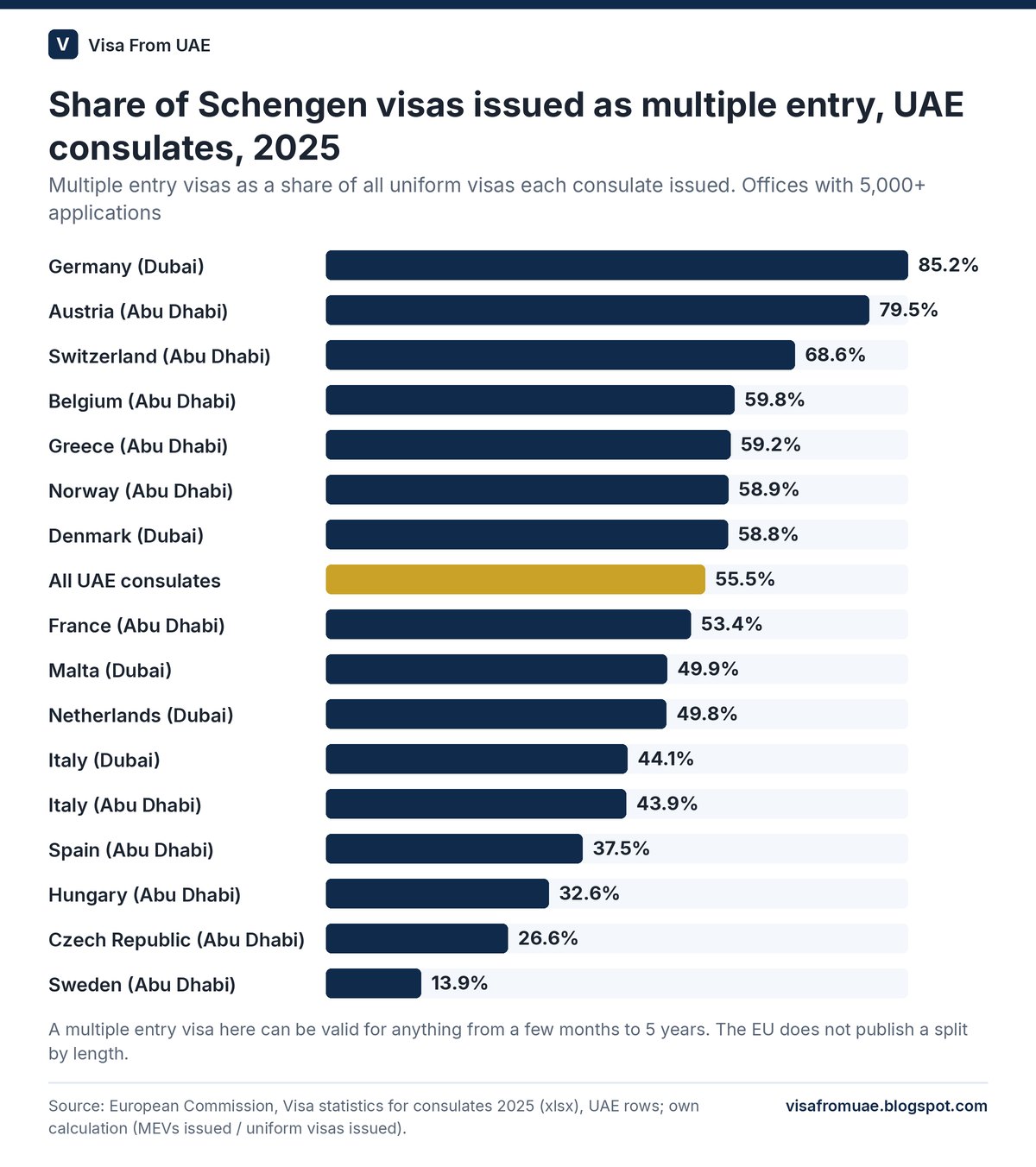
Germany in Dubai issued 85.2% of its visas as multiple entry, and Austria 79.5%. At the other end, Spain issued 37.5%, the Czech Republic 26.6% and Sweden 13.9%. Italy is almost identical in Dubai and Abu Dhabi, around 44%, even though its refusal rates in the two offices are very different (21.7% in Dubai and 12.9% in Abu Dhabi, as we showed in our easiest Schengen visa data post).
Before you read this as a shopping list: you cannot choose Germany because it gives more multiple entry visas. Article 5 sends you to the country of your main destination, and a consulate can refuse if it thinks you are not really going where you say. The real use of this chart is to set expectations. If your trips are mostly to Spain, a first multiple entry visa may take more history than it would at the German consulate.
Has it changed since the cascade began?
We repeated the count for 2019, 2022, 2023 and 2024 (2020 and 2021 were distorted by Covid closures).
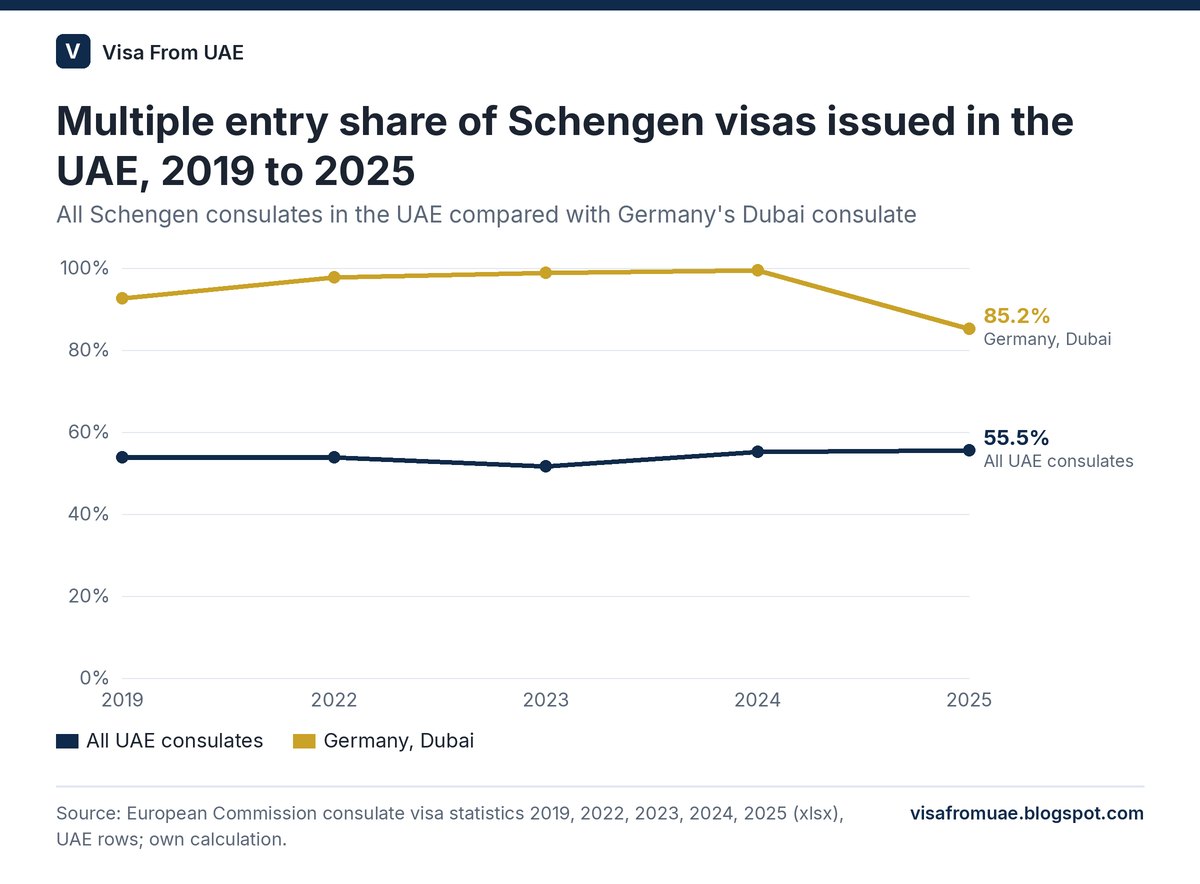
The UAE wide share has stayed in a narrow band, from 51.6% to 55.5%. Germany is the striking line. It issued almost every visa as multiple entry from 2022 to 2024, reaching 99.5% in 2024, then fell to 85.2% in 2025, the same year its Dubai office issued about a third more visas (31,124 against 23,399). Our reading is that more first time applicants came through, and first timers rarely qualify for long visas. The data cannot prove that, so treat it as a likely explanation, not a fact.
A worked example: from first visa to five years
Here is how the ladder plays out for a typical expat with a clean record. Names and dates are invented to show the timing.
Arun is an Indian engineer in Dubai with a 10 year passport issued in 2024 and a two year UAE residence visa renewed in 2026.
- April 2025: single entry visa for Italy, 10 day trip. Used.
- December 2025: visa for France for a family wedding. Used.
- May 2026: visa for Germany for a trade fair. Used.
- November 2026: he applies again. He now has three lawfully used visas within two years, so under Article 24(2)(a) he should get a one year multiple entry visa, as long as the consulate has no doubts and his residence visa runs at least three months past it.
- Late 2027: having used the one year visa, he applies again within two years of it and qualifies for two years.
- 2029: with the two year visa used and his passport valid until 2034, he can ask for five years. His UAE residence visa may be the limit here, so he renews it before applying.
From the first trip to the five year visa takes about four years for someone who travels once or twice a year. If Arun lived in India, the India decision would get him to a two year visa after two used visas and could shorten that path by a year or more. That is the real cost of the residence rule for Indian expats in the UAE.
Can you skip the ladder?
Sometimes. Article 24(2c) says a multiple entry visa valid for up to five years "may be issued" to people who prove a need or justify an intention to travel frequently or regularly, provided they prove their integrity and reliability, in particular lawful use of previous visas, their economic situation and their genuine intention to leave before the visa ends.
In practice this helps people such as a regional manager who flies to a head office in Frankfurt every quarter, someone with a parent or child living in a Schengen country, or a seafarer or flight crew member. It is a "may", not a "shall", so ask for it with evidence: a letter from your employer listing planned trips, invitations for several dates, or proof of a close family member in Europe. Without that, expect the ladder.
How to ask for a longer visa when you apply
- Gather your history. Copies of every Schengen visa from the last three years, plus the passport pages with entry and exit stamps. If they are in an old passport, bring that passport too.
- Check your passport and residence visa dates. Work out the longest visa your passport and UAE visa allow, counting back three months from the earlier expiry. Renew whichever is short before you book an appointment. Our appointment guide helps with the booking side.
- Fill in the form honestly. On the Schengen form, choose multiple entries and give the dates you want the visa to cover. Do not ask for a period your documents cannot support.
- Explain the need in your cover letter. One short paragraph: how often you travel, why, and a list of your previous Schengen visas with dates. Make it easy for the officer to see the step you qualify for.
- Keep your insurance and money in line with the request. For a multiple entry visa, Article 15(2) of the Visa Code only asks you to prove insurance for the first trip, and you sign that you will be insured on later ones. Check the consulate's checklist and our Schengen insurance guide.
- Use the visa properly. The next step depends on it. Keep every boarding pass and hotel receipt until you have your next visa.
What a five year visa does not do
- It does not let you stay longer. The 90 days in any 180 days limit still applies on every trip.
- It does not let you work or live in Europe. It is still a short stay visa.
- It does not cost more. The fee is EUR 90 for adults whether you get 15 days or five years. That was about AED 365 at the ECB rate of 13 November 2026, plus the visa centre's service charge.
- It does not survive a new passport on its own. If your passport is lost or replaced, carry both passports or ask the consulate what it accepts. Visa stickers are not moved to the new passport.
- It does not override the border check. Border officers can still ask about your trip, your money and your return, and the Entry/Exit System records each crossing.
What you read online vs what the rules say
- "Indians in Dubai can now get a five year visa after two trips." The India decision is for Indian nationals living in India. In the UAE the standard ladder applies.
- "The cascade is automatic." The text says "shall be issued", but only if you meet the entry conditions, and Article 24(2a) lets the consulate shorten the visa. Automatic it is not.
- "Kuwait is the only Gulf state with its own cascade." One widely shared guide says this. The Danish list shows decisions for Oman, Qatar, Kuwait, Saudi Arabia and Bahrain.
- "Germany is giving UAE residents five year visas." A 2025 report said Germany was considering it. We found no adopted rule. Germany does issue many multiple entry visas, but through the normal Visa Code.
- "The EU is extending visas beyond five years." In February 2026 the Commission's visa strategy proposed longer multiple entry visas for trusted travellers. That is a proposal. Article 24(1) still caps validity at five years.
Frequently asked questions
How many Schengen visas do I need for a five year visa from the UAE?
Under the standard rule, at least three used visas to reach the one year step, then a used one year visa, then a used two year visa. That is five visas in all before the five year one, unless the consulate uses Article 24(2c) to give you a long visa earlier.
Do single entry visas count towards the three?
Yes. Article 24(2)(a) says three visas. It does not say multiple entry. Airport transit visas and visas valid for only one country do not count.
Do UK or US visas count?
No, not for the cascade. They still help show you travel and come back, which matters when the officer decides whether to use Article 24(2a).
I qualified for two years but got one year. Can I appeal?
A shorter visa is not a refusal, so the appeal route for refused visas in Article 32 does not apply. You can write to the consulate and ask it to explain, and next time apply with a stronger file and passport and residence dates that clearly cover the period. If you were refused instead, see our Schengen refusal guide.
Can I use a five year visa from Germany to visit Spain?
Yes, a uniform Schengen visa is valid across the Schengen area, so later trips on a multiple entry visa can go anywhere in it. What matters is that the first trip matched what you told the issuing consulate. If you got a German visa for a trip to Spain, that is the kind of mismatch that can count against you at your next application.
Does my visa end when my UAE residence visa ends?
No, the visa stays valid on its own dates. But you need to be lawfully resident somewhere to show ties and to apply, and Germany asks for a residence permit valid three months past the visa you request. If you leave the UAE for good, you would apply in your new country of residence next time.
More trips from the UAE
- Schengen visa from Dubai and the UAE: documents, fees and steps
- Easiest Schengen visa from the UAE: refusal rates by consulate
- Germany visit visa from the UAE
- Schengen bank statement rules for UAE residents
- All Visa from UAE guides
Sources
- Regulation (EC) No 810/2009 (Visa Code), Article 24 as amended by Regulation (EU) 2019/1155
- Regulation (EU) 2019/1155 amending the Visa Code (EUR-Lex)
- Danish Immigration Service: Visa, determination of validity and list of adapted cascades (updated 26 May 2026)
- EU Delegation to India: more favourable Schengen visa rules for Indians, C(2024) 2434 of 18 April 2024
- German Missions in the UAE: Schengen visa, visit purpose (passport and residence permit validity)
- German Missions in the UAE: Schengen visa, business, trade fair and congress
- European Commission: Statistics on short-stay visas issued by Schengen countries (consulate files 2019 to 2025)
- Gulf News: Schengen visas given on a new cascade system (22 July 2025)
- Gulf News: EU visa strategy proposals for longer multiple entry visas (26 February 2026)
- European Central Bank reference rates, 13 November 2026 (USD 1.1052 per EUR); AED pegged at 3.6725 per USD
Rules were read on 15 November 2026. The multiple entry shares are our own calculation from the European Commission's consulate files for 2019 and 2022 to 2025. The decision on any visa, and its length, belongs to the consulate. This guide is general information, not legal or immigration advice. See our Disclaimer.
Last updated: November 15, 2026