Ask three visa agents in Dubai how much money you need in your account for a Schengen visa and you will get three answers. AED 15,000. AED 25,000. "At least two salaries." None of those numbers comes from an embassy. The real rule is a daily amount that each Schengen country sets for itself, and it ranges from EUR 45 a day for Germany to EUR 122.10 a day for Spain. For a two week trip that is the difference between about AED 2,600 and AED 7,000.
The amount is only half the story, though. The other half is what the statement looks like: how many months, whether it is stamped, whose account it is and what happened to the balance in the weeks before you printed it. For this guide I read the EU Visa Code articles on money, the reference amounts that each country sends to the European Commission, and the current UAE checklists of Germany, Italy (both missions), Spain, the Netherlands and Switzerland, and checked the figures again on 10 November 2026. Every AED number below uses that day's European Central Bank rate. If you have not picked a country yet, our refusal rates by consulate may help, and the Schengen visa from UAE guide has the full document list.
Short answer: There is no single Schengen minimum balance. Each country sets a daily amount and the consulate multiplies it by your days. For a 14 day solo trip with a hotel, the floor is about AED 7,040 for Spain, AED 6,265 for Switzerland, AED 3,750 for France, AED 3,170 for the Netherlands and AED 2,325 for Italy (ECB rate of 10 November 2026, check before applying). Every UAE checklist I read asks for at least the last 3 months of statements in your own name. Italy wants them on bank letterhead with the bank's original stamp, and its Dubai consulate will not consider accounts outside the UAE. A steady balance that builds with each salary matters more than a big number that arrived last week.
Where the "minimum balance" actually comes from
Two articles of the EU Visa Code (Regulation 810/2009) do all the work here.
- Article 14 says you must show documents proving "sufficient means of subsistence both for the duration of the intended stay and for the return" to your country of residence. For you, that country is the UAE.
- Article 21(5) says the consulate assesses that money "in accordance with the duration and the purpose of the stay and by reference to average prices" for budget board and lodging, "multiplied by the number of days stayed", using the reference amounts each member state sets.
So the formula is simple: the country's daily amount times your days. Each country reports its amount to the Commission, which collects them in Annex 18 of the Visa Code Handbook. Some countries set one flat figure, some change it with where you sleep, and two (Austria and, strictly speaking, Germany) set none at all and look at each case. Annex II of the Visa Code lists bank statements as one of the documents a consulate may ask for, both as proof of money and as proof of your job and ties to the UAE.
That second point is what agency pages miss. Your statement is not only checked against a daily figure. It is also read as evidence that you have a real job and a real life in the UAE that you will come back to. A statement can clear the money line and still hurt your file.
How much each country wants, in AED
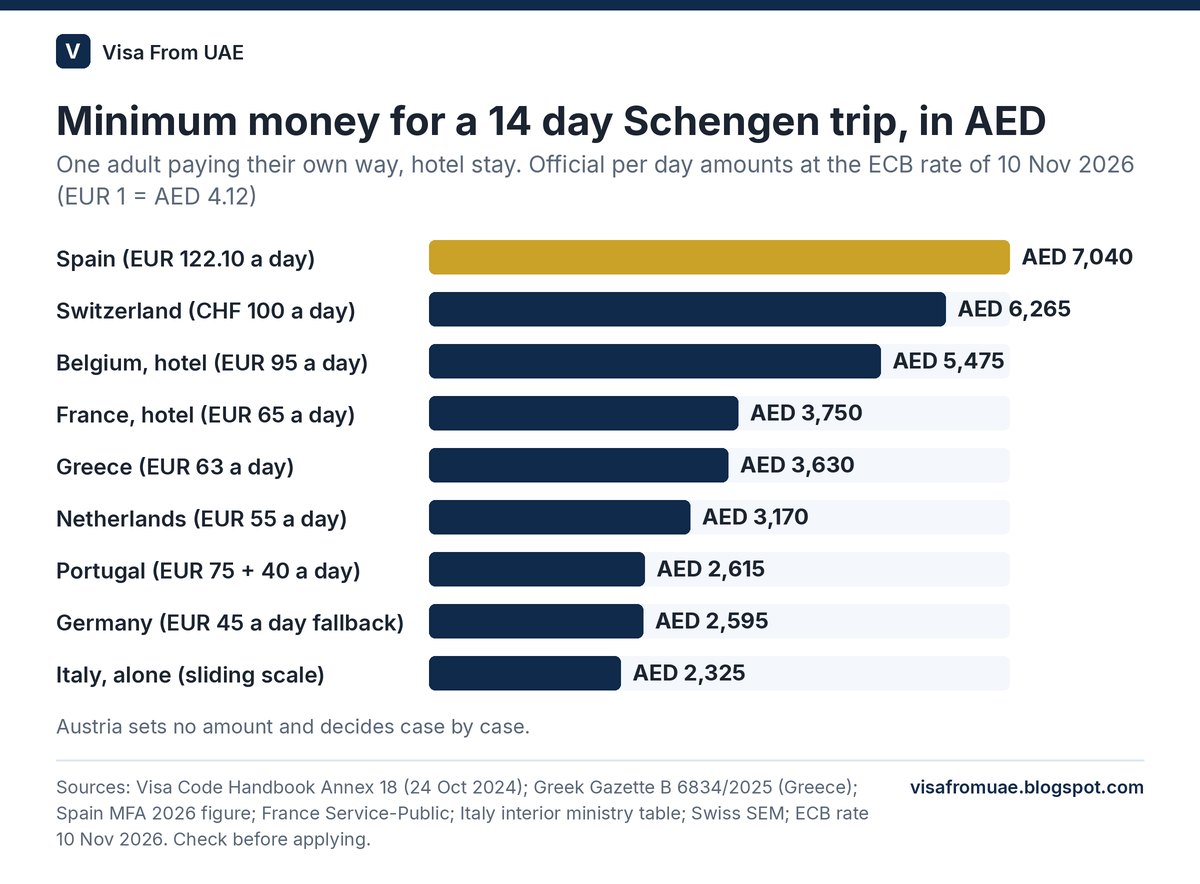
Here are the official daily amounts for the countries UAE residents apply to most, turned into dirhams for 7, 14 and 21 day trips. I used one adult paying their own way and staying in a hotel, at the ECB rate of 10 November 2026 (EUR 1 = USD 1.1214, so about AED 4.12; CHF 1 is about AED 4.48). Amounts are rounded to the nearest AED 5.
| Country | Official rule | 7 days | 14 days | 21 days |
|---|---|---|---|---|
| Spain | EUR 122.10 a day, never less than EUR 1,098.90 (2026) | AED 4,525 | AED 7,040 | AED 10,560 |
| Switzerland | CHF 100 a day | AED 3,130 | AED 6,265 | AED 9,395 |
| Belgium | About EUR 95 a day in a hotel, EUR 45 staying with a host | AED 2,740 | AED 5,475 | AED 8,215 |
| France | EUR 65 a day with a hotel booking, EUR 120 with no accommodation proof, EUR 32.50 with an attestation d'accueil | AED 1,875 | AED 3,750 | AED 5,620 |
| Netherlands | EUR 55 a day | AED 1,585 | AED 3,170 | AED 4,755 |
| Greece | EUR 63 a day, at least EUR 378 for up to 5 days, half for minors (Gazette B 6834, December 2025) | AED 1,815 | AED 3,630 | AED 5,450 |
| Portugal | EUR 75 per entry plus EUR 40 a day | AED 1,460 | AED 2,615 | AED 3,770 |
| Germany | No fixed amount; EUR 45 a day as a fallback | AED 1,295 | AED 2,595 | AED 3,890 |
| Italy, travelling alone | Sliding scale: EUR 44.93 a day for 6 to 10 days, a fixed sum plus a daily rate after that | AED 1,295 | AED 2,325 | AED 3,265 |
| Austria | No reference amount, case by case | No figure | ||
A few things in this table are worth slowing down for.
Spain's floor bites on short trips. Spain's 2026 rule says EUR 1,098.90 "in any case", which is exactly nine days' worth. A five day city break in Madrid needs the same AED 4,525 as a nine day trip. A family of four on a seven day holiday needs 4 x EUR 1,098.90 = EUR 4,395.60, about AED 18,100, before the flights. Details are in our Spain visa from UAE guide.
France changes with your accommodation. The same two weeks costs AED 3,750 with a hotel booking and AED 6,920 with none. If family in France gets you an attestation d'accueil from their town hall, the rate halves to EUR 32.50. See our France visa from UAE guide.
Italy is cheaper in a group. Two or more travelling together each need less per person than a solo traveller. The full scale is in our Italy visa from UAE guide.
Germany's EUR 45 is not a target. Germany's own entry in Annex 18 says "mandatory reference amounts per day have not been set" and that EUR 45 a day applies only if a traveller cannot show anything better. Several agency pages print EUR 45 as Germany's rule. It is the minimum at the border, not what a visa officer in Dubai wants to see.
Switzerland is in francs. The franc is stronger than the euro right now, so CHF 100 is more than EUR 100. Our Switzerland guide and Netherlands guide have the full tables for those two.
One caution on the Annex 18 figures for Belgium, Portugal and Germany. The version I read is dated 24 October 2024, and countries update their entries at different times. Greece is a good example: Annex 18 still shows EUR 50 a day with a EUR 300 minimum, but Joint Ministerial Decision 70301, published in the Greek Government Gazette (B 6834) on 18 December 2025, raised it to EUR 63 a day with a EUR 378 minimum for up to five days, halved for minors. The table above uses the new figure, and our Greece visa from Dubai guide has the full breakdown in AED. Spain, France, Italy, the Netherlands and Switzerland figures come from each government's own current page, which I re-read on 10 November 2026.
Is the daily amount enough?
Usually not on its own, and this is where a lot of UAE files go wrong. The daily amount is spending money. The visa officer reads it next to three other things:
- Your salary. Someone earning AED 25,000 a month with AED 3,000 in the bank raises a question the daily amount does not answer: where does the money go?
- The trip itself. If your hotel and flights are not paid yet, the officer expects the balance to cover them too. A two week trip to Spain with an unpaid hotel needs far more than AED 7,040.
- Your ties to the UAE. Rent, school fees and a steady job are good signs. A balance that only exists for the visa is not.
A practical way to set your own target: add the country's daily amount for your trip to the cost of anything you have not paid yet, then keep a margin on top. That gives you a number that matches your actual trip, which is what the officer is checking. It is also why the "AED 15,000 to 25,000" figure you see on agency pages is neither a rule nor useless. It is roughly what a typical trip plus a margin comes to for many people, but it means nothing if it does not match your salary and your plans.
What UAE consulates ask for: months, stamps and accounts
The amount is set in Europe. The paperwork is set by each mission in the UAE, and they are not all the same.
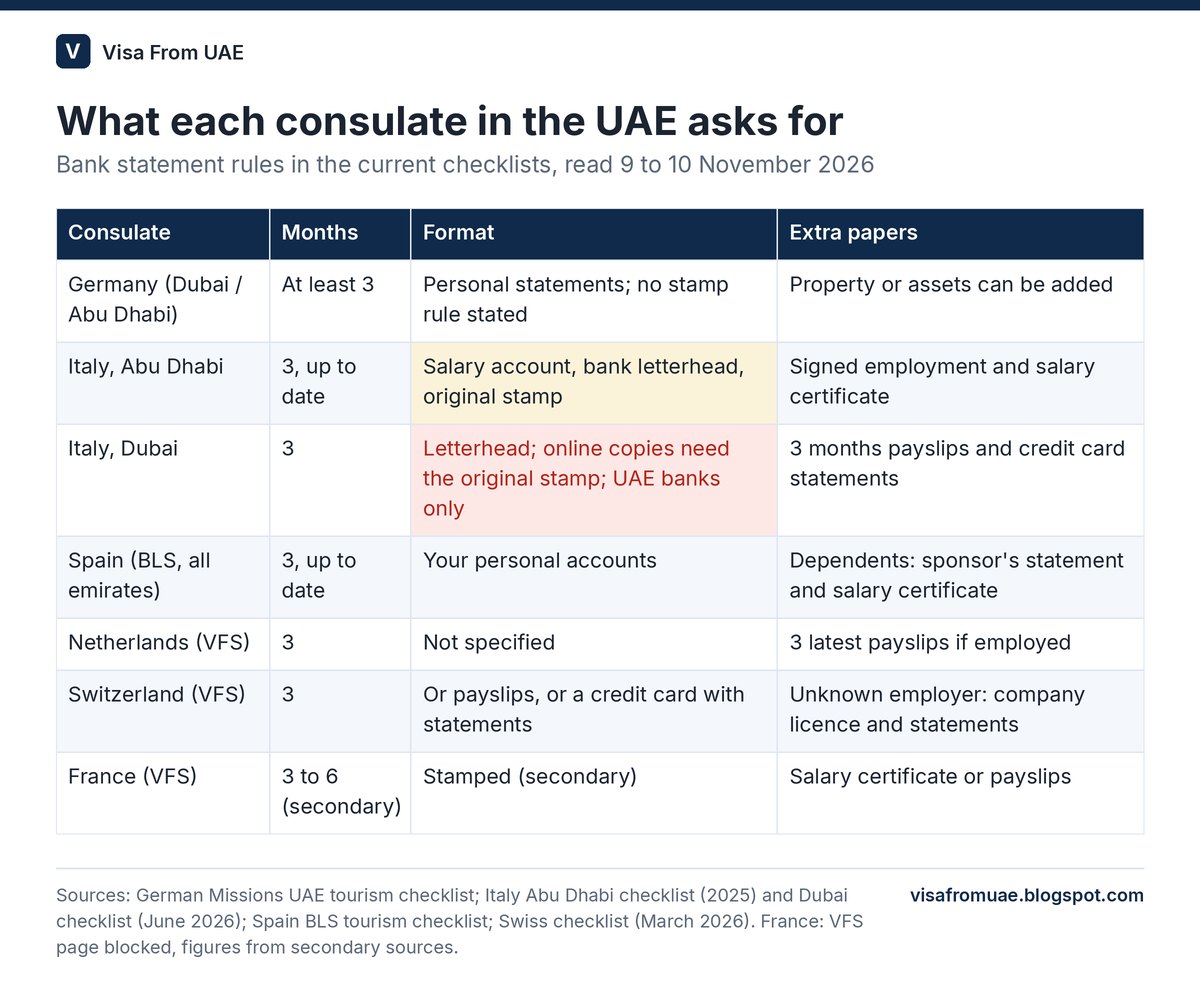
Germany (Consulate General Dubai and Embassy Abu Dhabi, via VFS). The tourism checklist asks for "personal bank statements of at least the last 3 months before application", and says property and other assets can be added. It does not mention a stamp.
Italy, Abu Dhabi (embassy, via BLS). The checklist asks for the "last three-month updated bank statement of the personal account in which the salary is received", and says all statements "must be printed out on a bank letterhead and bear the original stamp of the bank". Partners in a local company add the trade licence and the company's statements too.
Italy, Dubai (consulate, via VFS). The June 2026 checklist asks for 3 months of payslips, 3 months of bank statements and 3 months of credit card statements, and says "foreign bank accounts will not be considered". Statements go on bank letterhead, and "photocopies or online statements must bear the original bank stamp".
Spain (embassy, via BLS in Dubai and Abu Dhabi). "Up-to-date" personal statements for the last 3 months. Housewives, minors and other dependents use the sponsor's salary certificate and bank statement.
Netherlands and Switzerland (via VFS). Both expect 3 months of statements. The Dutch list adds your 3 latest payslips. The Swiss March 2026 checklist accepts payslips, an international credit card backed by statements, or 3 months of statements, and if your employer is not a known company it wants the trade licence and 3 months of the company's statements as well.
France (via VFS). The VFS checklist page for France blocked my requests on 10 November, so I could not read it directly. Agency guides and our earlier France research say 3 to 6 months of stamped statements. Treat that as secondary and check the VFS list when you book.
So how many months? Three is the official baseline at every mission above. Some agencies tell everyone to bring six. That does no harm if the extra three months look normal, and it can help if a bonus or a large transfer happened four months ago and you want the officer to see where it came from. But no checklist I read asks for six.
Stamped, e-statement or app download?
This question comes up in almost every Dubai expat forum thread about Schengen visas. The safe answer: get the statement from your bank on letterhead with the bank's stamp. Italy requires it, and no consulate rejects a stamped statement. A PDF from your banking app may be fine for Germany or the Netherlands, whose checklists do not mention a stamp, but it saves you very little and takes one doubt off the table.
Ask your branch for a stamped statement, and ask whether your bank can also issue a certified statement online. Options and charges differ from bank to bank, so check your bank's current fee schedule before you go. Ask for it within a few days of your appointment. Every checklist says "up to date", and a statement that ends a month before you submit leaves a gap the officer cannot see into.
A screenshot of your app is not a statement. Neither is a balance certificate on its own. Some banks will give you a letter confirming your balance, which can go in the file as an extra, but it does not replace three months of transactions.
Why a big deposit can hurt you
Here is the pattern that refusal letters are full of.
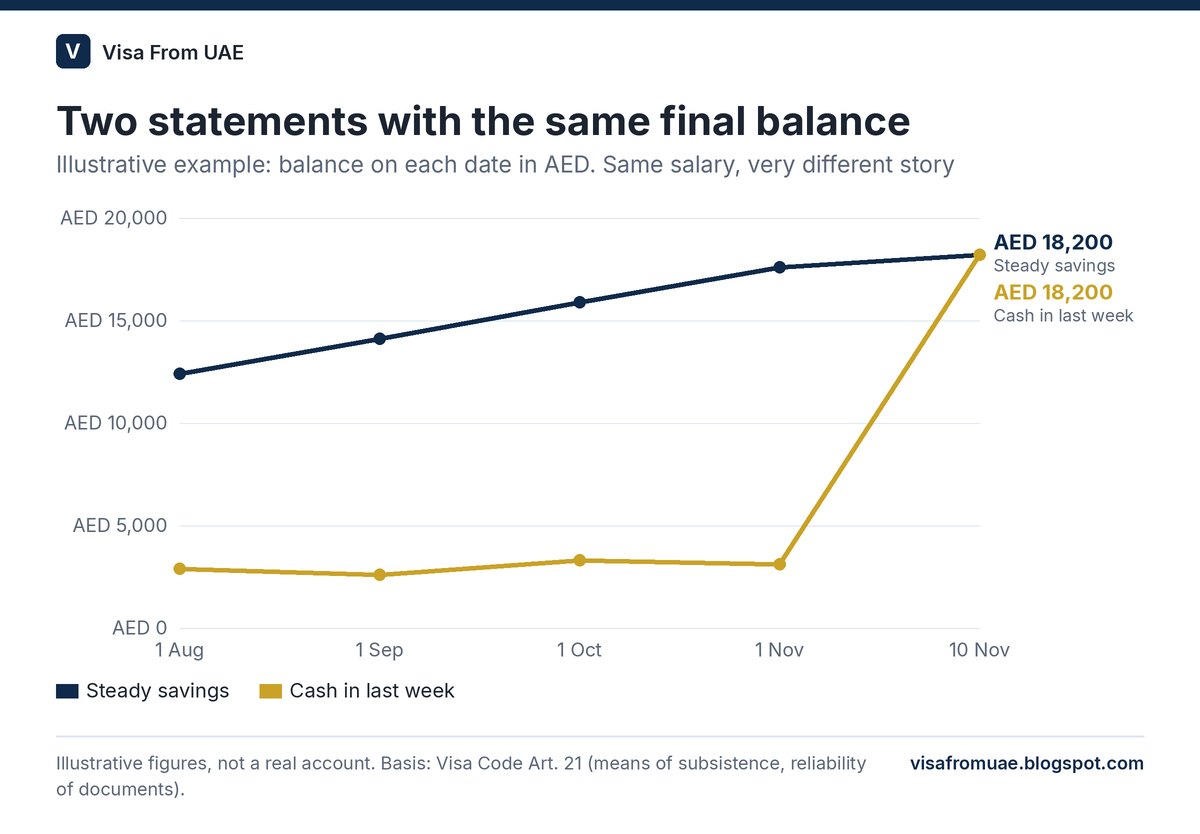
Article 21(7) of the Visa Code says the examination is based on "the authenticity and reliability of the documents submitted". A balance that sat at AED 3,000 for three months and jumped to AED 18,000 last week is not reliable proof of anything. It looks like borrowed money, because often it is. Gulf News's February 2026 guide to Schengen refusals for UAE residents makes the same point from the other side: it tells applicants to show recent statements "with consistent transactions and sufficient balances".
If you do have a real reason for a large credit, explain it. A short signed letter that says what the money is and attaches proof (a bonus letter from HR, a sale agreement, a transfer from your own savings account with that account's statement) turns a red flag into a normal line. What you should not do is move money in for the visa and out again after. The consulate keeps your file, and your next application will be read next to it.
The opposite pattern also hurts: a balance that drops to almost zero before each salary. It suggests the trip would stretch you, and it makes the officer wonder what you send home or spend each month. If that is your account, bring other savings statements, show what is already paid for the trip, or consider a sponsor.
Joint accounts, sponsors and spouses
- Joint account: fine if your name is on it. Add a line in your cover letter saying who the other holder is, especially if it is your spouse and you are travelling together.
- Housewives and dependents: Spain says so directly, and the others work the same way in practice. You submit the sponsor's NOC, salary certificate and statements showing the salary arriving, plus your marriage or birth certificate.
- Someone in Europe paying: the Visa Code lets a sponsor or host replace part of your own money. Each country has its own form. Germany has the formal obligation letter (Verpflichtungserklärung), France the attestation d'accueil, the Netherlands a legalised sponsorship form and Switzerland a declaration of sponsorship. The consulate still wants to see your own UAE job and salary papers, because those show you will come back.
- Self-employed or partners: expect to add the trade licence and the company's statements next to your personal ones. Italy and Switzerland say so in their checklists.
- Home country accounts: useful as an extra, never as the only statement. Italy's Dubai consulate says it will not consider them.
Check before you submit
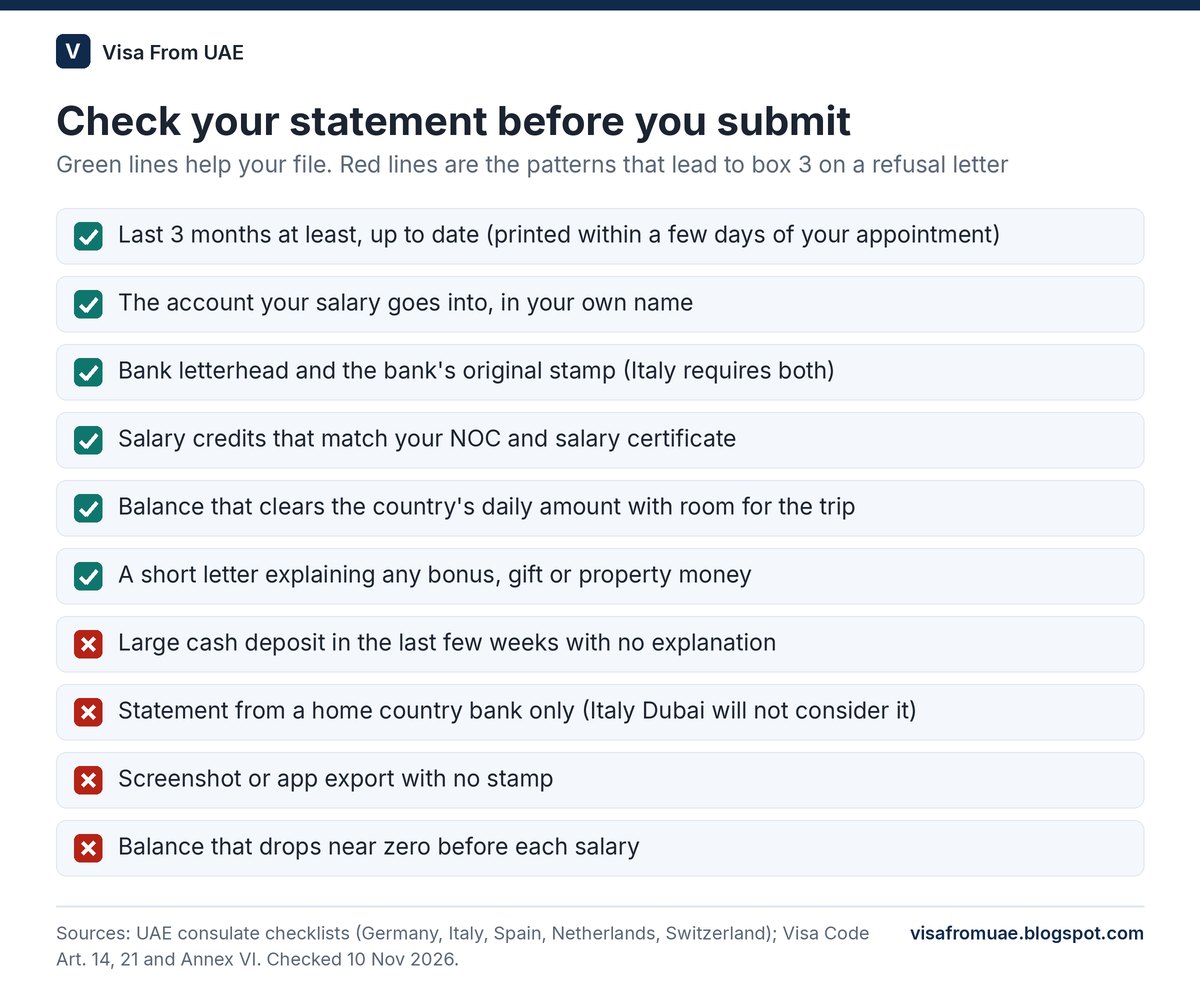
"Box 3" is the line on the standard Schengen refusal form that reads "you have not provided proof of sufficient means of subsistence". It is the money refusal. If it is ticked on your letter, our guide on what to do after a Schengen refusal in the UAE explains the appeal and reapply routes. A money refusal is one of the easier ones to fix, because three more months of a normal statement change the picture.
While you are getting papers from the bank, sort the rest of the money side too. Travel insurance is the other finance document in the file, and our Schengen travel insurance from UAE guide covers the EUR 30,000 rule and what it costs in AED.
Frequently asked questions
How much bank balance do I need for a Schengen visa from Dubai?
It depends on the country and your days. For 14 days alone in a hotel, the official floor is about AED 7,040 for Spain, AED 3,750 for France, AED 3,170 for the Netherlands and AED 2,325 for Italy at the 10 November 2026 rate. Keep a clear margin above it for anything not yet paid. Check before applying.
How many months of bank statements do I need for a Schengen visa from the UAE?
At least the last 3 months, up to date, at every consulate whose UAE checklist I read (Germany, Italy, Spain, the Netherlands, Switzerland). Six is not required, but it can help if there is a large credit earlier that you want to show the source of.
Does the bank statement need to be stamped?
For Italy, yes: bank letterhead and the bank's original stamp, including on online statements. Germany and the Netherlands do not mention a stamp. A stamped statement is accepted everywhere, so it is the safe choice.
Is AED 10,000 enough for a Schengen visa?
For a one week trip to most countries it clears the daily floor. Spain alone needs about AED 4,525 just to meet its minimum. Whether it is enough for you depends on your salary, what the trip costs and whether the balance has been steady.
Can I use my home country bank account?
As an extra, yes. As your only statement, no. Italy's Dubai consulate says foreign accounts will not be considered, and every mission wants to see your UAE salary account.
Can my husband's or father's bank statement be used?
Yes, if they are your sponsor. You add their NOC, salary certificate and statements showing the salary coming in, plus proof of your relationship.
More country guides and checklists are on our Visa from UAE guides page.
Official sources
- EU Visa Code (Regulation 810/2009), Article 14: Supporting documents
- EU Visa Code, Article 21: Verification of entry conditions (means of subsistence, reliability)
- EU Visa Code, Annex VI: Standard refusal form
- Visa Code Handbook, Annex 18: Reference amounts by member state (24 October 2024, PDF)
- Spain Ministry of Foreign Affairs: Conditions for entry into Spain (EUR 122.10 a day in 2026)
- Service-Public (France): Resources per day for a short stay
- Polizia di Stato (Italy): Table of means of subsistence
- SEM (Switzerland): Entry FAQ, CHF 100 a day
- NetherlandsWorldwide: Applying for a Schengen visa in the UAE
- German Missions in the UAE: Schengen visa checklist, tourism
- Embassy of Italy, Abu Dhabi: Tourism checklist (PDF)
- Consulate General of Italy, Dubai: Tourism checklist, June 2026 (PDF)
- Embassy of Spain in the UAE: Tourism checklist, via BLS (PDF)
- Gulf News: Top reasons Schengen visas get rejected for UAE residents in 2026 (press, not official)
- European Central Bank: Euro reference exchange rates
Daily amounts and checklists were read on 9 and 10 November 2026, and AED figures use the ECB rate of 10 November 2026 with the dirham's fixed rate of 3.6725 to the dollar. They are legal minimums, not a promise that a visa will be issued. Belgium, Portugal and Germany figures come from the October 2024 Annex 18 and may have changed. The Greece figure was updated on 18 November 2026 from Gazette B 6834/18.12.2025 (Decision 70301). The France VFS checklist and the March 2026 Swiss checklist could not be downloaded on 10 November, so those points rely on our earlier reading and secondary sources. Check the current rules before applying. See our Disclaimer.
Last updated: November 18, 2026