
Australia is a long way from Dubai, about fourteen hours to Sydney or Melbourne, and for many families in the UAE it is not a holiday they take lightly. Often there is a brother in Perth, a daughter studying in Brisbane, or grandparents who want to see a new baby in Melbourne. So the visa has to work the first time. A refusal costs you the fee, and it also stays on your record for the next application.
The trouble is that most pages about the Australia visa from the UAE are written by agencies, and they disagree with each other. One says the median processing time is four to eight weeks. Another lists every processing time as "varies". Some still quote the old AUD 200 fee, and several suggest you need a fixed bank balance, which the law does not say anywhere. For this guide I went to the source that decides all of it: the Migration Regulations 1994, in the compilation that took effect on 1 November 2026, which sets the fees and the legal tests for each visa. I added the Department of Home Affairs processing time data released on 2 November 2026 and the euro reference rates of the European Central Bank for 13 November 2026, so every AED figure below is worked out, not guessed. If you are new here, our Visa from UAE guides page lists every country we cover.
Short answer: Your passport decides which Australian visa you need, not your UAE residence. Emiratis and holders of Indian, Pakistani, Filipino, Egyptian, Bangladeshi, Sri Lankan and Nepali passports apply online for the Visitor visa (subclass 600), Tourist stream. It costs AUD 250, about AED 623, per person (children too) since 1 July 2026, and it is not refunded if you are refused. Half of tourist applications are decided within 21 days and 90% within 31 days. British and EU passport holders use the free eVisitor, and US, Canadian, Japanese, Korean, Singaporean and Malaysian passport holders use the ETA app for AUD 20.
Which Australian visa do UAE residents need?
Australia has no rule for UAE residents as such. It has three visitor visas, and which one you can use depends on the passport in your hand. A Pakistani engineer who has lived in Abu Dhabi for fifteen years applies the same way as a Pakistani living in Lahore. A German who arrived in Dubai last month uses the same free eVisitor as any other German. Your Emirates ID matters later, as evidence that you have a life to come back to.
- eVisitor (subclass 651). Free, applied for online through ImmiAccount. It covers the UK and the passports of the European Union plus a few other European states, such as Norway, Switzerland and Iceland. You can enter as many times as you like for 12 months from the grant and stay up to 3 months after each entry.
- Electronic Travel Authority, or ETA (subclass 601). For a fixed list of passports that includes the United States, Canada, Japan, South Korea, Singapore, Malaysia, Brunei, Hong Kong and Taiwan (the UK and several EU passports are on the ETA list as well). The regulations set the visa charge at nil, but the Australian ETA app charges a service fee of AUD 20, and the app is the only way to apply. Like the eVisitor, it allows 3 months per visit within 12 months.
- Visitor visa (subclass 600). Everyone else, and that includes the passports that make up most of the UAE's population: India, Pakistan, the Philippines, Egypt, Bangladesh, Sri Lanka and Nepal. It also includes the UAE passport itself. Emiratis are not on the eVisitor or ETA lists, so they apply online for the subclass 600 like most expats do.
New Zealand citizens are the one group that does not apply for anything before they fly. They get a visa when they arrive.
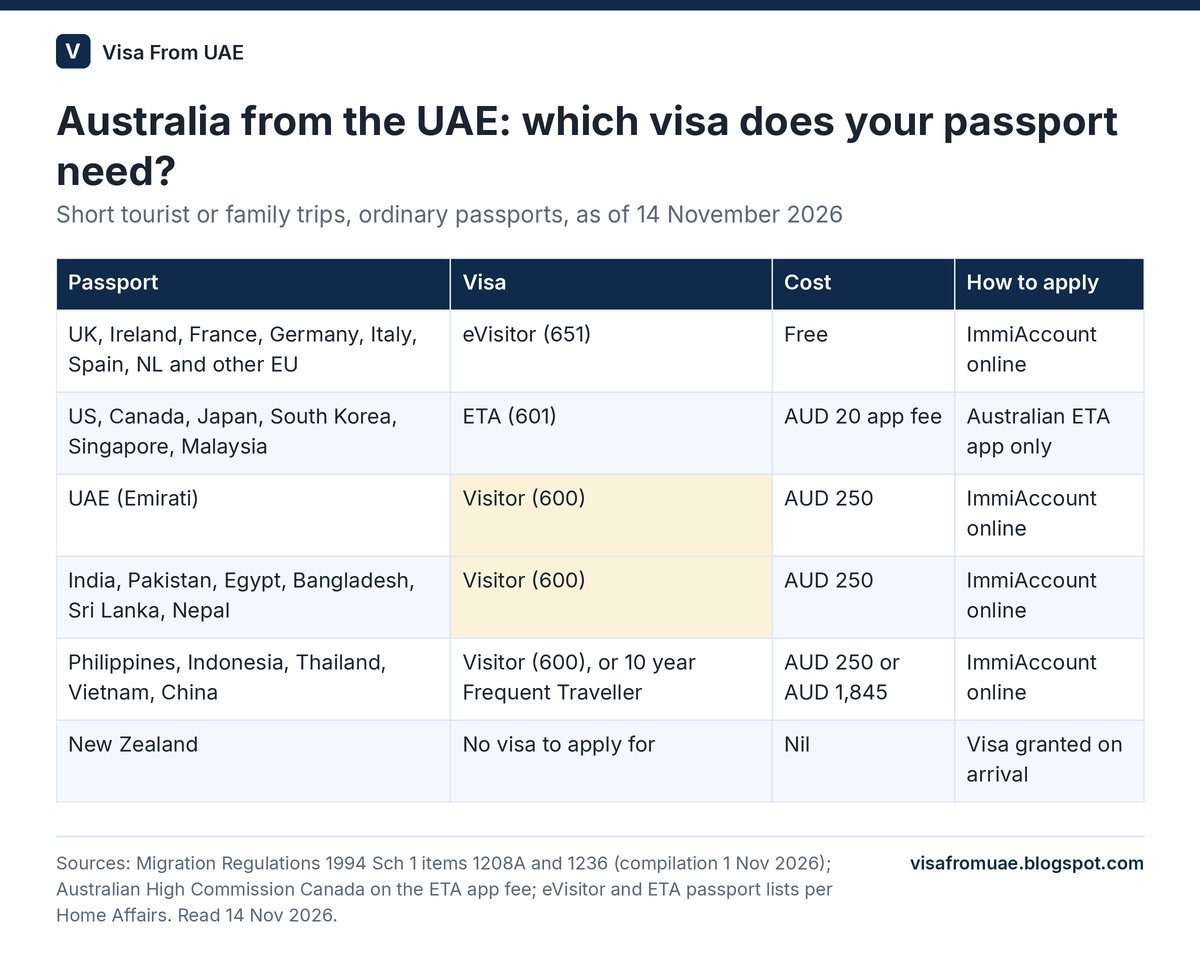
The table shows why so many families in the UAE end up on the subclass 600. It is the full visa, with a real assessment by an officer, and the rest of this guide is mostly about it.
The Visitor visa (subclass 600): five streams, and which one you want
The subclass 600 is one visa with five streams. The regulations give each stream its own criteria, and picking the wrong one is a common way to waste a fee.
- Tourist stream. For holidays, and also for visiting family. Clause 600.221 allows it for visiting a parent, spouse, partner, child, brother or sister who is an Australian citizen or permanent resident, or for any other purpose that is not business or medical treatment. This is the stream for most UAE residents.
- Sponsored Family stream. Your relative in Australia formally sponsors you. You must apply from outside Australia, and the visa always comes with a "no further stay" condition. It takes much longer to decide, as the processing chart below shows. Officers can also ask the sponsor to lodge a security bond.
- Business Visitor stream. For meetings, conferences and negotiations, not for paid work. It is the fastest stream in the Home Affairs data.
- Frequent Traveller stream. A visa valid for up to 10 years, with stays of up to 3 months each time, for an approved list of passports. It costs AUD 1,845. More on who can use it from the UAE below.
- Approved Destination Status stream. Only for Chinese citizens in China on an approved group tour, so not relevant here.
If you are visiting your son in Sydney, the Tourist stream is usually the better choice than Sponsored Family. It is faster and less paperwork for your son. The Sponsored Family stream makes sense when an officer has already refused you in the Tourist stream over doubts that you would go home, because the sponsorship and any bond give the department extra comfort.
What the Australia visa costs from the UAE, in AED
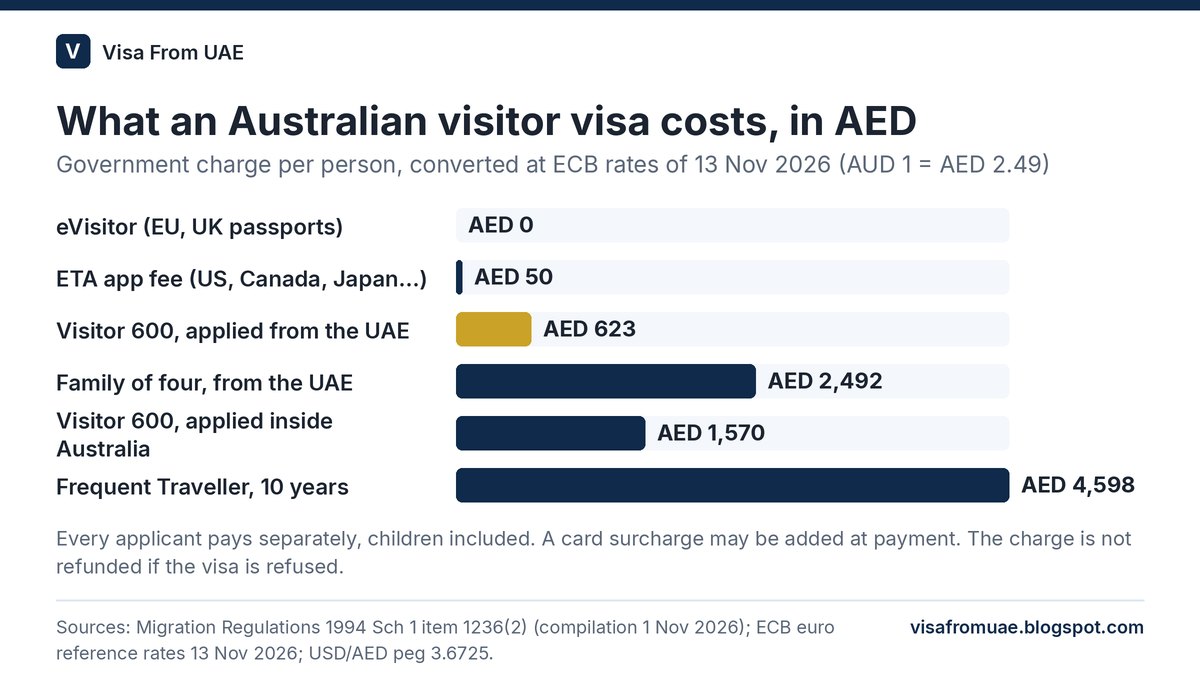
The fees are set in law, in Schedule 1 item 1236 of the Migration Regulations. In the 1 November 2026 compilation, the base application charge for a subclass 600 visa (not Frequent Traveller) is:
| Visa and where you apply | Charge in AUD | About AED |
|---|---|---|
| Visitor (600), applied from outside Australia (from the UAE) | AUD 250 | AED 623 |
| Visitor (600), applied inside Australia | AUD 630 | AED 1,570 |
| Visitor (600) Frequent Traveller stream, 10 years | AUD 1,845 | AED 4,598 |
| ETA (601), app service fee only | AUD 20 | AED 50 |
| eVisitor (651) | Nil | Nil |
The AED amounts use the ECB rates of 13 November 2026: one euro bought USD 1.1052 and AUD 1.6288, which with the dirham's fixed peg of 3.6725 to the dollar works out to AUD 1 = AED 2.49. Your card may show a little more after the bank's foreign exchange margin, and a card surcharge can be added at payment. Holders of passports from Pacific island countries pay lower amounts (AUD 205 offshore), which does not apply to anyone reading this from the UAE with an Asian, Arab or European passport.
Three things about the fee catch people out:
- It went up on 1 July 2026. The offshore Tourist stream charge was AUD 200 before that. Many agency pages and even some 2026 blog posts still show AUD 190 or AUD 200. The second instalment is nil, so AUD 250 is the whole government charge.
- Each person pays. The visitor visa has no cheaper "additional applicant" rate. A couple with two children pays four times AUD 250, which is AUD 1,000, or about AED 2,492.
- Do not apply after you land on an ETA or eVisitor. The same visa applied for inside Australia costs AUD 630. If you know you will want a longer stay, apply for it before you fly.
How long processing takes
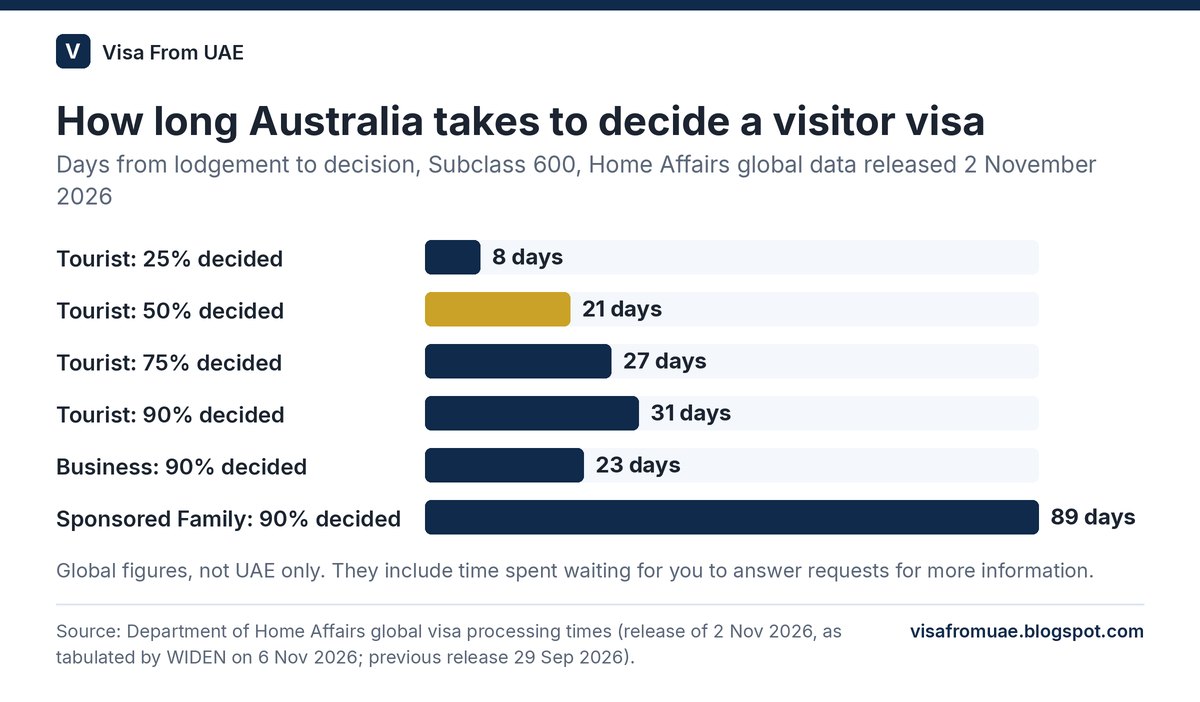
Home Affairs publishes processing times as percentiles. The 50% figure means half of all applications were decided within that many days, and the 90% figure is the one to plan around. Measured from the day you lodge to the day of the decision, the global figures released on 2 November 2026 were:
| Stream | 25% | 50% | 75% | 90% |
|---|---|---|---|---|
| Tourist | 8 days | 21 days | 27 days | 31 days |
| Business Visitor | 4 days | 7 days | 14 days | 23 days |
| Sponsored Family | 32 days | 40 days | 54 days | 89 days |
The previous release, dated 29 September 2026, put the Tourist stream's 90% figure at 33 days, so things are steady to slightly faster. These are worldwide figures, not a UAE number. Home Affairs does not publish one per country. They also include the time an application sits waiting for the applicant to answer a request for more information, which is why a complete application at the start tends to land in the faster part of the curve.
Compare that with what you read online. One large UAE agency guide says the Tourist stream median is four to eight weeks with 75% decided in 56 days. The official data says 21 days and 27 days. An older idea that you need three months is also out of date. My advice is simple. Apply at least six weeks before your flight, and do not pay for flights or hotels that cannot be refunded until the visa is granted.
Do you need a set bank balance for an Australia visa from the UAE?
No. This is the single most common myth in the UAE agency pages. The legal test is in clause 600.212: you must have "adequate means to support" yourself, or access to adequate means, for the period of your stay. There is no amount in the regulation, and no AED or AUD figure in the criteria.
What the officer is really checking is two things. The first is whether you can pay for this trip. The second, under clause 600.211, is whether you "genuinely intend to stay temporarily". In other words, will you go home? The officer looks at your past compliance with visas, whether you will follow the conditions of this one, and "any other relevant matter". For a UAE resident, the strongest evidence of both is usually the same set of papers: a steady salary going into a UAE bank account, a job or business you will return to, a residence visa that runs past your trip, and family in the UAE.
So instead of chasing a number, make the statement tell a clear story:
- Your salary credits are visible every month, and they match the salary certificate.
- The balance is plausible for a trip of the length you asked for, including flights, a hotel or a contribution to the family you stay with, and daily costs.
- There are no unexplained large deposits right before you apply. If a relative gave you money, say so in your cover letter and show where it came from.
- If your relative in Australia is paying, include their statement or payslips and a short letter.
Our guide to the UK visit visa bank balance from the UAE walks through the same idea for the UK, where the rules are also written as a test rather than a figure, and it shows how to explain gifts and sudden deposits.
How to apply for the subclass 600 from the UAE, step by step
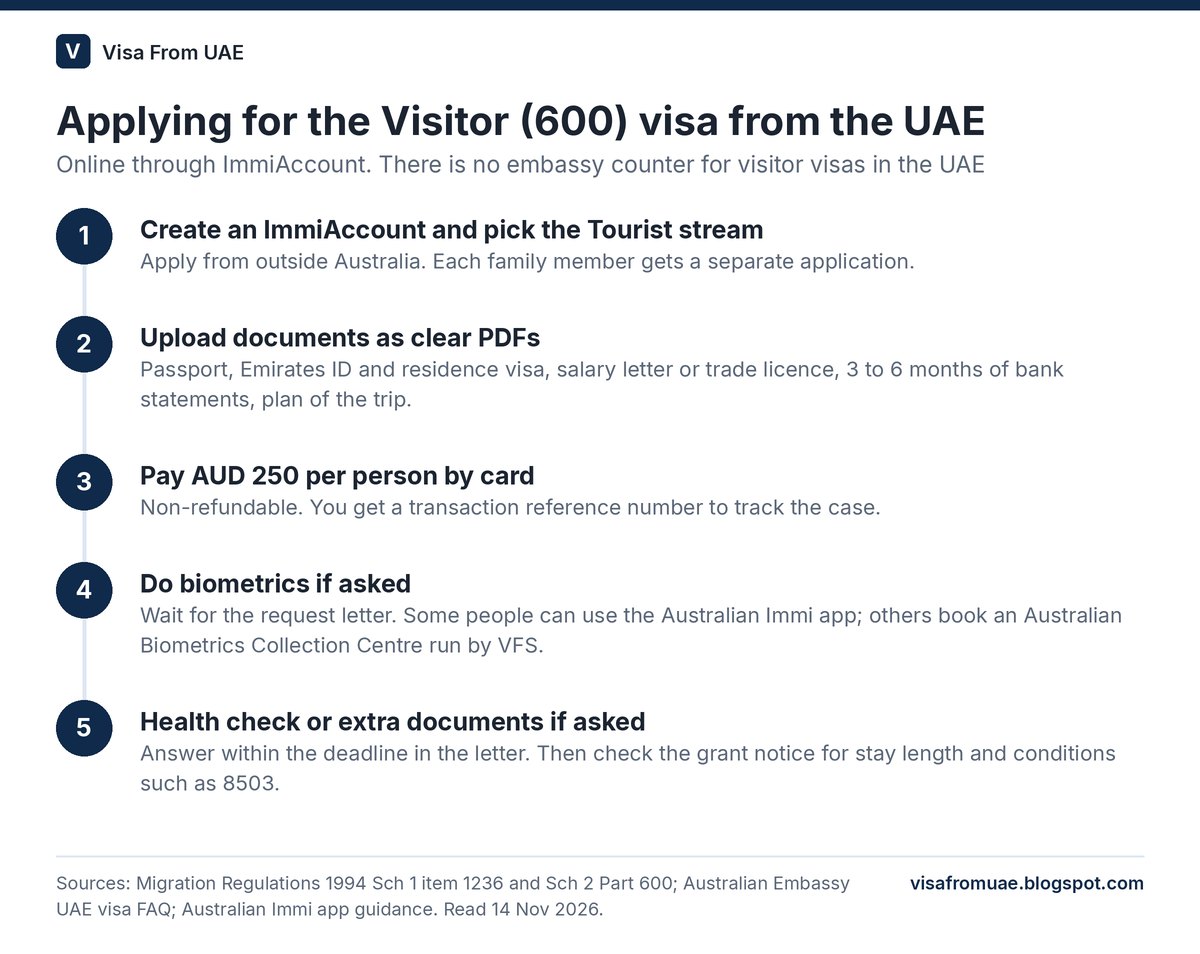
There is no visa counter for visitor visas at the Australian Embassy in Abu Dhabi or the Consulate-General in Dubai. Decisions are made by the Department of Home Affairs, and applications go in online.
- Create an ImmiAccount on the Home Affairs website and start a Visitor (600) application in the Tourist stream. Choose "outside Australia". Each traveller needs their own application, including children.
- Answer the form honestly, especially the questions about previous refusals, overstays and health. A refusal by another country (for example a Schengen or UK refusal) is not an automatic problem, but hiding one is.
- Upload documents as clear PDFs, labelled in English. Arabic documents need a certified English translation.
- Pay AUD 250 per person by card. You get a transaction reference number (TRN) to track the case.
- Wait for any request. If the department needs biometrics, a health examination or more documents, it writes to you through ImmiAccount with a deadline.
- Read the grant notice. It shows the visa's end date, how long you can stay each time and the conditions. Check it in the free VEVO service before you fly. There is no label in your passport, and airline staff check the visa electronically at check-in.
Biometrics in the UAE
Do not book biometrics before you are asked. If Home Affairs needs your fingerprints and photo, you get a "requirement to provide personal identifiers" letter. Depending on the letter, you either go to an Australian Biometrics Collection Centre, which VFS Global runs for the department, or you may be able to use the Australian Immi app on your phone to scan your passport chip and take a live photo. Agency reports say the UAE is among the countries where the app works, but the letter decides, so follow what it says. Bring the letter and your passport if you go in person.
Health examinations
Most short-stay visitors are not asked for medical tests. The department can still ask, for example if you have spent time in countries with a higher risk of tuberculosis, if you are older and planning a long stay, or if you declare a medical condition. If you are asked, you book with a panel physician approved by Australia using the HAP ID in your letter. Do not pay for a medical before the department asks for it.
Documents for an Australian tourist visa from the UAE
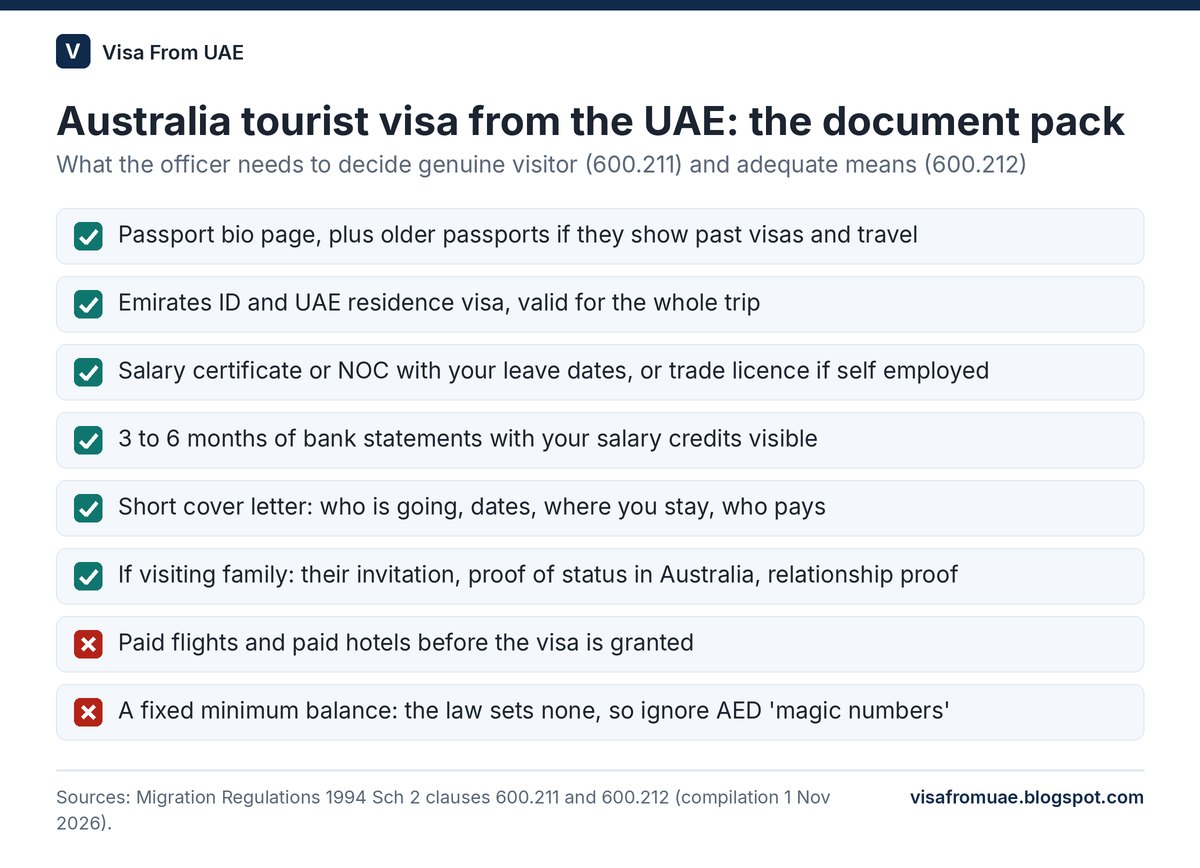
The regulations do not publish a fixed document list for the Tourist stream. The department's own checklist in ImmiAccount guides you, and the officer can ask for more. Each document should answer one of the two legal questions: will you go home, and can you pay. This is the pack I would put together for a typical UAE resident:
- Passport bio page, and older passports if they show past visas for Australia, the UK, the US, Canada, Schengen or Japan. A good travel history helps.
- Emirates ID and residence visa. The visa should be valid for the whole trip and ideally well beyond it.
- Salary certificate or employer letter with your job title, salary, start date and the approved leave dates. Self-employed applicants should add the trade licence and business bank statements.
- Personal bank statements for 3 to 6 months, showing the salary credits.
- A short cover letter: who is travelling, the dates, where you will stay, who pays, and why you will come back (job, family, property, children in school).
- If visiting family: an invitation letter from them, proof of their Australian citizenship or permanent residence, and proof of the relationship, such as birth or marriage certificates.
- Children: birth certificate, and the consent of the parent who is not travelling if only one parent goes.
What you do not need: paid flight tickets, paid hotels or a fixed minimum balance. A rough plan of the trip is enough. Travel insurance is not a general rule for the Tourist stream either. The officer can attach condition 8501, which requires you to keep adequate health insurance during the stay, and that happens more often for older parents on long visits. Medical bills in Australia are expensive for visitors, so good cover is sensible anyway.
Conditions on your visa, and the new "no further stay" plan
Clause 600.611 lists the conditions an officer must or may attach to a Tourist stream visa. Every Tourist visa gets condition 8101 (no work) and 8201 (no more than 3 months of study). The officer may also add:
- 8501: keep adequate health insurance while in Australia.
- 8503: "no further stay". You cannot be granted most other visas while you are in Australia. You would have to leave and apply from outside. A request to waive it is possible only in narrow cases.
- 8558: you must not stay in Australia for more than 12 months in any 18 month period.
Separately, clause 600.215 says that if a new visa would take your total time in Australia on visitor visas past 12 consecutive months, there must be "exceptional circumstances". That is the rule that stops back-to-back visitor visas from becoming a way to live there.
On 17 September 2026 the Home Affairs Minister, Tony Burke, announced that a no further stay condition would be attached to all visitor visas. As of the 1 November 2026 compilation of the regulations, the wording for the Tourist stream still says 8503 "may be imposed". I could not find an instrument that makes it automatic yet. In practice, plan as if your visa will carry 8503. If you hope to visit and then switch to a partner, student or work visa inside Australia, you need advice before you apply, not after you land.
The 10 year Frequent Traveller visa: can UAE residents get it?
The Frequent Traveller stream gives a visa for up to 10 years, with stays of up to 3 months at a time, for AUD 1,845 (about AED 4,598). The regulations limit it to passports that the Minister specifies. According to reporting on the current list, it covers citizens of 11 countries: China, Brunei, Cambodia, Indonesia, Laos, Malaysia, the Philippines, Singapore, Thailand, Timor-Leste and Vietnam. Indian, Pakistani, Egyptian and Emirati passports are not on it.
For a Filipino or Indonesian family in Dubai with children or parents in Australia, this matters. At AUD 250 a time, a 10 year visa pays for itself after about seven to eight ordinary visitor visas, and it saves a new assessment every time. The catch is in the regulations: the Minister can also set a place where you must be when you apply. Before you pay AUD 1,845, check on the Home Affairs Frequent Traveller page that applications lodged from the UAE are accepted for your passport. If the page says you must apply from your home country, the cheaper Tourist stream from Dubai is the safer route. The visa also carries condition 8573, which limits you to 12 months in Australia in any 24 months.
Which visa is right for you: a quick decision table
| Your situation | What to apply for | Cost per person |
|---|---|---|
| British, Irish or EU passport, holiday or family visit up to 3 months | eVisitor (651) in ImmiAccount | Free |
| US, Canadian, Japanese, Korean, Singaporean or Malaysian passport | ETA (601) in the Australian ETA app | AUD 20 (AED 50) |
| Emirati passport, holiday | Visitor (600) Tourist stream, online | AUD 250 (AED 623) |
| Indian, Pakistani, Egyptian or Bangladeshi passport, holiday or family visit | Visitor (600) Tourist stream, online | AUD 250 (AED 623) |
| Parents visiting a child who is an Australian citizen or PR, refused before in the Tourist stream | Visitor (600) Sponsored Family stream | AUD 250, plus a possible bond |
| Filipino, Indonesian, Thai or Vietnamese passport, going every year | Frequent Traveller stream, if it can be lodged from the UAE | AUD 1,845 (AED 4,598) for up to 10 years |
| Conference or meetings in Australia | Visitor (600) Business Visitor stream, or ETA if eligible | AUD 250 or AUD 20 |
| Already in Australia and want to stay longer | Apply before your visa ends, if no 8503 condition | AUD 630 (AED 1,570) |
What you read online vs what the rules say
| Common claim | What the law and official data say |
|---|---|
| "The Australia tourist visa costs AUD 190 or AUD 200" | AUD 250 from outside Australia since 1 July 2026 (Schedule 1 item 1236). |
| "Processing takes 4 to 8 weeks" | Tourist stream: 21 days for half of all cases, 31 days for 90% (release of 2 November 2026). |
| "You need AED 20,000 (or another fixed amount) in the bank" | No amount in the law. The test is "adequate means" for your stay (clause 600.212). |
| "UAE residents can use the ETA" | Only ETA-eligible passports can. A UAE residence visa does not count, and the UAE passport is not on the list. |
| "Book a VFS appointment first" | Apply online first. Go for biometrics only if the department sends a request letter. |
| "You get your fee back if refused" | The charge is not refunded on refusal. |
| "All visitor visas now have no further stay" | Announced on 17 September 2026. The regulations as compiled on 1 November 2026 still say "may be imposed" for the Tourist stream. |
If your Australia visa is refused
A refusal letter explains which criterion the officer was not satisfied about. For visitors in the UAE, it is almost always 600.211 (genuine temporary stay) or 600.212 (means). A visitor visa refused outside Australia usually has no merits review. The main exception is a visit to a close relative who is an Australian citizen or permanent resident, where that relative may be able to ask the Administrative Review Tribunal to review it. Your refusal letter says whether review is open and gives the deadline. For most people the practical path is a fresh application that fixes the reason, which means a new fee. Before you reapply, read the reasons line by line, add the evidence that was missing (for example a clearer employer letter, the source of a large deposit, or proof of your family's ties to the UAE), and consider the Sponsored Family stream if a close relative in Australia can sponsor you. Our guide to reapplying after a UK visa refusal from the UAE uses the same method, and most of it carries over.
Always declare an Australian refusal on later applications, including for Canada, the UK, the US and New Zealand. Those countries share information, and a missing refusal causes far more trouble than the refusal itself.
Frequently asked questions
Can UAE residents apply for an Australia visa online?
Yes. The subclass 600 and the eVisitor are applied for online through ImmiAccount, and the ETA only through the Australian ETA app. There is no visitor visa counter at the Embassy in Abu Dhabi or the Consulate-General in Dubai.
How much is the Australia visit visa from Dubai in AED?
AUD 250 per person for the subclass 600 Tourist stream, which was about AED 623 at the ECB rates of 13 November 2026. A family of four pays about AED 2,492. The fee is not refunded if the visa is refused.
How long does an Australia visa take from the UAE?
Home Affairs does not publish a UAE figure. Globally, half of Tourist stream applications were decided within 21 days and 90% within 31 days in the data released on 2 November 2026. Apply at least six weeks before you travel.
Do Emiratis need a visa for Australia?
Yes. UAE passport holders are not on the eVisitor or ETA lists, so they apply online for the Visitor (600) visa. Biometrics are taken only if the department asks.
Is the Australia visa for Indians in Dubai different?
No. Indian passport holders in the UAE apply for the same subclass 600 visa with the same AUD 250 fee. India is not on the Frequent Traveller list, so the 10 year option does not apply.
Can a Pakistani living in the UAE get an Australian visit visa?
Yes, through the subclass 600 Tourist stream, the same as any other passport not on the ETA or eVisitor lists. Strong evidence of a job, family and residence in the UAE does most of the work.
How long can I stay in Australia on a visitor visa?
The eVisitor and ETA allow 3 months per entry within 12 months. For the subclass 600, the grant notice tells you the stay per entry, commonly 3 months, and longer stays such as 6 or 12 months are possible for family visits. Condition 8558, if attached, limits you to 12 months in any 18 months.
Can I work on an Australian visitor visa?
No. Condition 8101 means no work. Business visitors can attend meetings and conferences, but cannot do paid work for an Australian business.
More trips from the UAE
If Australia is part of a bigger trip, see our Japan visa from the UAE and China visa from the UAE guides for the stopovers people often add. For other long-haul family visits, our Canada visitor visa from the UAE, UK visit visa from the UAE and US B1/B2 visa from Dubai and Abu Dhabi guides use the same approach.
Sources
- Federal Register of Legislation: Migration Regulations 1994, compilation No. 290 (1 November 2026), Schedule 1 items 1208A and 1236, Schedule 2 Parts 600, 601 and 651
- Department of Home Affairs: Visitor visa (subclass 600)
- Department of Home Affairs: Global visa processing times
- WIDEN: Subclass 600 processing times table from Home Affairs data (release of 2 November 2026, read 6 November 2026)
- Australian High Commission in Canada: ETA app and the AUD 20 service fee
- Australian Embassy in the UAE: Visa frequently asked questions
- European Central Bank: euro reference exchange rates (13 November 2026)
- Migratio: the 17 September 2026 No Further Stay announcement and its legal status
- PhilSTAR Life: 10 year Frequent Traveller visa for Filipino travellers (17 October 2026)
- OraVisa: Australia visa application charges from 1 July 2026
Rules and fees were read on 14 November 2026. Fees are in Australian dollars as set in the Migration Regulations, with AED amounts converted at ECB rates for 13 November 2026 (AUD 1 = AED 2.49). Processing times are global figures from the Department of Home Affairs, not a promise for any single case. The final decision on a visa and on entry is made by the Australian authorities. This guide is general information, not legal or migration advice. See our Disclaimer.
Last updated: November 14, 2026