A UK visit visa refusal usually arrives as a short email from UK Visas and Immigration, and the first question almost everyone in Dubai or Abu Dhabi asks is the same: can I apply again? Yes. There is no waiting period and no limit on how many times you can apply. The harder question is whether the next application will be any different, because the officer who decides it will have your first one open on the same screen.
This guide is about getting that second application right. I read the current Immigration Rules for visitors (Appendix V, updated 8 October 2026), the Home Office's own Visit caseworker guidance (version 18.0, published for staff on 8 October 2026), the new Part Suitability rules on deception that replaced the old Part 9 on 11 November 2025, and the GOV.UK pages on administrative review and judicial review. I also worked out refusal rates by passport from the Home Office's own visa dataset, which most "UK visa rejected" pages never look at. If you have not applied before, start with our UK visit visa from UAE guide instead.
Short answer: You can apply again for a UK visit visa straight away, from the UAE, as many times as you like. Each try costs the full fee again (£135 for a standard visit visa, about AED 665 at the 10 November 2026 rate), and the fee for a refused application is not refunded. There is no administrative review for visitor visas, and no appeal unless your application raised a human rights claim. Judicial review is possible within 3 months, but it only tests whether the decision was lawful and starts at £179 in tribunal fees before any lawyer. For most UAE residents the right move is a fresh application that answers every paragraph in the refusal letter with new evidence, and that declares the earlier refusal. If your letter mentions deception or false documents, stop and get advice first, because that can carry a 10 year ban.
Can you apply again after a UK visa refusal?
Yes, and nothing in the Immigration Rules makes you wait. Appendix V does not set a gap between applications, and the GOV.UK Standard Visitor pages describe no cooling off period. Immigration firms say the same: OTS Solicitors calls reapplying "the simplest and most cost-effective option" when the refusal came from missing or weak documents.
What you cannot do is pretend the first one did not happen. The online form asks about previous refusals, and the Home Office's staff guidance on deception gives "failure to disclose previous refusals of entry clearance or permission" as a standard example of non-disclosure. The same guidance walks officers through a case where an applicant "forgot" two earlier refusals and concludes it is "not credible" they would forget going through the visa process twice. Leaving a refusal off the form is the fastest way to turn an ordinary refusal into a deception finding.
Two other practical points before you rush back to the form:
- The fee is gone. GOV.UK says you "will not get a refund of the application fee" if your application is refused. A second standard visit visa is another £135, plus any optional VFS extras you choose.
- Speed does not help you. An application sent two days later with the same papers will usually get the same answer, because the officer is applying the same test to the same evidence. The gap between applications should be as long as it takes to change what the officer saw, not a number of weeks someone told you.
Your refusal letter, decoded
A UK visitor refusal letter is written around one paragraph of the rules: V 4.2 of Appendix V, the "genuine visitor" test. The officer has to be satisfied that you meet each part of it. When they are not, the letter quotes the part that failed, sometimes several. Here is what each one means and what kind of evidence answers it.
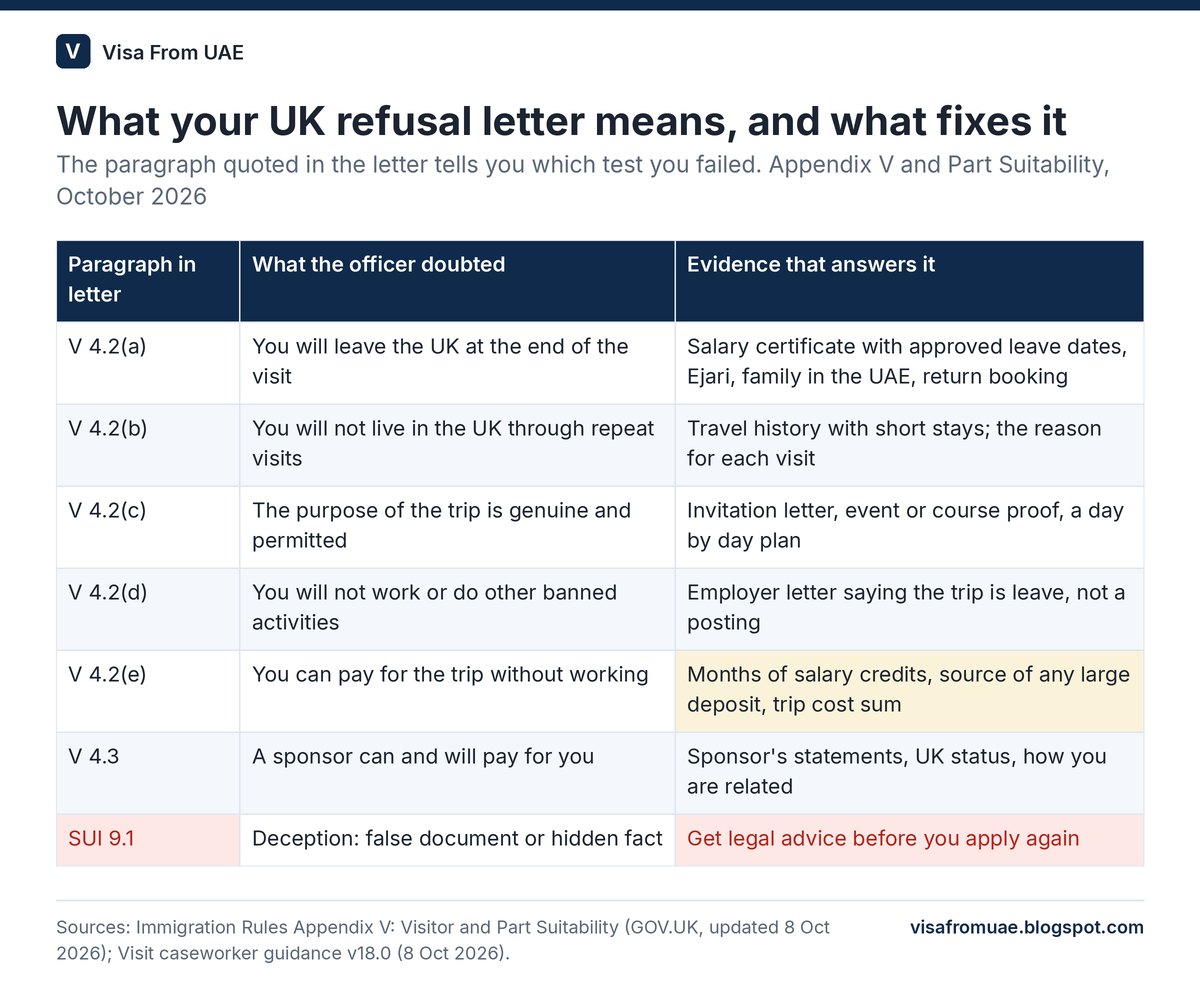
The full text of V 4.2 says the applicant must satisfy the decision maker that they are a genuine visitor, which means they:
- (a) "will leave the UK at the end of their visit"
- (b) "will not live in the UK for extended periods through frequent or successive visits, or make the UK their main home"
- (c) are "genuinely seeking entry or stay for a purpose that is permitted under the Visitor route"
- (d) "will not undertake any of the prohibited activities", which mainly means working
- (e) "must have sufficient funds to cover all reasonable costs in relation to their visit without working or accessing public funds, including the cost of the return or onward journey"
V 4.3 adds the rule for sponsors: someone else can pay your costs only if they have "a genuine professional or personal relationship" with you, are not in breach of immigration law, and "can and will provide support" for the whole stay.
Notice the wording "satisfy the decision maker". The burden is on you. The caseworker guidance tells officers to refuse "if the applicant has not provided sufficient evidence to satisfy you, on the balance of probabilities". So a refusal does not mean the officer thinks you lied. In most letters it means your papers left a question open and nobody asked you to close it. Do not count on UKVI asking you for anything that is missing. Prepare as if the officer will see only what you uploaded.
What the officer was told to look at
The Visit caseworker guidance is the closest thing to the officer's checklist, and it is public. Section 7.2 lists the factors that help an officer decide if you are a genuine visitor:
- your previous immigration history, "including visits to the UK and other countries"
- whether earlier visits ran longer than you said they would
- "their financial circumstances as well as their family, social and economic background"
- "their personal and economic ties to their country of residence", which for you means the UAE, not your passport country
- how much time you have spent in the UK in the last 12 months
- whether your reasons for the trip "are credible and correspond to their personal, family, social and economic background"
Section 7.5 lists reasons for doubt. Two are worth reading slowly if you have family in Britain: an applicant with "few or no family and economic ties to their country of residence" and "several family members in the UK", and "discrepancies between the statements made by the applicant and the statements made by the sponsor". If your brother in Manchester writes that you are coming for three weeks and your form says ten days, that is a discrepancy.
Section 7.3 on travel history has a detail that agency pages get wrong. It says a record of complying with UK law "may indicate the applicant is likely to be a genuine visitor, as might travel to other countries, especially the USA, Canada, Australia, New Zealand, Ireland, Schengen countries or Switzerland". Many Dubai agencies tell refused applicants to take a quick trip to Georgia or Turkey first to "build travel history". Those trips do no harm, but they are not the countries the guidance names.
The money test: why UAE residents fail V 4.2(e)
Section 8.1 of the guidance is the most useful paragraph for anyone refused on funds, because it explains exactly how the officer does the sum. There is "no set level of funds required". Instead the officer looks at the likely cost of your trip and then:
"You must also take into account any ongoing financial commitments the applicant has in their country of residence such as rent / mortgage payments and any dependants who they support financially, including those who are not travelling with them. Their income or savings, minus their financial commitments, must be sufficient to meet the likely costs they will incur in the UK and be reasonable expenditure in light of their financial situation."
Read that with a typical UAE expat budget in mind. Rent is a commitment. School fees are a commitment. So is the money you send home to parents every month, because they are "dependants who they support financially". Many refused applicants list a healthy salary on the form, then mention remittances and rent, and never add up what is left. The officer does.
Here is a worked example. The figures are made up, but the method is the one in section 8.1.
| Monthly picture (illustrative) | AED |
|---|---|
| Salary credited to the account | 12,000 |
| Rent (Ejari in your name) | -3,500 |
| Sent home to parents | -3,000 |
| Living costs, car, phone | -3,000 |
| Left each month | 2,500 |
| 10 day London trip (illustrative) | GBP | AED |
|---|---|---|
| Return flight Dubai to London | 3,000 | |
| Hotel, 10 nights at £120 | 1,200 | 5,915 |
| Food, transport, sights, £60 a day | 600 | 2,960 |
| Visa fee | 135 | 665 |
| Total | 12,540 |
AED converted at the European Central Bank rate of 10 November 2026 (GBP 1 is about AED 4.93), rounded to the nearest AED 5.
With AED 2,500 spare a month, this applicant needs about five months of savings to pay for the trip. If the statement shows a steady balance of AED 13,000 or more that has built up over those months, the sum works. If it shows AED 2,000 that jumped to AED 14,000 the week before applying, the guidance tells the officer what to think: where funds "have not been held in their account for long, you may want to make further checks to establish the origin of this money". On r/ukvisa and in Dubai expat forums this pattern has a name, "funds parking", and it is behind a large share of the refusal letters people post.
The fix is not a bigger number. It is a number that makes sense. Show the salary landing every month, show savings that grew, and if a large amount did come in recently, prove where it came from: a bonus letter from HR, an end of service payment, a car sale agreement, or a transfer from your own savings account with that account's statement. If a sponsor is paying, show their money and their relationship to you under V 4.3, and declare the sponsor on the form. The guidance says undeclared third party money that you cannot show is yours "should not be counted in any assessment".
Our Schengen bank statement guide covers stamped statements and sudden deposits in more detail. The UK officer reads a statement the same way, without the Schengen daily amounts.
Ties to the UAE: the V 4.2(a) problem
V 4.2(a), "will leave the UK at the end of their visit", is the other common line. For a UAE resident the question behind it is simple: what is waiting for you in the UAE when the trip ends? The answer has to be on paper.
- Your job. A salary certificate or employer letter with your title, salary, joining date and the dates of your approved leave. "On leave from 3 to 14 March, expected back 15 March" is much stronger than a generic NOC.
- Your home. Your Ejari or tenancy contract, or your title deed if you own.
- Your family here. If your spouse and children live with you in the UAE and are not travelling, say so and show it. If they are travelling, show the children's school term dates.
- Your residence. Make sure your UAE residence visa and Emirates ID are valid well past the trip. A residence visa that runs out a month after you land in London invites the obvious question.
A short employment history in the UAE is not a reason to refuse on its own, but it weakens this part of the file. Someone who arrived in Dubai four months ago, with a probation period running and most of their family in the UK, matches the profile in section 7.5 almost word for word. In that case the honest fix is often time: apply once you have a confirmed job, a lease and a few months of salary history.
Refusal rates by passport: what the Home Office data shows
Agency pages love to say the UK refuses "many applicants from Dubai". The Home Office publishes the real numbers every quarter, though not by the country you apply from. Its entry clearance dataset (table Vis_D02) counts visitor visa decisions by nationality. I added up issued and refused visitor visas for the passports most common among UAE residents, leaving withdrawn and lapsed cases out.
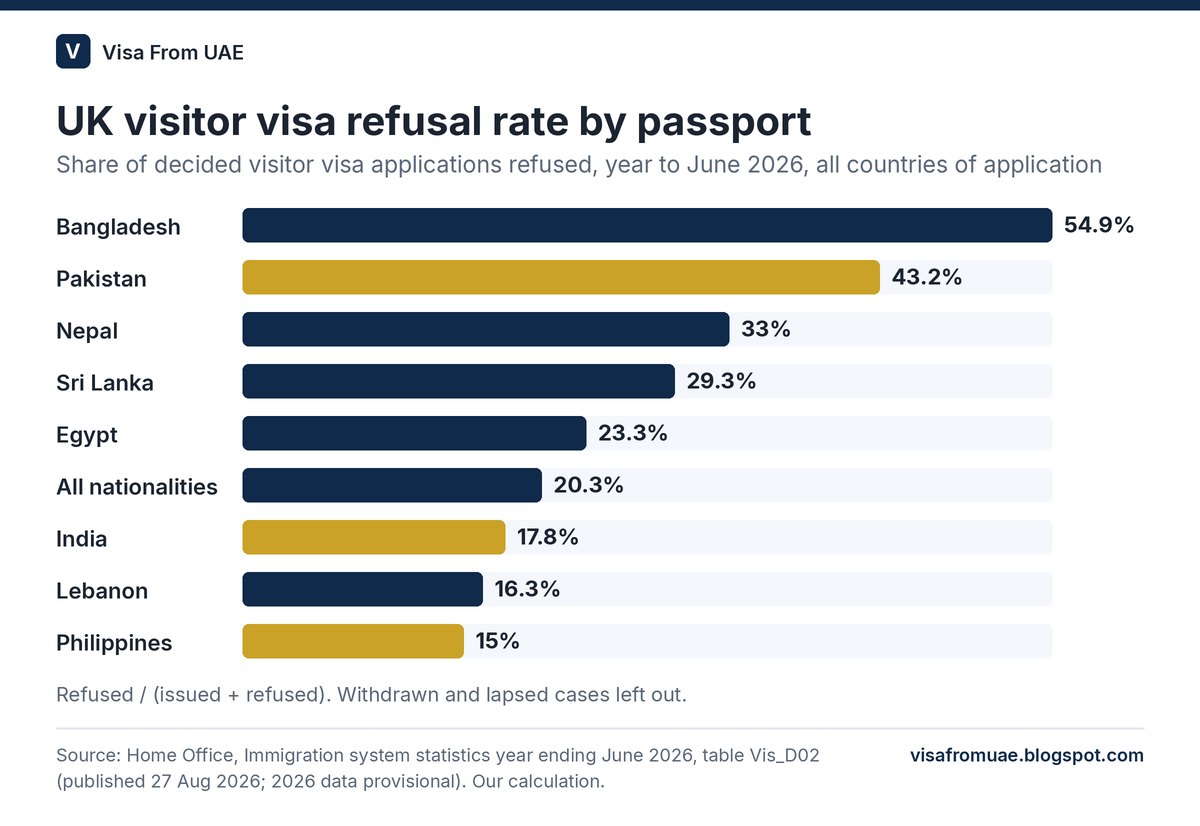
| Passport | 2019 | 2023 | 2024 | 2025 | Year to June 2026 |
|---|---|---|---|---|---|
| India | 11.0% | 18.1% | 16.5% | 18.0% | 17.8% |
| Pakistan | 36.7% | 35.2% | 40.5% | 41.3% | 43.2% |
| Philippines | 10.9% | 15.4% | 13.8% | 13.8% | 15.0% |
| Egypt | 22.2% | 21.4% | 22.3% | 23.7% | 23.3% |
| Bangladesh | 40.0% | 47.8% | 52.3% | 48.6% | 54.9% |
| Sri Lanka | 23.0% | 24.0% | 24.2% | 27.3% | 29.3% |
| Nepal | 24.3% | 25.7% | 33.2% | 29.2% | 33.0% |
| All nationalities | 12.3% | 20.9% | 19.4% | 20.3% | 20.3% |
Refusal rate = refused divided by (issued plus refused), visitor visas only, all application locations. Source: Home Office, Immigration system statistics year ending June 2026, published 27 August 2026. Figures from 2026 Q1 onwards are provisional. The next release is due on 26 November 2026.
Three things stand out. First, one in five visitor visa decisions worldwide is now a refusal, up from about one in eight in 2019. Second, the gap between passports is huge: in the year to June 2026, Pakistani nationals were refused 43.2% of the time and Indian nationals 17.8%, so a Pakistani applicant in Dubai starts with roughly two and a half times the risk. Third, the trend for Pakistani, Bangladeshi and Sri Lankan passports has been rising, not falling.
What the table cannot tell you is how UAE-based applicants do compared with people applying from their home country. The dataset does not split by location. In practice, a UAE residence visa with a steady job and a clean travel record is exactly the "economic ties" the guidance asks about, so a strong UAE file should do better than the national average. But do not read these figures as your personal odds. They are a reason to make the second application stronger than the first, especially on the Pakistani and Bangladeshi passports.
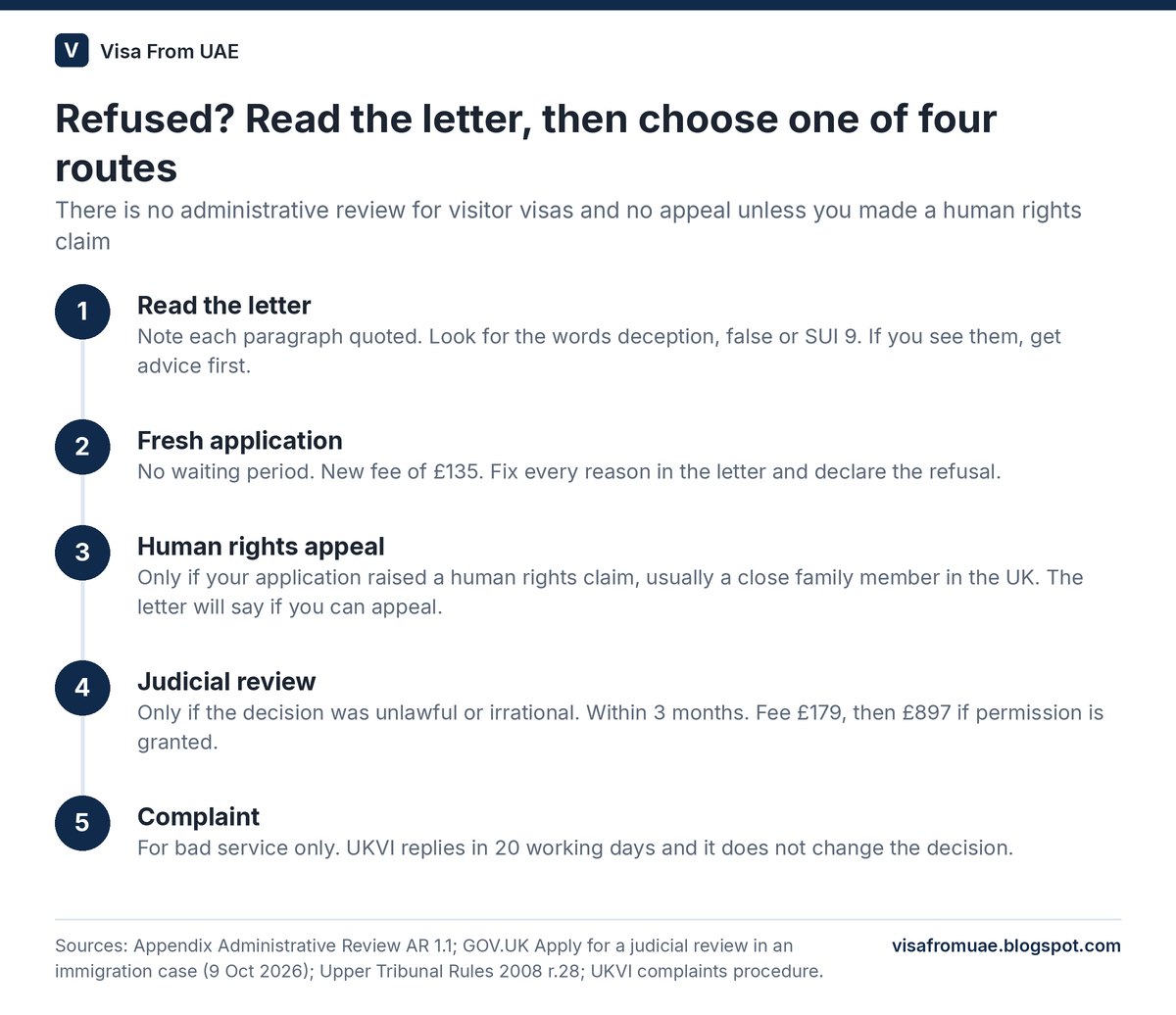
Your options: appeal, review, judicial review or reapply
This is where most confusion comes from, because the words "appeal" and "review" get used loosely online.
Administrative review: not for visitors
GOV.UK has a page on administrative review for people refused outside the UK, with a £80 fee and a 28 day deadline, and it is easy to assume it covers you. It does not. Appendix Administrative Review, paragraph AR 1.1, lists the routes that are eligible: Student, Skilled Worker, Graduate, Global Talent, Youth Mobility and a long list of others. Appendix V: Visitor is not on the list. Your refusal letter will confirm this, because GOV.UK says the letter tells you if you can ask for a review.
Appeal: only with a human rights claim
Visit visa refusals have had no general right of appeal since 2013. The exception is a human rights claim. The Home Office caseworker guidance has two refusal templates for visit visas: a "no right of appeal" letter for most refusals and a "right of appeal" letter for refusals "that attract a right of appeal on human rights grounds". In practice that means a claim under Article 8 (family life), usually for visiting a spouse, a child or another very close relative. OTS Solicitors, citing the Upper Tribunal case Mostafa (2015), notes that only in "very unusual circumstances" will someone other than a close relative get over that threshold. Visiting a cousin for a wedding will not.
Judicial review: lawfulness, not a second opinion
Judicial review is a court challenge to how the decision was made. GOV.UK puts it plainly: "Do not apply for a judicial review if you believe that the decision was wrong, only if you think it was unlawful." Typical grounds are that the officer ignored evidence you sent, got a fact wrong, or reached a decision no reasonable officer could reach.
- Where: the Upper Tribunal (Immigration and Asylum Chamber), form UTIAC1.
- Deadline: the tribunal must receive it "no later than 3 months after the date of the decision" (Upper Tribunal Procedure Rules 2008, rule 28, and GOV.UK). It must also be made "promptly".
- Tribunal fees: £179 to apply (about AED 880), then £897 (about AED 4,420) if permission is granted and the case goes to a hearing. These are the fees on GOV.UK and on the July 2026 tribunal forms. Lawyer's fees come on top, and if you lose you may be ordered to pay the Home Office's costs.
- First step: a "letter before claim" under the pre-action protocol. The protocol says the public body's reply "should normally be sent within 14 days". Sometimes the Home Office agrees to reconsider at this stage, which is the cheapest outcome of the whole process.
Even a win usually just means the Home Office takes the decision again. Several law firms, including the authors of a Latitude Law piece republished on Mondaq, point out that visit decisions are quick and cheap compared with judicial review, so a fresh application is normally the better route. Judicial review makes sense when the refusal is clearly wrong on its own facts and you cannot fix it with new evidence, or when a deception finding is unfair and will follow you for years.
Complaint: for service, not decisions
UKVI's complaints procedure covers things like rude staff or lost documents. It promises a reply within 20 working days. It is not a way to overturn a refusal, and the complaints page itself sends people who are unhappy with a decision to administrative review or appeal instead.
Deception findings: the refusal you must not ignore
Most refusals are about evidence. A small number are about honesty, and those are a different category. Since 11 November 2025 they fall under Part Suitability of the Immigration Rules, which replaced the old Part 9.
- SUI 9.1 (mandatory): an application "must be refused" where the officer is satisfied you used deception by "making false representations or providing false documents or false information", or by "not disclosing relevant facts".
- SUI 10.1 (discretionary): an application "may be refused" where you or a third party made false representations in relation to the application. That third party can be the agent who "prepared" your bank statement or salary letter.
- SUI 12.1, row (f): if you used deception in an application, the mandatory refusal period is 10 years from the date of refusal. For visits it applies to entry clearance applications, which is exactly what a visa from Dubai is.
Some older pages, including ones still ranking for this search, quote paragraph 320(7A) or say non-disclosure only brings a one year ban. Those references come from rules that no longer apply. Check the paragraph numbers in your own letter: if you see "SUI 9", "SUI 10", "deception" or "false", treat it as serious.
The staff guidance also protects genuine mistakes. Officers "must not refuse on grounds of deception or false representations grounds if there may have been an innocent mistake", such as a wrong postcode or a misspelt name. If you think a deception finding came from an error, for example a bank that issued a statement in the wrong format, this is the one situation where paying a regulated UK immigration adviser before you do anything else is money well spent.
The lesson for anyone in the UAE: never use a document that did not come from the person or organisation named on it. A salary certificate typed by a visa agent, a "balance confirmation" from a shop on the same floor as the typing centre, or a hotel booking made and cancelled for the visa are all the kind of thing that turns a refusal into a decade-long problem.
Refused 2 or 3 times? How to break the pattern
Search suggestions show how common this is: "uk visa refused 3 times" comes up when you type "uk visa refused" in the UAE. If you have been refused more than once, the officer is no longer reading one application. They are reading a history, and the guidance tells them to look at "the history of previous applications".
- Lay all the letters side by side. If the same paragraph appears in each, you have not fixed it yet, whatever you added.
- Look for drift. If your salary, job title, trip length or sponsor changed between applications without explanation, that alone can look like a credibility problem. Explain each change in your cover letter.
- Wait for something real to change. A pay rise, a promotion, a permanent contract, a family move to the UAE, or a trip to the US, Canada or Schengen area and back. These are the changes the guidance actually weighs.
- Consider a sponsor's role carefully. If the money is genuinely your brother's in London, show his statements, his status in the UK and your relationship. Do not split the money between you in a way that hides who is really paying.
- Get one paid opinion. After two refusals, an hour with an OISC-registered adviser or a UK solicitor who reads all your letters costs less than a third wasted fee and the extra refusal on your record.
How to apply again from the UAE, step by step
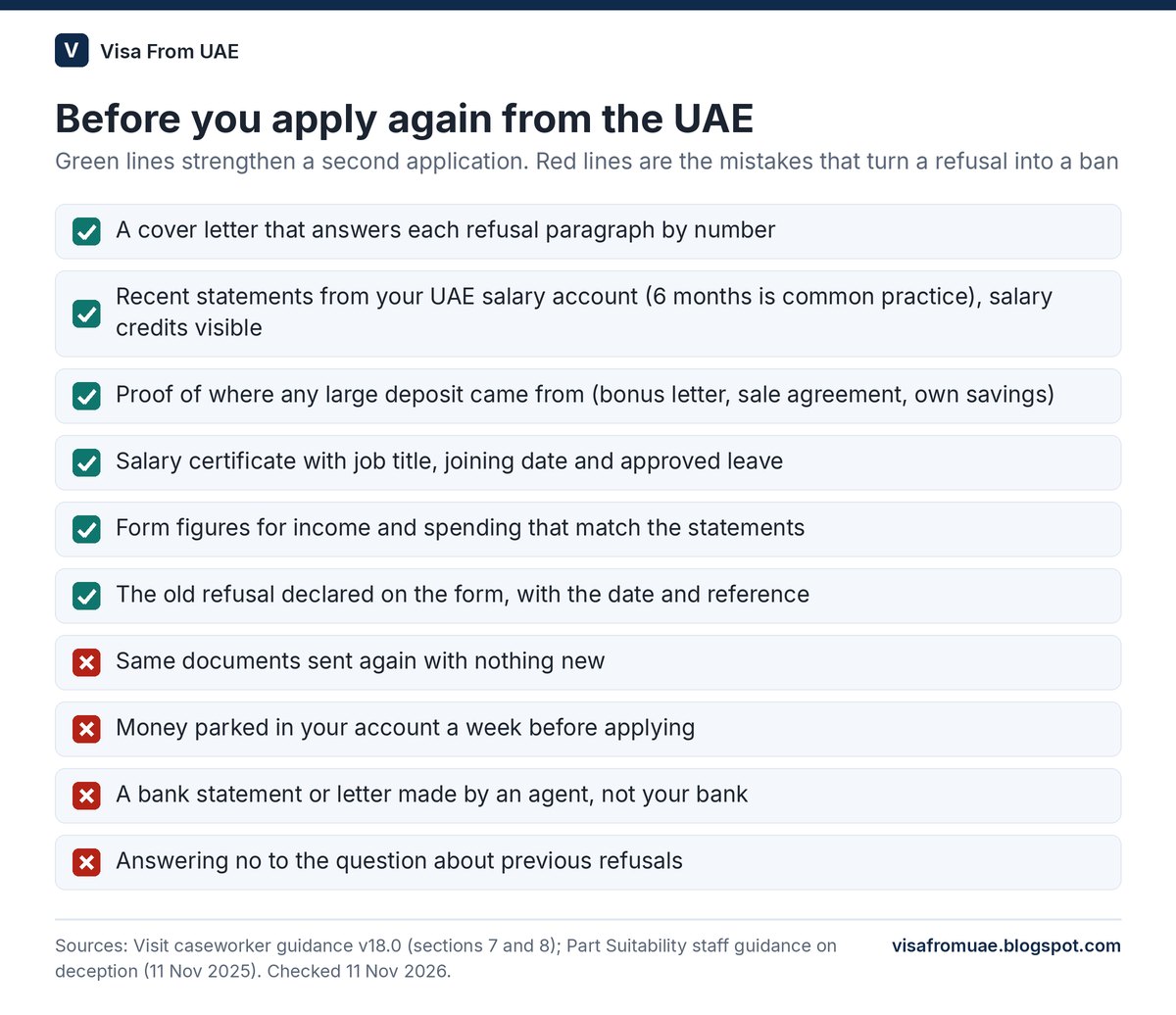
- Answer the letter in writing first. Make a list of every paragraph quoted and every sentence of reasoning. Next to each, write the document that answers it. If a line has nothing next to it, you are not ready.
- Collect new evidence, not more copies. Fresh statements from your salary account up to the week you apply, a new salary certificate with leave dates, proof for any large credit, and the sponsor's papers if relevant.
- Write a one page cover letter. Start with your refusal date and reference. Then take each refusal reason in turn: "The refusal of 2 September said I had not shown the source of AED 9,000 credited on 20 August. This was my annual bonus; the HR letter is attached as document 4." Keep it factual and short.
- Fill in the form on GOV.UK again from scratch. Choose the UAE as the country you are applying from, declare the previous refusal, and make sure income, rent and trip cost figures match your documents. Apply no more than 3 months before you travel.
- Pay £135 and book biometrics at VFS Global in Dubai or Abu Dhabi. The standard appointment is included in the fee; the extras are optional and do not affect the decision.
- Wait for the decision. GOV.UK says you will "usually get a decision on your visa within 3 weeks" once you have applied, given your biometrics and uploaded your documents. Do not buy non-refundable tickets before then.
If you applied for a 2, 5 or 10 year long-term visit visa and were refused, think about applying for the standard 6 month visa (£135) next time. A long-term visa costs £506 to £1,128 and GOV.UK says you may be given "a shorter visa than requested" anyway, so asking for less after a refusal costs you nothing in practice and keeps the fee small if it goes wrong again.
Frequently asked questions
How soon can I reapply after a UK visa refusal from Dubai?
Immediately, if you want. There is no waiting period in the rules. The useful question is whether your evidence has changed. If the refusal was about a missing document, you can reapply as soon as you have it. If it was about savings or job history, you need time for those to change.
Can I appeal a UK visit visa refusal?
Only if your application included a human rights claim, usually to visit a spouse or child, and the refusal letter says you have a right of appeal. Otherwise there is no appeal and no administrative review. Your options are a fresh application or judicial review within 3 months.
My UK visa was refused because of my bank statement. What should I do?
Work out what the officer could not see. Usually it is one of three things: a balance that does not match your salary, a recent large deposit with no explanation, or monthly commitments such as rent and money sent home that leave too little for the trip. Fix the one that applies, prove the source of any large credit, and show the trip cost sum in your cover letter.
Do I have to declare a previous UK visa refusal?
Yes. The form asks, and the Home Office treats a hidden refusal as non-disclosure, which can lead to a deception refusal and a 10 year ban. Declare it with the date and reference number.
Will a UK refusal affect my Schengen or US visa?
It is not an automatic bar anywhere. Some other countries' forms ask whether you have ever been refused a visa by any country, and you must answer truthfully. A refusal that you have since fixed, followed by a granted UK visa, tells a much better story than an unexplained one.
Do I get my £135 back if I am refused?
No. GOV.UK says the fee is not refunded if the application is refused or if you get a shorter visa than you asked for.
Should I pay for judicial review?
Only if you can point to a legal error, such as the officer ignoring documents you clearly sent, and a fresh application cannot fix it. The tribunal fees alone are £179 and then £897, and legal costs are usually much higher. For most refusals a better second application is cheaper and faster.
More country guides and checklists are on our Visa from UAE guides page. If you were refused a Schengen visa instead, see what to do after a Schengen refusal in the UAE, where the appeal routes are very different.
Official sources
- Immigration Rules Appendix V: Visitor (GOV.UK, updated 8 October 2026), paragraphs V 4.2 and V 4.3
- Home Office: Visit caseworker guidance, version 18.0 (8 October 2026), sections 6, 7 and 8
- Immigration Rules Part Suitability (GOV.UK, updated 8 October 2026), SUI 9, 10, 11 and 12
- Home Office: Part Suitability guidance on deception, false representations and non-disclosure (11 November 2025)
- Immigration Rules Appendix Administrative Review, AR 1.1 eligible routes
- GOV.UK: Ask for a visa administrative review
- GOV.UK: Apply for a judicial review in an immigration or asylum case (updated 9 October 2026)
- Tribunal Procedure (Upper Tribunal) Rules 2008, rule 28: 3 month time limit
- Ministry of Justice: Pre-Action Protocol for Judicial Review
- UK Visas and Immigration: Complaints procedure
- GOV.UK: Visit the UK as a Standard Visitor (fees, refunds, decision times)
- Home Office: Immigration system statistics data tables, entry clearance outcomes year ending June 2026 (Vis_D02)
- OTS Solicitors: What should you do if your UK Standard Visitor visa is refused? (law firm, not official)
- Latitude Law via Mondaq: Addressing visit visa refusals (law firm, not official)
- European Central Bank: Euro reference exchange rates (10 November 2026)
Rules, guidance, fees and statistics were read on 11 November 2026. AED figures use the ECB rate of 10 November 2026 and the dirham's fixed rate of 3.6725 to the dollar, so GBP 1 is about AED 4.93. Refusal rates are our own calculation from the Home Office dataset and are by nationality, not by the country where the application was made; 2026 figures are provisional. The money example is illustrative, not a real case. This guide is general information, not legal advice: if your refusal mentions deception, or you are thinking about judicial review, speak to a regulated UK immigration adviser. See our Disclaimer.
Last updated: November 11, 2026