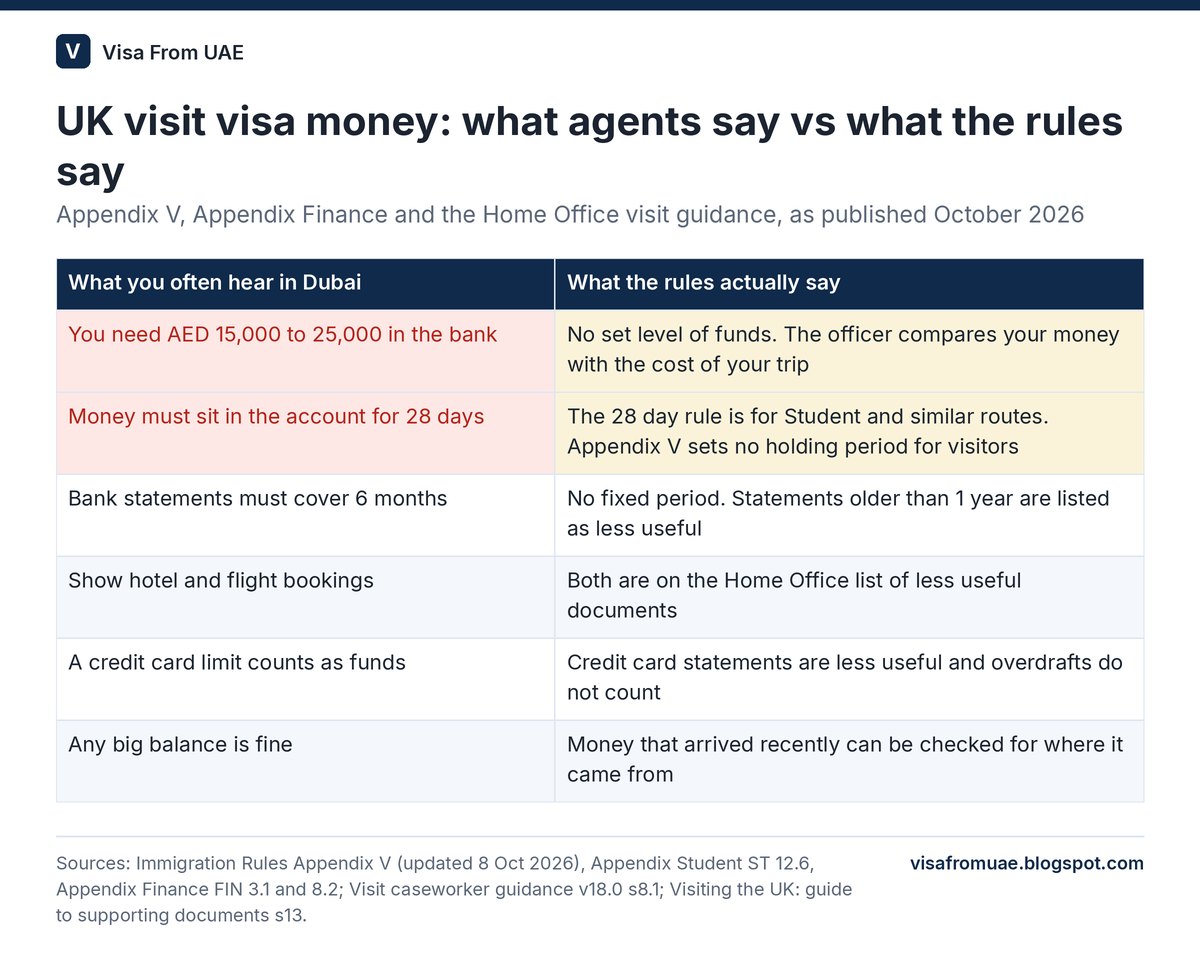
"How much should I keep in my account for a UK visit visa?" is the money question every Dubai and Abu Dhabi resident asks before applying, and it gets a different answer from every typing centre. One agent says AED 15,000. Another says AED 25,000 and it must sit there for 28 days. A third says six months of stamped statements or you will be refused. None of those numbers appear in the UK's visitor rules.
For this guide I went back to the documents UK visa officers actually work from: Appendix V of the Immigration Rules (updated 8 October 2026), Appendix Finance, the Home Office's Visit caseworker guidance (version 18.0, 8 October 2026) and the official GOV.UK guide to supporting documents for visitors, which was also updated on 8 October 2026. I then compared them with what the top "UK visa bank balance" pages tell people, and with the money questions UAE residents post after a refusal. The short version is that there is a test, it is a sum rather than a threshold, and you can do the sum yourself before you pay the fee. If you need the full application walkthrough first, read our UK visit visa from UAE guide.
Short answer: There is no minimum bank balance for a UK Standard Visitor visa. The Home Office tells its officers there is "no set level of funds required". Instead the officer works out what your trip will cost, looks at your income, takes away your rent, loans and the money you send to family, and checks that what is left covers the trip and makes sense for someone on your salary. As a rough guide, one adult spending 10 nights in a London hotel needs about AED 12,500 for the whole trip (our illustration below), on top of normal monthly commitments. The 28 day rule you hear about is for students and some work routes, not visitors. Show statements from the account your salary is paid into, ending within a month of applying, and be ready to prove where any large deposit came from.
Is there a minimum bank balance for a UK visit visa?
No. This is the one point where the official sources and the better law firms all agree. The Visit caseworker guidance, section 8.1, says it plainly: "There is no set level of funds required for an applicant to show this." Richmond Chambers, a firm of UK immigration barristers, puts it the same way in its guide on visit visa finances: "there are no financial requirements or mandatory evidence for a visitor visa application". A Y and J Solicitors, writing in January 2026, says "There is no fixed minimum bank balance for UK tourist visa."
What the rules do require is in paragraph V 4.2(e) of Appendix V. You must show you "have sufficient funds to cover all reasonable costs in relation to their visit without working or accessing public funds, including the cost of the return or onward journey, any costs relating to their dependants, and the cost of planned activities". The same paragraph adds one technical condition that many guides leave out: the money must be "held in a financial institution permitted under FIN 2.1 in Appendix Finance". I explain what that means for UAE bank accounts further down.
So when a Dubai agent quotes you a fixed number, ask where it comes from. It is usually a rule of thumb from their own past files, which is not useless, but it is not the test the officer applies. A person earning AED 6,000 a month who suddenly shows AED 40,000 can be refused. A person earning AED 20,000 a month with AED 14,000 in the bank and a short trip planned can be approved. The balance only means something next to your income and your plans.
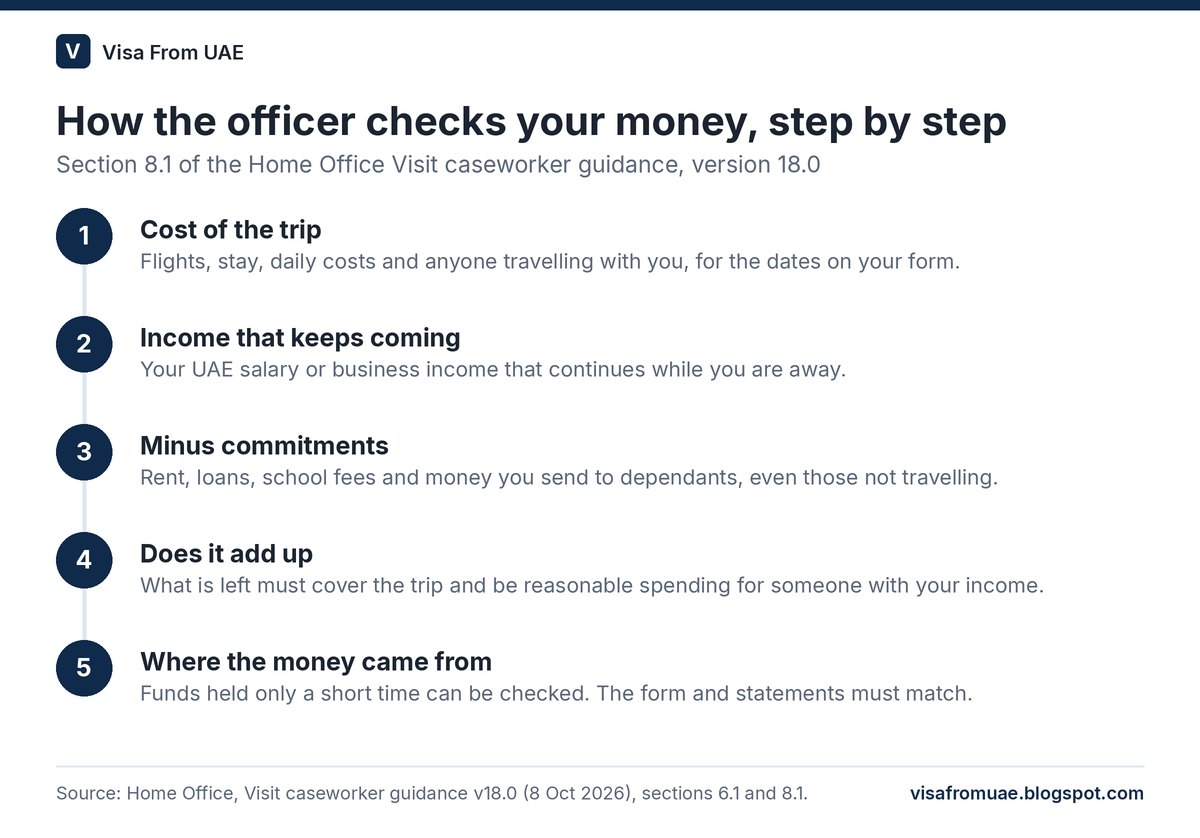
How the officer decides if you have enough money
Section 8.1 of the caseworker guidance is short, and it is worth reading in full because it is the officer's method. They are told to "consider the likely cost of their stay and assess any sources of revenue that will continue to be available to the applicant whilst they are visiting the UK". Then comes the part that catches UAE residents:
"You must also take into account any ongoing financial commitments the applicant has in their country of residence such as rent / mortgage payments and any dependants who they support financially, including those who are not travelling with them. Their income or savings, minus their financial commitments, must be sufficient to meet the likely costs they will incur in the UK and be reasonable expenditure in light of their financial situation."
Two phrases matter here. "Minus their financial commitments" means the officer is not looking at your balance in isolation. Your rent in Dubai keeps running while you are in London, and so does the money you send to parents in Kerala, Lahore or Manila. "Reasonable expenditure in light of their financial situation" means a trip can be refused even if you can technically afford it, when it would swallow most of your savings. Richmond Chambers makes the same point: an expensive trip compared with your regular income can lead to a refusal unless you explain how it is being paid for.
The guidance also tells the officer to compare your form with your papers. Section 6.1 says there "should be a correlation between the information applicants have declared on their application form (such as income, large account deposits and / or support received by family / friends), and the actual evidence provided". If the form says you earn AED 12,000 and the statement shows AED 8,500 arriving each month, the officer will notice before they notice anything else.
How much money to show: work out your own number in AED
Because there is no fixed figure, the useful thing is to calculate yours the way the officer will. Start with the trip itself. Below is an illustration for one adult, using round numbers: a return flight from Dubai of AED 3,000, a hotel at £120 a night, £60 a day for food, transport and sights, and the £135 visa fee. Pounds are converted at the European Central Bank reference rates for 11 November 2026, which put £1 at about AED 4.89.
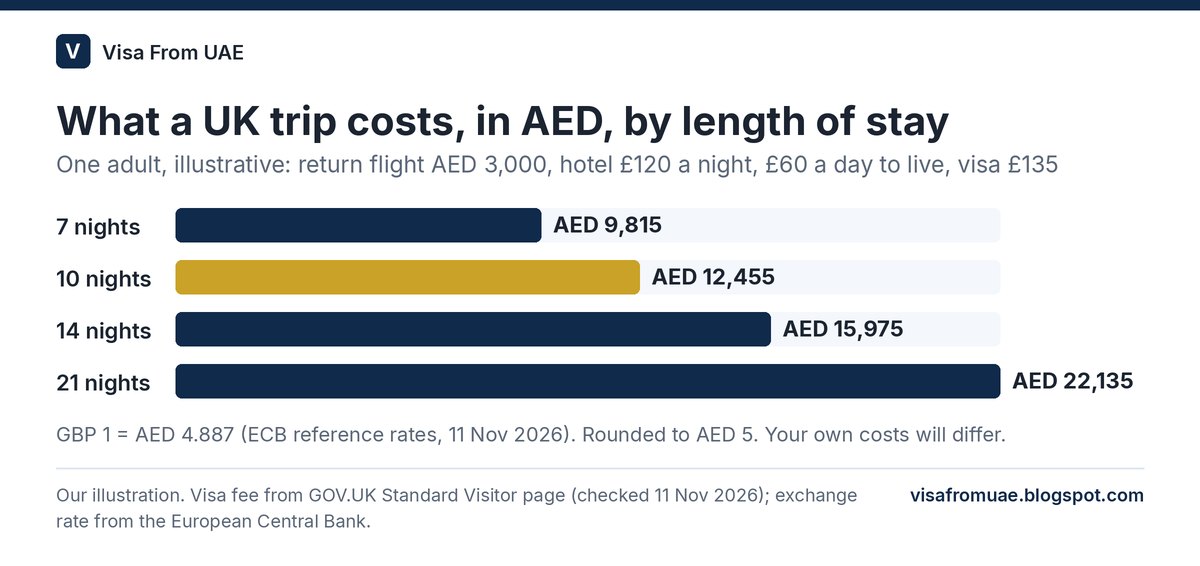
Is £120 a night realistic? It is a mid-range figure, not a quote, and London will often cost more. For a sense of what real visitors spend, VisitBritain's market page for the UAE says the UK received 374,000 visits from the UAE in 2024, with total spending of £613.2 million, an average of £1,641 per visit, or roughly AED 8,020. That figure does not include the flight to the UK, and VisitBritain notes it comes from the International Passenger Survey, which is still badged "official statistics in development", with revised 2024 estimates released in September 2026. Treat it as a reality check, not a target.
Then do the second half of the officer's sum: what you have left after commitments. Here are three common UAE situations. The figures are made up to show the method; they are not real cases and they are not approval thresholds.
| Illustrative profile | Single, salaried | Couple with two children | Business owner |
|---|---|---|---|
| Monthly income into the account | AED 9,000 | AED 28,000 | AED 35,000 (average drawings) |
| Rent | AED 2,500 (shared flat) | AED 9,000 | AED 10,000 |
| Sent home to family | AED 2,500 | AED 3,000 | AED 5,000 |
| Other living costs, loans, school | AED 2,500 | AED 10,000 | AED 10,000 |
| Left each month | AED 1,500 | AED 6,000 | AED 10,000 |
| Planned trip | 7 nights alone, about AED 9,800 | 10 nights, family of four, roughly AED 35,000 to 40,000 | 14 nights alone, about AED 16,000 |
| Savings that make the sum work | About AED 10,000 or more, built up over months | About AED 40,000 or more | About AED 16,000 or more, plus business papers |
Illustration only. The family trip figure assumes two hotel rooms or a family room and four flights, so it is a range rather than a single number.
Look at the single applicant. AED 10,000 in the bank sounds modest, but if the statements show it growing by AED 1,000 to 1,500 a month, it matches the salary and the trip, and the story is easy to believe. Now imagine the same person with AED 30,000 in the bank, most of which arrived in two transfers last week. The bigger balance is the weaker application, because it raises the question in the next section.
Large deposits, "funds parking" and borrowed money
The caseworker guidance has one sentence on this, and every refused applicant should know it: "Where an individual provides documents which show sufficient funds for their planned stay, but either all or most of these funds have not been held in their account for long, you may want to make further checks to establish the origin of this money."
Notice what it does not say. It does not say recent money is banned, and it does not say money must be held for 28 days. It says the officer may check where it came from. On r/ukvisa and in UAE expat groups this pattern is called "funds parking": a friend or relative transfers a lump sum to make the balance look healthy, and it goes back after the decision. A Y and J Solicitors warns that "A single large credit that appears a few days before you apply looks like borrowed money." The supporting documents guide asks for exactly the opposite: "bank statements which detail the origin of the funds held".
There are plenty of honest reasons for a large recent credit in the UAE, and each has a paper trail:
- Annual bonus or commission. A letter or payslip from HR showing the amount and the date paid.
- End of service gratuity after changing jobs. The final settlement from the old employer.
- Car or property sale. The sale agreement and the transfer record.
- Moving your own savings. The statement of the account the money came from, showing it was yours before it moved.
- A gift from family. A signed letter from the person giving it, their own statement showing the money left their account, and proof of the relationship. If they are paying for your trip rather than giving you money, they are a sponsor and should be declared as one (see below).
Cash deposits deserve a special mention because many UAE workers are still paid partly in cash or keep savings at home. A cash deposit is not illegal and is not listed as a reason to refuse, but it has no visible source. If you deposit AED 15,000 in cash before applying, expect the officer to ask where it came from, and have an answer on paper. Depositing it in one go a week before applying is the worst way to do it.
Borrowed money is different. A balance that is not really yours, presented as if it were, is not only weak evidence. Undeclared third party money that you cannot show is genuinely yours "should not be counted in any assessment", says section 8.1, and a false picture of your finances can move the case from an ordinary V 4.2(e) refusal to a deception finding under Part Suitability, which can bring a ban of up to 10 years. Our guide to reapplying after a UK refusal explains how those deception findings work.
The 28 day rule: it is not for visitors
Several of the top pages for this search say the money "must sit in your bank account for 28 consecutive days before you apply". That rule is real, but it belongs to other routes. Appendix Student, paragraph ST 12.6, says a student "must show that they have held the required level of funds for a 28-day period and as specified in Appendix Finance". Skilled Worker and several other routes have similar wording. Appendix V has no holding period at all, because it has no required level of funds to hold.
Why does the myth survive? Partly because the same agencies handle student and visit files, and partly because "keep the money there for a while" is sensible advice anyway. The officer is told to look harder at money that has "not been held in their account for long". So the honest answer is: there is no 28 day rule for visitors, but money that has been there for months is always easier to explain than money that arrived last week.
Bank statements: how many months, how recent, and do they need a stamp?
How many months. No rule sets a number. The GOV.UK supporting documents guide lists bank statements as a document you "might want to provide" and does not give a period. In practice, six months is what most advisers ask for. A Y and J Solicitors recommends "bank statements covering at least the last 6 months", and that is also what most applicants in the UAE send. Six months is a sensible default because it shows six salary credits and how your balance moves across them. If you changed jobs or banks recently, send the old account too so the pattern is visible.
How recent. The visitor rules set no date limit, but Appendix Finance does, and Appendix Finance lists the Visitor route among the routes it applies to. FIN 7.1 says "the most recently dated piece of financial evidence must be dated within 31 days before the date of application". The supporting documents guide separately lists "bank statements or letters issued more than 1 year before the date of application" as less useful. The safe approach is simple: download your statements in the week you submit, so the closing date is as close to the application date as possible.
Stamps. Neither the supporting documents guide nor the caseworker guidance asks for stamped bank statements for UK visits. Stamping is a Schengen habit; some Schengen consulates in the UAE insist on it, as we covered in our Schengen bank statement guide. For the UK, what matters is that the statement is genuine and can be checked. The caseworker guidance tells officers that if they doubt a document "you should try to verify it at source". A bank-issued PDF or a statement collected from the branch is fine. A statement "prepared" by an agent is not.
Language. If a statement or letter is not in English or Welsh, the supporting documents guide says it "must be accompanied by a full translation that can be independently verified by the Home Office", with the translator's confirmation that it is accurate, the date, the translator's full name and signature, and their contact details. Most UAE bank statements are issued in English, but check any Arabic-only salary certificates or trade licence pages.
Which accounts and funds count
This is where Appendix Finance matters. V 4.2(e) points to FIN 2.1, and the rest of the appendix covers the kind of money that counts. The parts relevant to a UAE resident:
- The bank must be checkable. FIN 2.1 says funds "will not be considered" if the officer cannot make "satisfactory verification checks", if the institution is not regulated in its own country, or if it "does not use electronic record keeping". A normal account with a bank licensed by the UAE Central Bank should meet this. Money held through an informal arrangement does not.
- Overdrafts do not count. FIN 3.1: "Overdraft facilities will not be counted towards meeting financial requirements."
- Credit cards, shares and locked money do not count as funds. FIN 8.2 excludes "shares, bonds, credit cards" and pensions that cannot be withdrawn immediately. FIN 8.1 allows current, savings, deposit and investment accounts "provided the account allows the funds to be accessed immediately". A fixed deposit you cannot break without notice may not count, so if your savings sit in one, show the current account as well.
- Joint accounts are fine. FIN 5.1 allows accounts in the applicant's name "either alone or as a joint account holder".
- The exchange rate is the officer's, not yours. FIN 1.1 says money in a foreign currency is converted to pounds "using the spot exchange rate which appears on www.oanda.com for the date of the application". The dirham is pegged to the dollar, so the AED value in pounds only moves with the pound to dollar rate, but do your sum on the day you apply rather than using an old rate.
Money in your home country counts too, as long as the same tests are met. If your savings are in India, Pakistan or the Philippines and your salary is in the UAE, send both statements and explain in one line why you keep money in two places. It is common, and officers know it is common, but they should not have to guess.
What to send, and what not to send
The supporting documents guide is the official list, and it is shorter and more specific about money than most agency checklists. For financial evidence it asks for documents that "clearly show that you have access to the funds", such as bank statements that detail the origin of the funds and "proof of earnings, such as a letter from your employer confirming employment details (start date of employment, salary, role, company contact details)". If you are self-employed, it suggests "business registration documents or recent invoices that confirm on-going self-employment", which in the UAE usually means your trade licence and recent invoices or company statements.
Section 13 of the same guide lists "documents you should not use as evidence", which it describes as "less useful". Several of them are on almost every Dubai agency checklist:
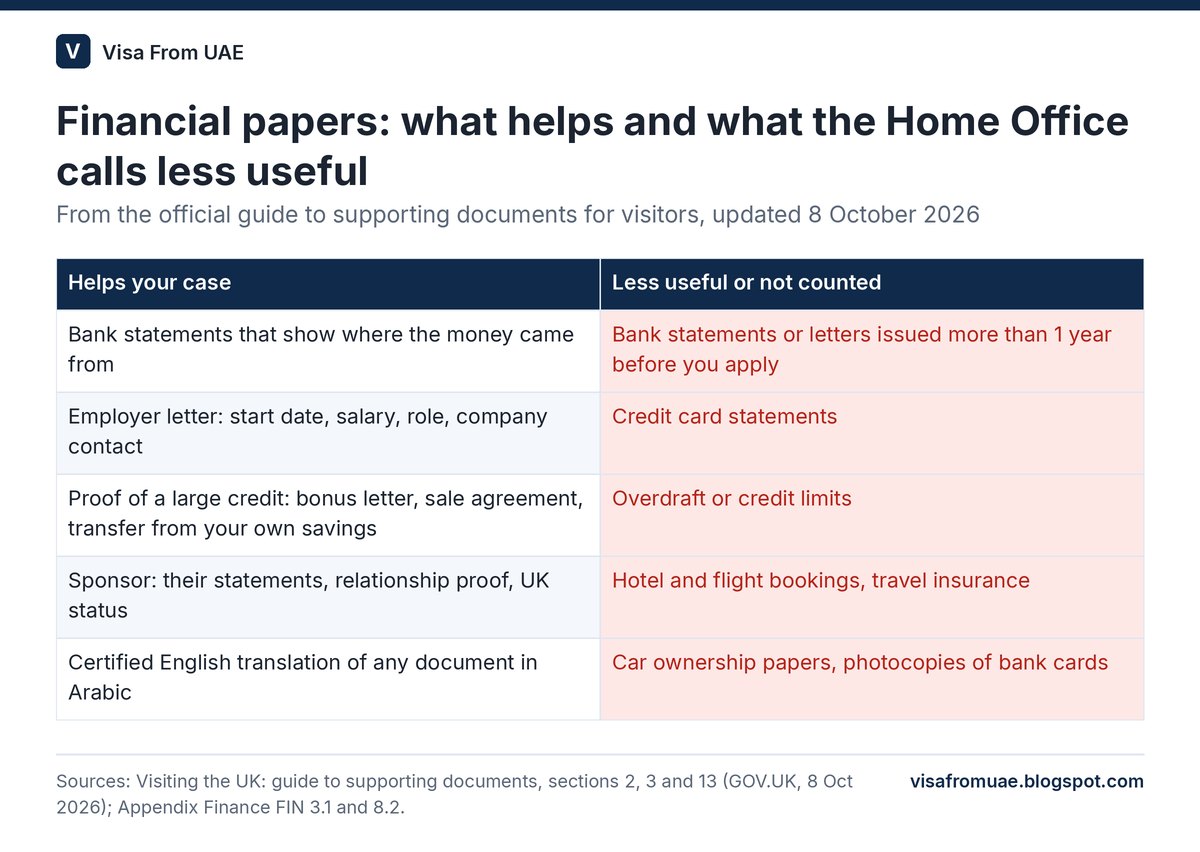
The full "less useful" list also includes driving licences, personal photographs, notarial certificates, business cards, photocopies of bank cards, sports certificates, travel insurance, and a sponsor's utility or council tax bills. Sending them will not get you refused, but it will not help, and a file stuffed with paper can hide the one document that matters. The caseworker guidance also says that not sending a recommended document "is not of itself a ground for refusal", which is a reminder that the officer is judging the overall picture, not ticking boxes.
When someone else pays: sponsor rules
A family member or friend can pay for your trip, whether they live in the UK or in the UAE. V 4.3 allows it only if that person has "a genuine professional or personal relationship" with you, is not in breach of UK immigration law, and "can and will provide support" for the whole stay. The common UAE cases are a spouse paying for a non-working partner, a parent paying for an adult child, or a brother or son in the UK hosting a parent.
The supporting documents guide says your sponsor's evidence should show what support is being given, how it is being given, that they "have enough funds to adequately support themselves and their dependents", your relationship, and their legal status in the UK if they live there. The caseworker guidance, section 8.2, tells officers they may check "where and how they met" and "how often and by what method they communicate", and they may look at the sponsor's history of sponsoring other visitors.
The sponsor's money is judged with the same sum as yours. A brother in Birmingham with a family of five, a mortgage and £2,000 in his account is not a strong sponsor for a three week trip, however close you are. A sponsor letter should say who is paying for what (for example: "my sister will stay in my home in Leeds and I will pay for her food and travel inside the UK; she is paying her own flights"), and the numbers in that letter should match the numbers on your form.
Two mistakes come up again and again in refusal letters people share online:
- Not declaring the sponsor. If a relative's money is in your account but the form says you are paying, section 8.1 says that money "should not be counted in any assessment" unless you can show it is really yours.
- Stories that do not match. Section 7.5 lists "discrepancies between the statements made by the applicant and the statements made by the sponsor" as a reason to doubt a visitor. Agree the dates, the purpose and who pays before either of you writes anything.
Children are treated differently. Section 8.1 says a child visitor is "not expected to have funds in their own name" and can rely on a parent or third party, so for a family application the parents' statements cover everyone.
Your money pack, step by step
Put together, a strong financial section for a UAE resident looks like this. It is short, every document answers a question the officer will ask, and nothing in it needs explaining away.
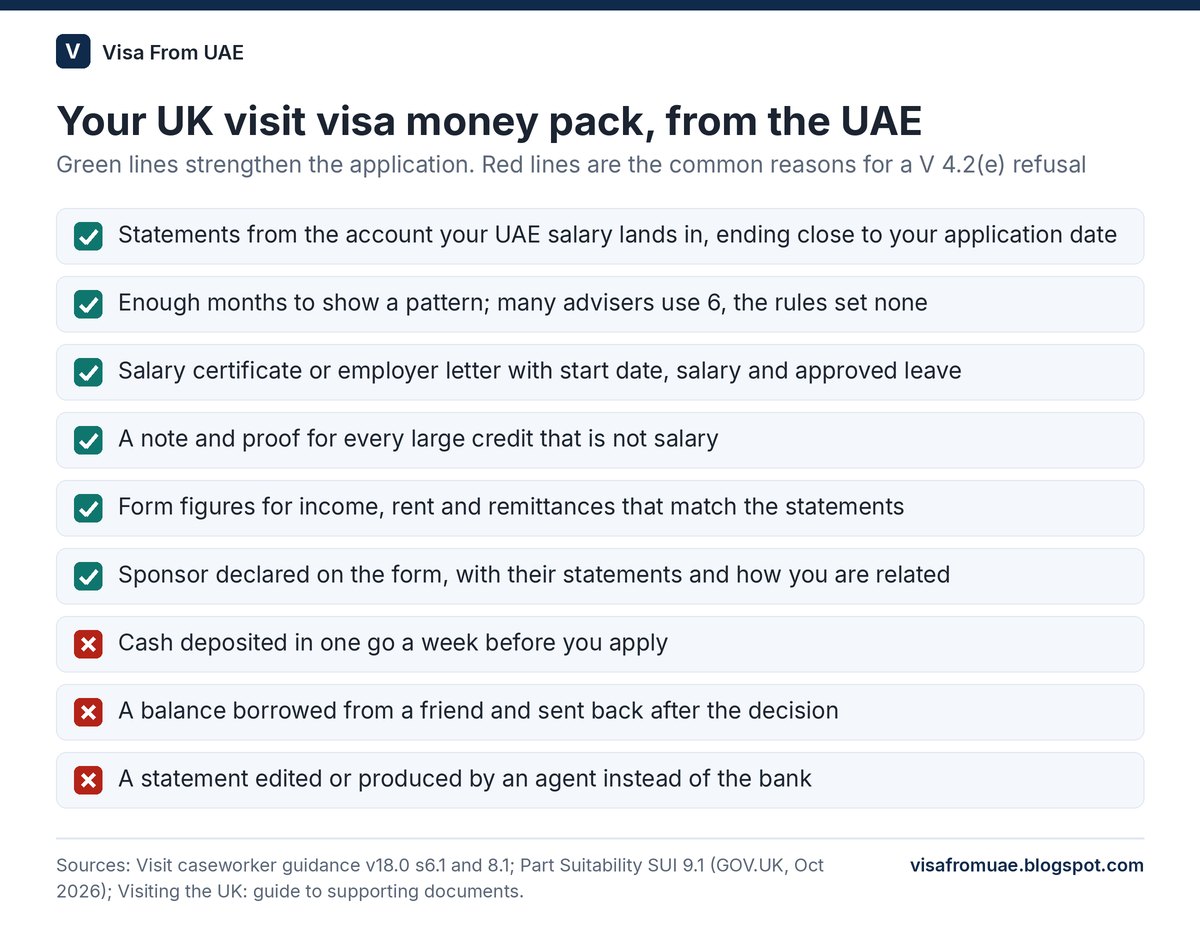
- Do the sum first. Price the trip for your real dates and the people travelling. Write down your monthly income and your monthly commitments, including remittances. If what is left plus your savings does not cover the trip with room to spare, change the trip (shorter, cheaper, or with a declared sponsor) rather than the bank balance.
- Fill in the form honestly and consistently. The income, the amount you spend each month and the amount you send to family should match what the statements show. Round numbers are fine; contradictions are not.
- Download statements in the week you apply. Use the account your salary is paid into. Six months is the usual choice. Add any savings account you are relying on.
- Explain every large credit. One line in your cover letter plus the proof: bonus letter, sale agreement, statement from the account the money came from.
- Add proof of income. An employer letter with your start date, salary, role and company contact details, ideally with your approved leave dates. Business owners add the trade licence and recent invoices or company statements.
- If someone is paying, declare them. Their letter, their statements, proof of your relationship and, if they live in the UK, proof of their status.
- Leave out the clutter. No credit card statements, no car papers, no hotel or flight bookings unless you are transiting.
Then check the rest of your application against the other parts of the genuine visitor test. Money is only V 4.2(e). If your ties to the UAE are thin, a perfect bank statement will not save the application on its own; the same reapplying guide covers how officers judge those ties. The fee for a standard six month visitor visa is £135 (about AED 660), it is not refunded if you are refused, and GOV.UK says you will usually get a decision within 3 weeks once you have applied online, proved your identity and provided your documents.
Does your passport change how much you need?
No. The rules are the same for every nationality: there is no higher balance for Indian, Pakistani, Filipino or Egyptian passport holders. What does differ is how often each nationality is refused. From the Home Office's own visa data for the year to June 2026, Pakistani nationals were refused UK visitor visas about 43 percent of the time and Indian nationals about 18 percent of the time; our refusal guide has the full chart. Those figures are for each nationality worldwide, not only for applications made in the UAE. A higher refusal rate does not mean you need a bigger number; it means officers are likely to read your file more carefully, so the consistency of your money story matters even more.
Living in the UAE helps here. Your country of residence is where the officer looks for ties and income, and a stable UAE salary with a valid residence visa is the kind of evidence section 7.2 of the guidance asks for when it mentions "personal and economic ties to their country of residence".
Frequently asked questions
How much bank balance do I need for a UK visit visa from Dubai?
There is no fixed amount. You need enough to cover the whole trip after your normal monthly commitments, and the balance has to make sense for your income. As an illustration, a 10 night hotel trip for one adult comes to about AED 12,500 including flights and the visa fee.
Is AED 10,000 enough for a UK visit visa?
It can be, for a short trip if your income supports it and the money has built up from your salary. It can also be too little, for example for a two week family trip or if most of your salary goes on rent and remittances. Do the sum in this guide with your own figures.
Do I need to keep money in my account for 28 days?
Not for a visit visa. The 28 day rule is in Appendix Student and some work routes. Visitors have no holding period, but officers can check the origin of money that has not been in your account for long.
How many months of bank statements do I need?
The rules do not set a number. Six months is what most advisers recommend and what most UAE applicants send. Make sure the latest statement is very recent; Appendix Finance asks for the most recent evidence to be dated within 31 days of applying.
Do UK visit visa bank statements need to be stamped?
No such requirement appears in the GOV.UK supporting documents guide or the caseworker guidance. The statement must be genuine and checkable. Stamped statements are mainly a Schengen requirement.
Can my husband or wife's bank statement be used?
Yes. A joint account counts as yours. If the account is only in your spouse's name, they are supporting you, so show their statements, your marriage certificate and a short letter from them, and say on the form that they are paying.
My UK visa was refused under V 4.2(e). What now?
Find out which part of the sum failed: not enough money left after commitments, money with no explained source, or figures on the form that did not match the statements. Fix that part with new evidence before reapplying, and declare the earlier refusal. Our UK refusal guide walks through each paragraph of the refusal letter.
Can my sponsor in the UK pay for everything?
Yes, if they have a genuine relationship with you, are lawfully in the UK, and can show they have enough money for themselves, their own family and you. Send their statements, proof of their UK status and proof of your relationship, and make sure their letter matches your form.
More country guides and checklists are on our Visa from UAE guides page. If you are planning a Schengen trip as well, the money rules there are different and some countries do set a daily amount; see the Schengen bank statement guide for UAE residents.
Official sources
- Immigration Rules Appendix V: Visitor (GOV.UK, updated 8 October 2026), paragraphs V 4.2(e) and V 4.3
- Immigration Rules Appendix Finance (GOV.UK), FIN 1.1, 2.1, 3.1, 5.1, 7.1, 8.1 and 8.2
- Immigration Rules Appendix Student, ST 12.6 (the 28 day rule)
- Home Office: Visit caseworker guidance, version 18.0 (8 October 2026), sections 6.1, 7, 8.1 and 8.2
- GOV.UK: Visiting the UK, guide to supporting documents (updated 8 October 2026)
- GOV.UK: Visit the UK as a Standard Visitor (fees and decision times)
- VisitBritain: Inbound market data, United Arab Emirates (2024 estimates)
- Richmond Chambers via Legal 500: The role of finances in UK visit visa applications (barristers, not official)
- A Y and J Solicitors: How much bank balance is required for a UK visit visa (law firm, not official)
- European Central Bank: Euro reference exchange rates (11 November 2026)
Rules, guidance, fees and statistics were read on 11 November 2026. AED figures use the ECB reference rates of 11 November 2026 and the dirham's fixed rate of 3.6725 to the dollar, so £1 is about AED 4.89; the Home Office itself converts using the OANDA rate on your application date. The trip costs and salary profiles are illustrations, not real cases or approval thresholds. This guide is general information, not legal advice: if your refusal mentions deception or false documents, speak to a regulated UK immigration adviser. See our Disclaimer.
Last updated: November 11, 2026