A Canada refusal usually lands on a weekday morning as a notice in your IRCC account. You open a one page letter, see "paragraph 179(b)" and a ticked line about family ties, and wonder what you did wrong. You had a job in Dubai, a lease, money in the bank and a sister waiting in Mississauga. Then the questions start. Can you apply again straight away? Should you appeal? Is a friend right that you now have to wait six months?
I wrote this guide for UAE residents who are in that spot. For it I read the regulation behind most refusals (section 179 of the Immigration and Refugee Protection Regulations), IRCC's own refusal letter template, its "If your application was refused" page, its officer decision notes page and its fee list, all on 15 November 2026. I also pulled IRCC's processing time data, checked the court deadline in the Act, and went through forum threads and agency pages written for Dubai and Abu Dhabi applicants to see where people go wrong. If you have not applied yet, start with our Canada visitor visa guide for UAE residents. This post is about what happens after a no.
Short answer: Yes, you can apply again from the UAE, and there is no waiting period. There is also no appeal for a visitor visa. Your real options are a stronger new application or, if the officer made a legal error, judicial review in the Federal Court within 60 days. Read the officer decision note that now comes with most refusals, fix each reason it gives, declare the refusal on the new form, and pay the fees again: CAD 100, about AED 258, plus CAD 85 for biometrics only if yours are more than 10 years old. Applications made from the UAE took 48 days on IRCC's data of 12 November 2026.
Can you apply again after a Canada visitor visa refusal?
Yes. Nothing in the Act or the regulations makes you wait after an ordinary visitor visa refusal. IRCC's own refusal letter template ends with two plain lines: any new information has to come with a new application and a new fee, and you should reapply "only if your situation has changed substantively or you have significant new information to submit."
That second line is the whole game. IRCC's page for refused applicants says it again in different words: applying with the same information usually won't change the decision, and if you are refused again you won't get a refund. The examples it gives of a good reason to reapply are a better financial situation, a change in job or studies, new documents that answer the specific concerns in your letter, or a different purpose for the trip.
So the six month wait you may have heard about is not a rule. It is advice some agencies give because, for many people, it takes a few months for anything to change. If your file was refused because you forgot to upload a salary certificate, you can fix that next week. If it was refused because you have been in the UAE for eight months on a new job, waiting until you have more history may well be the smarter move. The calendar does not matter to the officer. What changed does.
There is one exception. If the last line of your letter says you are "inadmissible for misrepresentation", you are barred from applying for five years. That is covered further down, and it needs legal advice, not a quick second try.
What your refusal letter actually says
Most visitor visa refusals rest on section 179 of the regulations. It says an officer shall issue a temporary resident visa if it is established that you, among other things, "will leave Canada by the end of the period authorized for" your stay. That is paragraph 179(b). When the letter says the officer is "not satisfied that you will leave Canada at the end of your stay", it does not mean the officer thinks you are lying or planning to overstay. It means the evidence in the file did not convince them. The burden is on you, and it is a judgement call made on paper.
The template IRCC publishes for officers lists what they weigh: your travel and identity documents, the reason for the trip, your contacts in Canada, your money for the trip, and your ties to your country of residence, which IRCC spells out as immigration status, employment and family. Under that the officer ticks one or more reasons. IRCC's refused applicants page says these can also show up in short form as "Inconsistent Purpose", "Inconsistent with a temporary stay" or "Assets".
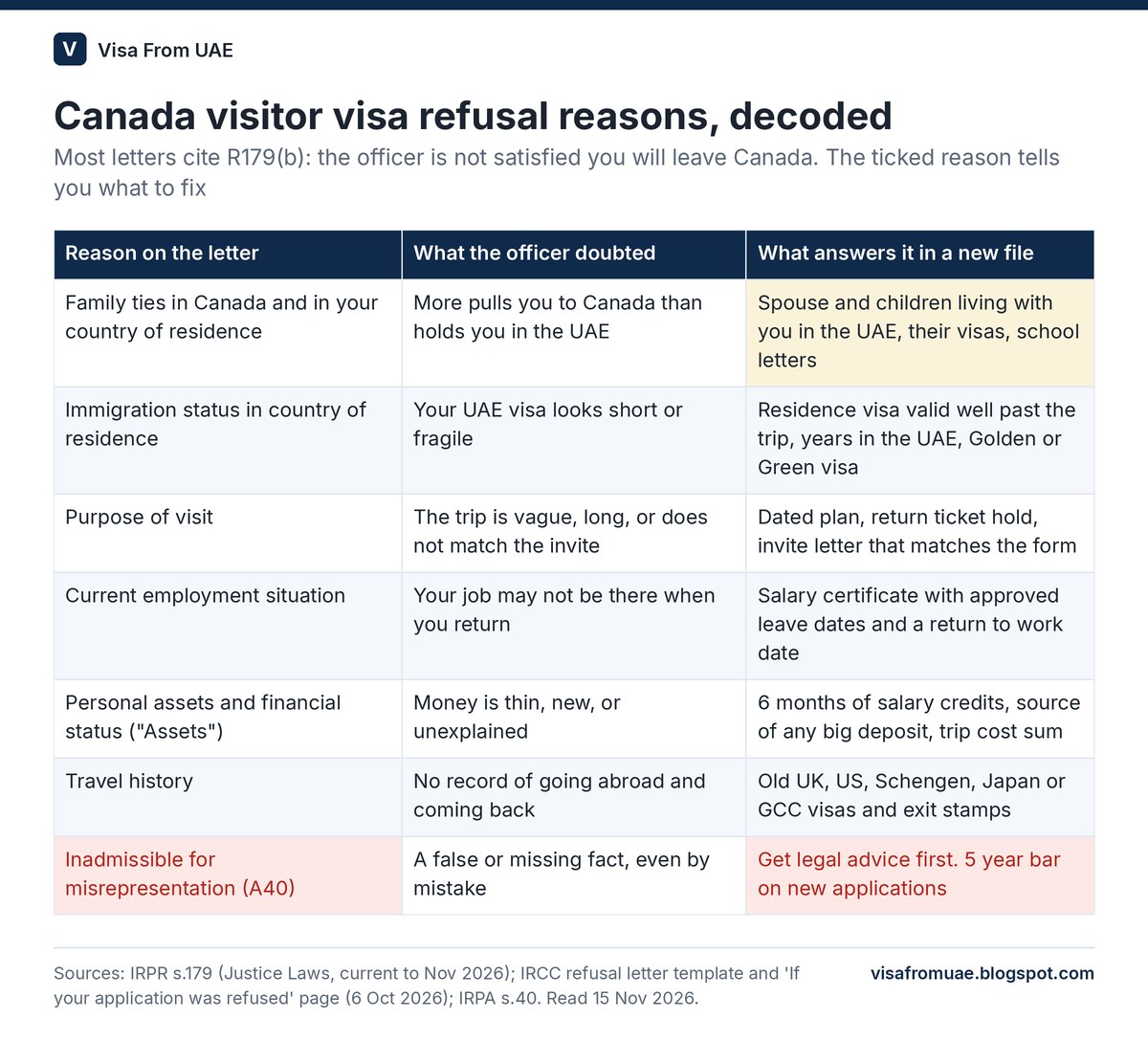
Read every ticked line as a question you did not answer well enough. "Family ties in Canada and in your country of residence" is not a finding that your family is a problem. It means the officer compared the pull of Canada with the pull of the UAE and the UAE side looked lighter. "Immigration status in country of residence" is very common for expats because a UAE residence visa is tied to a job or a sponsor. The officer knows it can end within weeks of losing that job.
The officer decision note: read this before anything else
For years the only way to see why an officer refused you was to request your file and wait. That changed on 29 July 2025. IRCC's officer decision notes page, last updated 27 August 2026, says it now sends a decision note, written by the officer who made the final decision, with the refusal letter for most temporary resident applications. Visitor visas, super visas and transit visas are covered. eTAs and temporary resident permits are not.
The note is short and often written in shorthand, but it is the most useful thing you have. It tells you which document the officer did not believe, which gap they noticed, or what they could not find. A typical note might say the applicant's employment in the UAE is relatively recent, funds are not sufficiently documented, or the purpose of the trip is unclear given the length of stay. Each of those points is a job for the next application.
A few practical points:
- Parts can be blacked out. IRCC says it may remove portions to protect secure, private or sensitive information.
- Some people still get no note. In 2025 several law firms reported that applicants who used the newer IRCC Portal were not getting notes yet. If your account shows only the letter, request your full file (next section).
- It has cut file requests sharply. IRCC told a House of Commons committee in April 2026 that requests for files after a refusal fell by 68% for this group compared with the year before.
If you are thinking about court, IRCC's page has an instruction that is easy to miss. When you apply for leave and judicial review, say in your court application that you have not received the reasons, even if you got a decision note. That lets the court ask IRCC for the complete reasons under Rule 9 of the court's immigration rules and check whether anything was removed from the note.
GCMS notes from the UAE: the free route most agencies skip
GCMS is IRCC's case system, and "GCMS notes" means your full file: every entry an officer or a system made, including checks, risk indicators and the full decision text. The decision note is a summary of the reasoning. The GCMS file is the whole record.
Many UAE agency pages still say you must hire someone in Canada to order these for CAD 5. That was true for most people abroad until 2022. The Privacy Act Extension Order, No. 3 came into force on 13 July 2022 and gave every individual outside Canada the right to ask for their own personal information under the Privacy Act. There is no fee for a Privacy Act request, and you can file it yourself from Dubai or Abu Dhabi through the government's online request service. The Act gives the department 30 days to answer, which it can extend.
The older route still exists. A Canadian citizen, permanent resident or someone in Canada can file an Access to Information request for you, with your signed consent, for CAD 5. That makes sense mainly when a lawyer is already handling your case.
Do you need the GCMS file at all? For a simple first refusal with a clear decision note, usually not. Order it if there is no note, if the note is heavily redacted, if you have been refused two or more times and cannot see why, or if you are talking to a lawyer about court.
Why UAE residents get refused
Reading refusal threads from Dubai and Abu Dhabi applicants on forums such as CanadaVisa and Immihelp, the same patterns come up again and again. None of them are about the UAE being a bad place to apply from. They are about how an expat file looks on paper.
Family in Canada, family elsewhere
The most confusing ticked line is family ties. Forum posters often say, "But my whole family is in the UAE!" and then it turns out their parents are in India or Pakistan, a brother is in Toronto, and they live alone in Dubai. To an officer that is a person with family pulling them to Canada and no family holding them in the UAE. A spouse and children living with you in the UAE, on your sponsorship, in school here, are the strongest family tie you can show. If they exist, prove it: marriage certificate, their residence visas, a school letter.
A residence visa that depends on one job
The officer knows a UAE employment visa ends when the job ends. If you joined your employer six months ago, are on probation, or your visa expires a few months after your trip, the "immigration status" box gets ticked. A long employment history, a residence visa valid well past your return date, or a Golden or Green visa that does not depend on one employer all help.
Money that appears out of nowhere
Many people try to fix a refusal by moving a large amount into their account. Officers look for where money came from as much as how much there is. A steady salary credit every month for six months, with savings that grow slowly, reads better than AED 40,000 that arrived from a cousin's account last Tuesday. If a big deposit is real, explain it with a document: a bonus letter, a sale agreement or a gift letter with the giver's own statement.
A purpose that does not add up
A four week stay for a "tourism" trip, an invitation letter that gives different dates from the form, or a sponsor who says you will stay with them while your plan lists hotels. Each of those looks like a story that changed. Make the form, the letter and the plan say the same thing.
No travel history
Previous trips abroad, and coming back on time, are evidence that you leave when you say you will. Gulf travel counts for less than a visa from the UK, US, Schengen or Japan, but it still counts. Upload old visas even if they have expired.
Refused twice or three times?
Second and third refusals are common in the forum threads, and they nearly always follow the same pattern: the person changed a few documents but not the facts the officer was worried about. Each refusal is now part of your history. Each new form asks about it, and each officer sees the earlier notes.
If you have two refusals, stop and do three things before a third try. Read every decision note side by side and list the reasons. If there are no notes, request your GCMS file through the free Privacy Act route. Then ask yourself honestly whether anything in that list has changed. If the answer is "my job is still eight months old and my family is still in Lahore", the kindest advice is to wait until it is not. A consultant who promises that a third application with a stronger cover letter will pass is selling you a fee, not a fix. IRCC's own page says using a representative gets no special attention and cannot guarantee approval.
Your options after a refusal
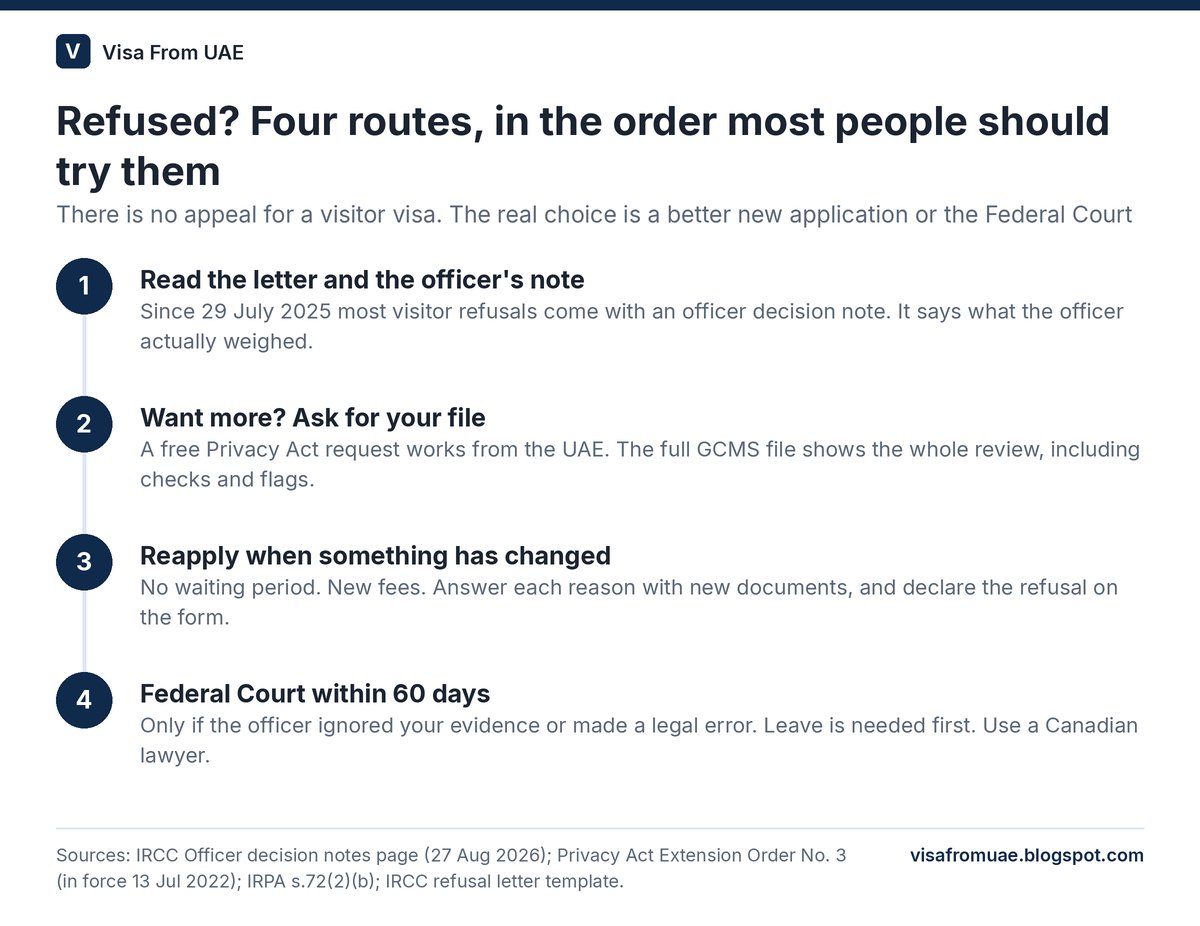
Reapply with a better file
This is the right route for most people. It is cheaper, faster and fully in your control. The rest of this post is about doing it well.
Ask an officer to look again
You can write to IRCC through its web form and ask for a reconsideration, for example if the note says a document was missing that you did upload. The Federal Court of Appeal has held that officers have discretion to reconsider, but they have no duty to. Do not let a request like this run down the 60 day court clock while you wait.
Judicial review in the Federal Court
There is no appeal to the Immigration Appeal Division for a visitor visa. What exists is judicial review under section 72 of the Immigration and Refugee Protection Act. For a decision made outside Canada you have 60 days from the day you were told of it to file for leave. A judge first decides whether to hear the case at all. If you win, the court does not give you a visa. It usually sends the file back to a different officer.
Court makes sense when the officer clearly ignored evidence you sent, for example writing that you have no family in the UAE when your wife's and children's visas were in the file, or when the reasons do not make sense at all. It does not help a file that was simply thin. You will need a lawyer licensed in Canada, and fees are far higher than a new application.
Misrepresentation: the refusal that is different
Under section 40 of the Act, a person is inadmissible for directly or indirectly misrepresenting or withholding material facts that could cause an error. For a finding made outside Canada the bar lasts five years. IRCC's page says the words "inadmissible for misrepresentation" will appear in the last sentence of the letter, and that it does not matter if a representative filled in the form or supplied the document. You are responsible.
The common ways UAE residents get there are a fake or altered salary certificate or bank statement, an agent's "improved" employment letter, and leaving a previous refusal off the form. That last one catches people who were refused by the UK, the US or a Schengen country years ago and think it does not count. The question asks about any country. Always answer it truthfully. An old refusal hurts far less than a misrepresentation finding. If you have one of these letters, talk to a Canadian immigration lawyer before you do anything else, because a quick new application can make things worse.
What a second application costs from the UAE
You pay IRCC's fees again in full. There is no discount for a reapplication and no refund of the first fee. These are from IRCC's fee list, page dated 10 November 2026. AED amounts use the European Central Bank's rates of 13 November 2026 (CAD 1 is about AED 2.58) and are rounded.
| What you pay | CAD | About AED |
|---|---|---|
| Visitor visa, per person | 100 | 258 |
| Visitor visa, family of 5 or more applying together | 500 total | 1,288 |
| Biometrics, one person (only if not given in the last 10 years) | 85 | 219 |
| Biometrics, family of 2 or more | 170 maximum | 438 |
| Typical repeat applicant with recent biometrics | 100 | 258 |
Biometrics you gave for Canada are valid for 10 years, so most people reapplying within that window pay only the CAD 100 visa fee. The visa application centre in Dubai or Abu Dhabi may charge for optional extras like courier return. Those are separate from IRCC's fees.
How long a new decision takes
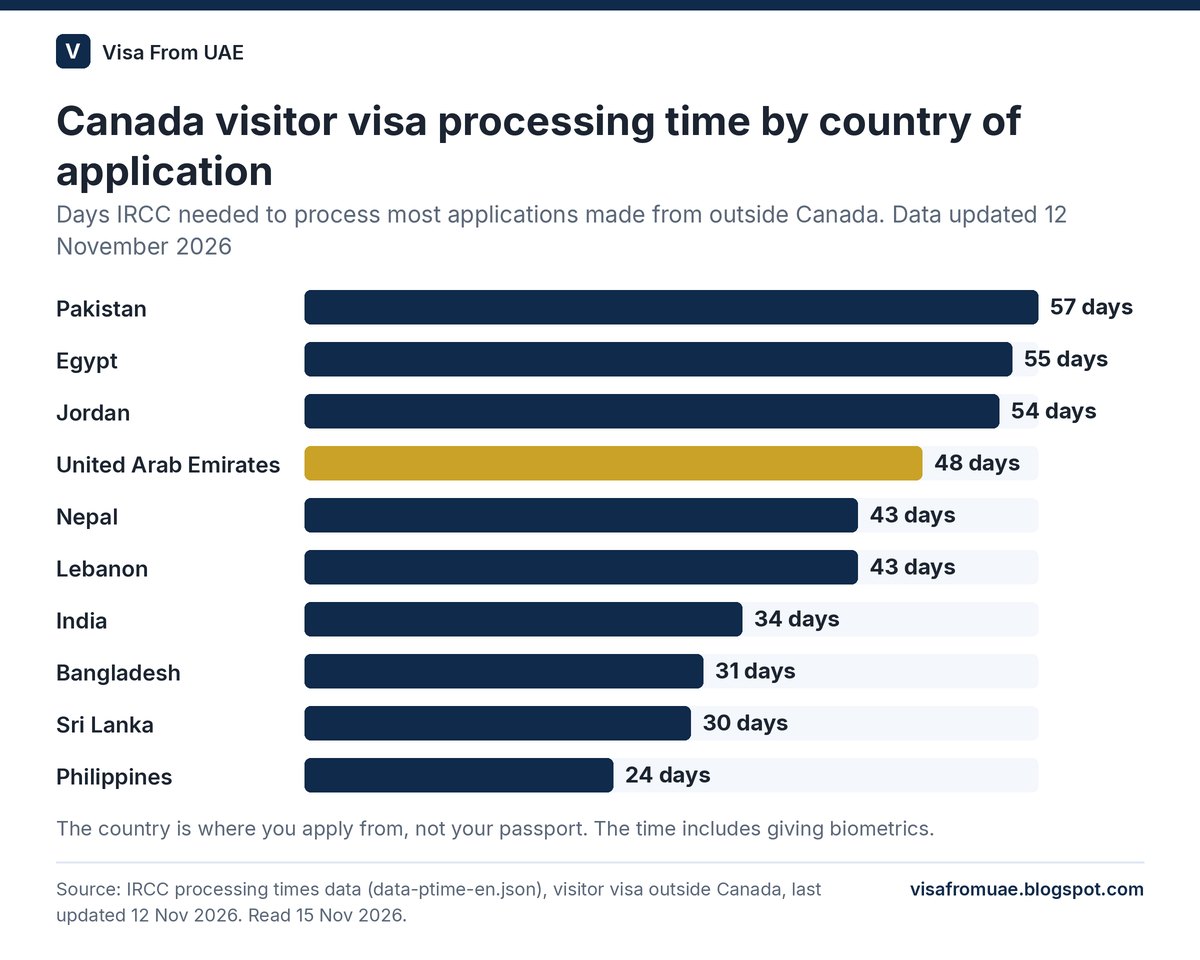
IRCC's processing time is counted from the day it receives your complete online application to the day it decides, and it includes the time to give biometrics. It is set by where you apply from, so a Pakistani passport holder living in Sharjah falls under the UAE figure of 48 days, not Pakistan's 57. When we checked for our main Canada guide on 29 October 2026 the UAE figure was 55 days, so it moves around. Check the live number on IRCC's processing times page before you book anything.
What you read online vs what the rules say
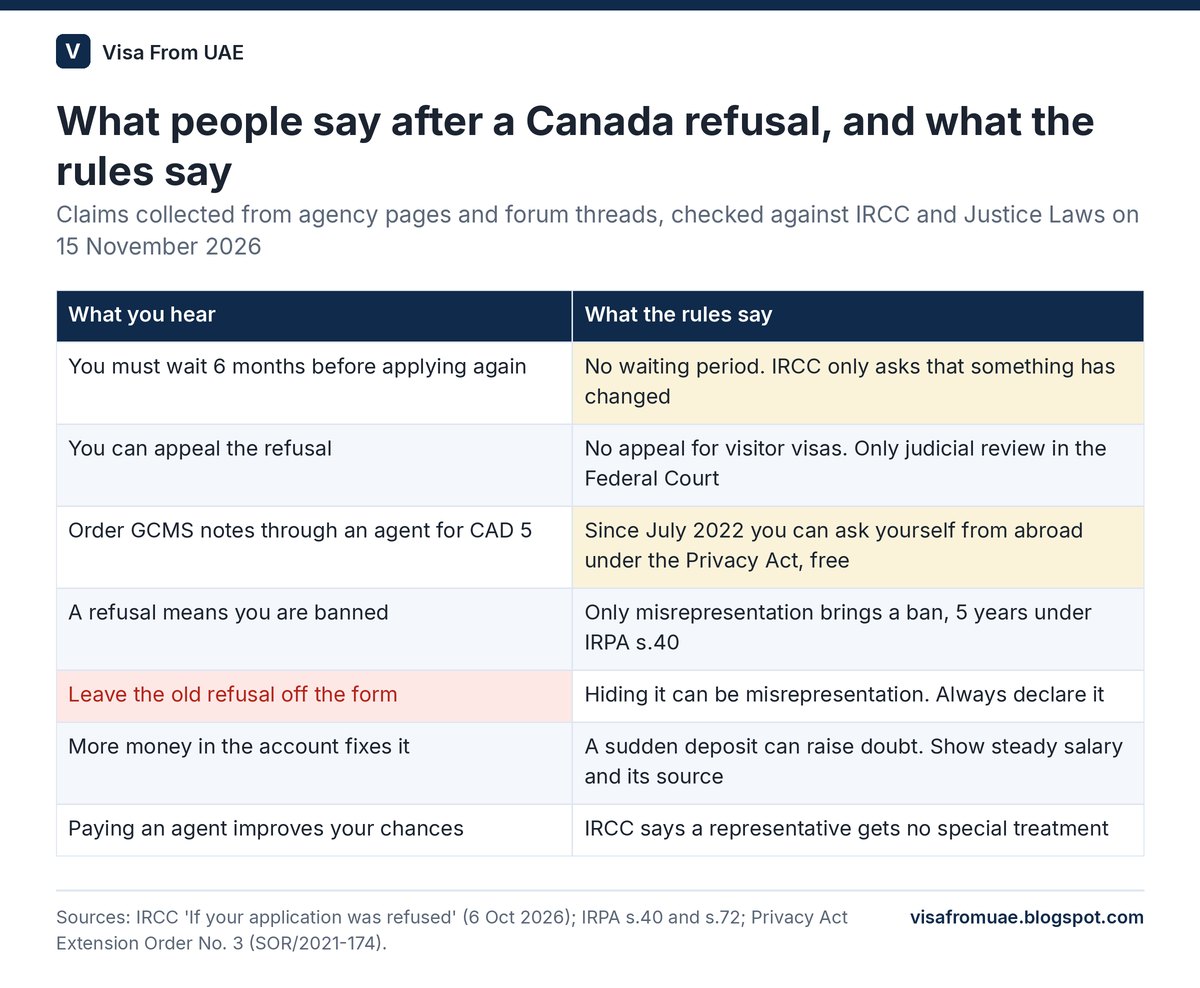
Two more claims we saw on agency pages are worth a word. One says Canada shares refusal data with the UK, the US, Australia and New Zealand, so a Canada refusal will hurt your next UK visa. The five countries do have information sharing arrangements, but the practical point is simpler: the UK and US forms ask about refusals by any country, so you will be declaring it anyway. The other says a refusal "stays on your record forever". It does stay in IRCC's system, but an officer judges your new application on the facts in front of them.
How to reapply from Dubai or Abu Dhabi, step by step
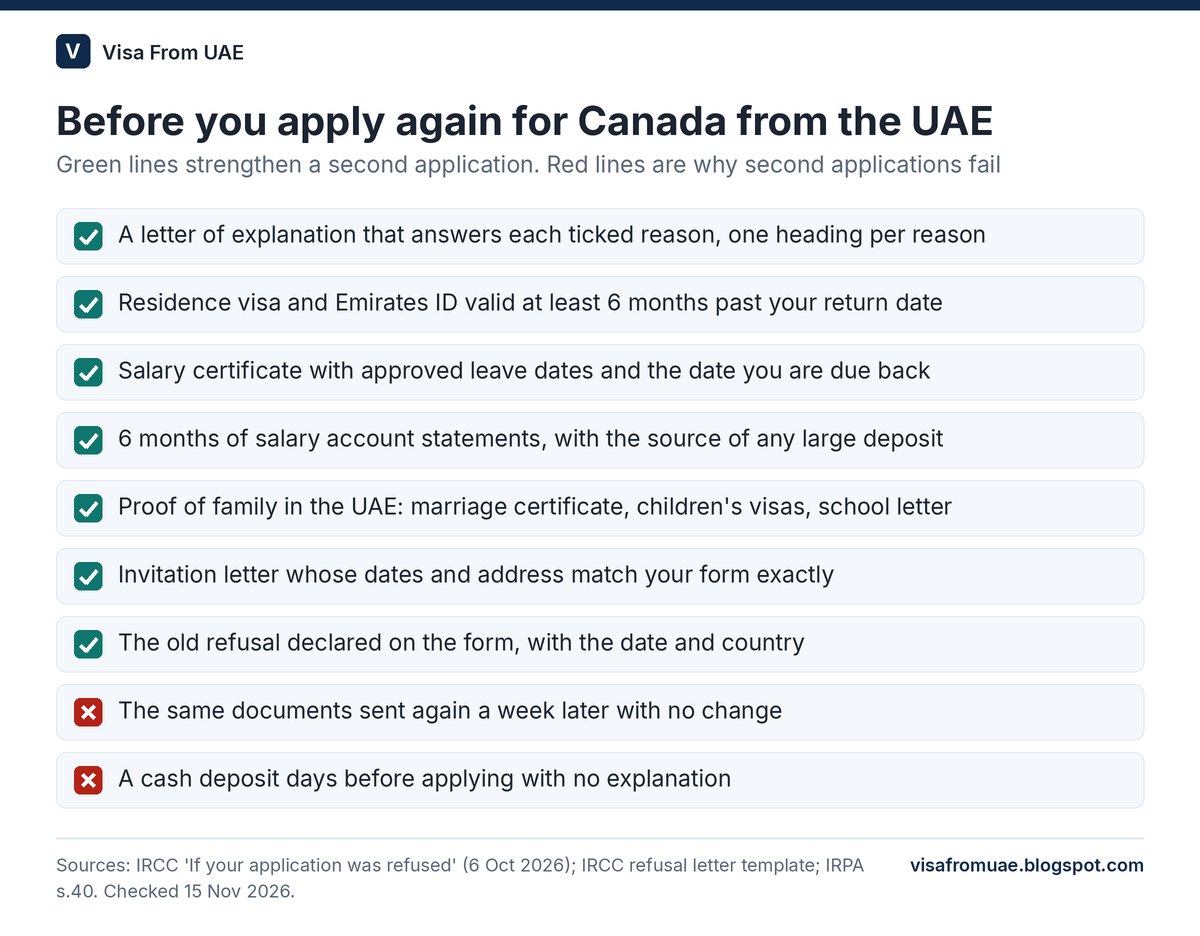
- Collect the reasons. Write down every ticked line in the letter and every point in the decision note. If there is no note, file a Privacy Act request for your GCMS file and wait for it.
- Check what has changed. For each reason, write the new fact or document that answers it. If a reason has no answer yet, wait until it does.
- Fix the documents at the source. Ask HR for a salary certificate that shows your start date, salary, approved leave dates and the date you are due back. Get six months of statements from the account your salary goes into. Renew your residence visa first if it expires within a few months of the trip.
- Write a letter of explanation. One page, with a short heading for each refusal reason and two or three lines under each saying what is new. Plain facts, no pleading.
- Make the story match. Dates, addresses and who pays must be the same on the form, the invitation letter and your plan.
- Declare the refusal. Answer yes to the refusal question and give the date and country. Do the same for any old UK, US or Schengen refusal.
- Apply and pay online. Use your IRCC account. If the system asks for biometrics, book the VFS centre in Dubai or Abu Dhabi within the 30 days in your instruction letter.
Frequently asked questions
How long should I wait to reapply after a Canada visa refusal?
There is no required wait. Reapply when you can answer the reasons in your letter with something new. That might be a week for a missing document or several months for a new job.
Can I appeal a Canada visitor visa refusal from the UAE?
No. Visitor visas have no appeal. The only legal challenge is judicial review in the Federal Court, which must be filed within 60 days for a decision made outside Canada.
Do I get my visa fee back if I am refused?
No. IRCC says fees are not refundable once processing has started, and a new application means paying again.
Will a Canada refusal affect my UK, US or Schengen visa?
Those forms ask about refusals by any country, so you must declare it. A single refusal for weak ties is common and is not a ban. Hiding it is what causes real damage.
How do I get my GCMS notes from Dubai?
File a Privacy Act request for your own IRCC file online. It has been open to people outside Canada since 13 July 2022 and costs nothing. You do not need an agent in Canada.
Should I apply for an eTA instead after a visa refusal?
Only if your passport is eligible for one. The eTA depends on nationality, not on your UAE residence. If you need a visa, applying for an eTA will not work, and an eTA refusal does not come with a decision note.
My parents in the UAE were refused. Should they try the super visa?
A super visa is for parents and grandparents of Canadian citizens and permanent residents and needs medical insurance and an income test from the child in Canada. It is assessed on the same question of whether they will leave, so it is not a way around a ties problem. It is a different product for a longer stay.
More trips from the UAE
- Canada visitor visa from the UAE: fees, biometrics and steps
- UK visa refused? Applying again from the UAE
- Schengen visa rejected in the UAE: appeal or reapply
- US visa renewal from the UAE
- All Visa from UAE guides
Sources
- Immigration and Refugee Protection Regulations, section 179 (Justice Laws, current to November 2026)
- Immigration and Refugee Protection Act, section 72: judicial review, 15 and 60 day limits
- Immigration and Refugee Protection Act, section 40: misrepresentation and the five year bar
- IRCC: If your application for a visitor visa, work permit or study permit was refused (6 October 2026)
- IRCC program delivery instructions: Refusal letter, temporary resident
- IRCC: Explaining application refusals, officer decision notes (27 August 2026)
- IRCC committee briefing, 22 April 2026 (68% fall in file requests after refusals)
- Privacy Act Extension Order, No. 3 (SOR/2021-174), in force 13 July 2022
- IRCC fee list (page dated 10 November 2026)
- IRCC processing times (data updated 12 November 2026)
- IRCC: Visitor visa, after you apply (28 August 2026)
- European Central Bank reference rates, 13 November 2026 (CAD and USD); AED pegged at 3.6725 per USD
- CanadaVisa forum: visit visa refused under 179(b), applicant threads
Rules, fees and processing times were read on 15 November 2026 from IRCC and Justice Laws pages. Each IRCC page's own "date modified" is given above. The decision on any visa belongs to the IRCC officer. This guide is general information, not legal or immigration advice. If your letter mentions misrepresentation or inadmissibility, speak to a lawyer licensed in Canada. See our Disclaimer.
Last updated: November 15, 2026