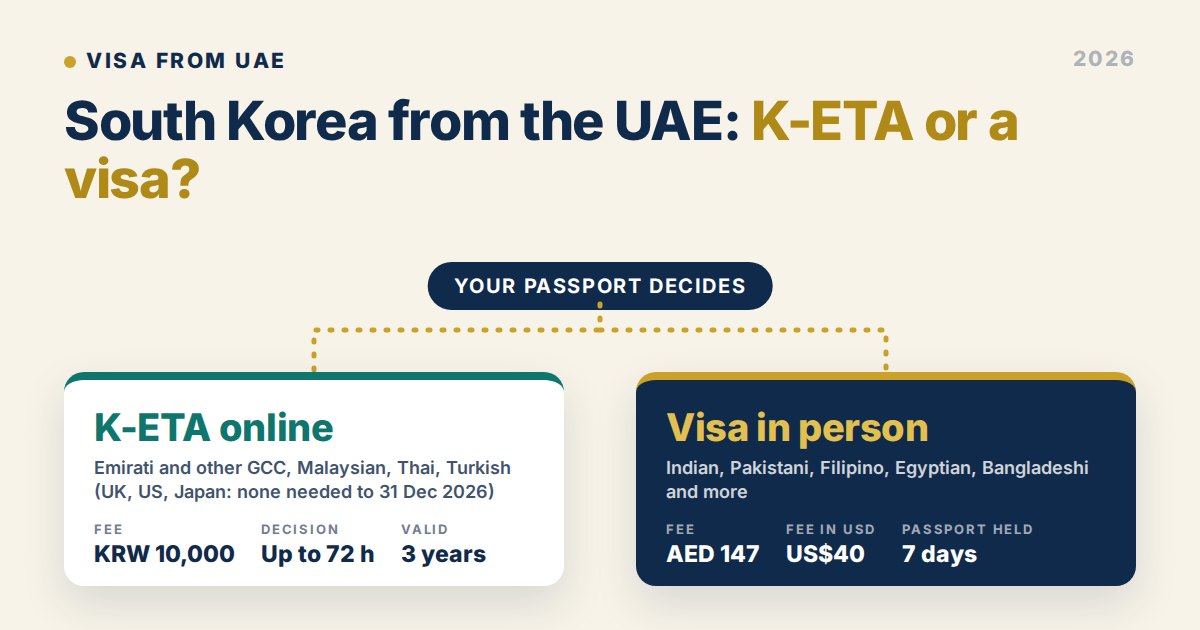
Seoul is about nine hours from Dubai on a direct flight, and Korea has quietly become one of the most asked about trips among UAE residents, mostly because of K-dramas, skincare shopping and cheap autumn fares. The entry rules, though, are split in a way that confuses a lot of people. Some passports need a K-ETA, which is an online approval you get from your sofa. Some need nothing at all until the end of 2026. Everyone else needs a proper visa, and for that you have to go in person to a Korean mission in the UAE with your original passport.
The pages that rank for this question are mostly travel agency blogs, and a few of them say there is no Korean consulate in Dubai. There is one, in Jumeirah 2, and it handles most tourist visa files in the country. So for this guide I went back to the official sources on 17 November 2026: the Korean Ministry of Justice's K-ETA portal (its country list, fee guide and notices), the visa pages and notices of the Consulate General of Korea in Dubai, and the visa notices of the Korean Embassy in Abu Dhabi, including its April 2026 notice on who can apply there. If you are comparing trips to East Asia, our guides to Japan, Singapore and Thailand cover the other popular options.
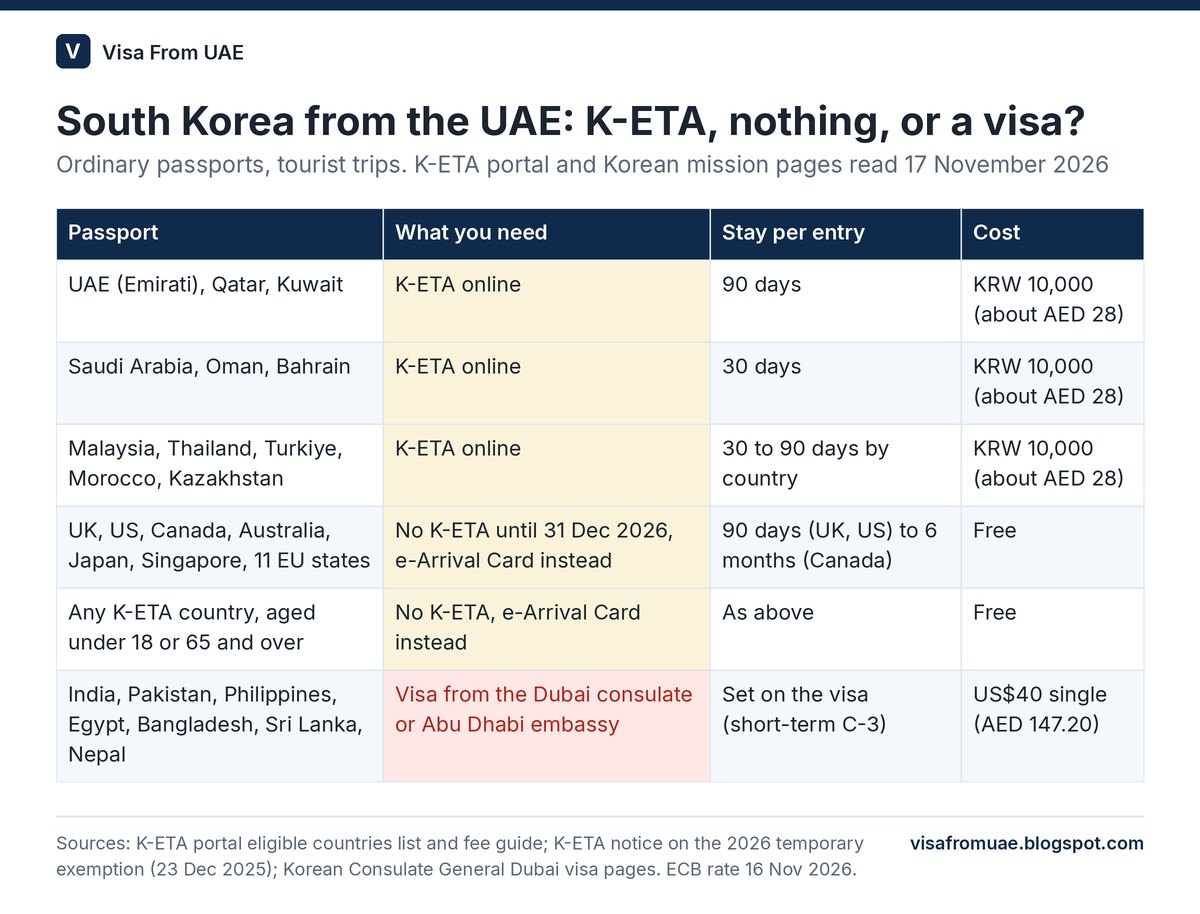
Short answer: Korea decides by passport, not by UAE residence. Emirati, Qatari, Kuwaiti, Saudi, Omani and Bahraini passport holders need a K-ETA (KRW 10,000, about AED 28, valid 3 years). UK, US, Canadian, Australian, Japanese, Singaporean and 11 EU passports need no K-ETA until 31 December 2026, only the free e-Arrival Card. Indian, Pakistani, Filipino, Egyptian, Bangladeshi, Sri Lankan and Nepali passports need a visa: about AED 147 (US$40) for a single entry, applied for in person at the Korean Consulate in Dubai (Dubai and Northern Emirates visas) or the Korean Embassy in Abu Dhabi (Abu Dhabi and Al Ain visas). Processing in Dubai takes 7 calendar days. Thirty-three nationalities, including India, Pakistan and the Philippines, must also have lived in the UAE for two years to apply here.
K-ETA or visa: which one do you need?
The only thing that matters is the passport you will travel on. A UAE residence visa, a Golden Visa or a Schengen visa does not turn a visa-required passport into a K-ETA passport. A Filipino nurse who has lived in Dubai for fifteen years needs a visa. An Emirati who has never left the country only needs a K-ETA.
There are three groups.
- K-ETA passports. These are the countries and regions that already have visa-free entry to Korea. Since 2021 their citizens must get a K-ETA online before they board. The K-ETA portal's list has 116 entries (it counts six types of British passport separately), and it includes the UAE and the rest of the GCC.
- K-ETA passports that are exempt for now. Twenty-two of those countries and regions do not need a K-ETA until 31 December 2026. They file the free e-Arrival Card instead.
- Visa passports. Anyone whose passport is not on the K-ETA list. For the UAE that means most of the big expat communities: India, Pakistan, the Philippines, Egypt, Bangladesh, Sri Lanka, Nepal, Indonesia, Vietnam, China, Jordan, Lebanon, Syria, Iraq, Iran and Nigeria, among others.
Emirati citizens
UAE passport holders can visit Korea without a visa for up to 90 days per entry, but the UAE is not one of the 22 exempt countries, so you need an approved K-ETA before you fly. The Korean Consulate in Dubai also accepts visa applications from UAE nationals, which matters only if you are going for something a K-ETA does not cover, such as study or work, or if your K-ETA is refused.
Two exceptions are worth knowing for families. Since 3 July 2023, K-ETA passport holders who are 17 or younger, or 65 or older on the day they arrive do not need a K-ETA. Your children and parents fill the e-Arrival Card instead, and you pay for your own K-ETA only.
The rest of the GCC: same K-ETA, different stay
This is something I did not see on any of the UAE pages I checked. The K-ETA portal lists the allowed stay for every passport, and the GCC is not uniform. Emirati, Qatari and Kuwaiti passports get 90 days. Saudi, Omani and Bahraini passports get 30 days. If you are a Saudi family living in Dubai and planning a long summer in Seoul, plan around 30 days, not 90. The K-ETA itself is valid for three years, but the stay per visit is fixed by your passport.
UK, US, Canadian, Australian and European passports
The 22 exempt countries and regions are Australia, Austria, Belgium, Canada, Denmark, Finland, France, Germany, Hong Kong, Italy, Japan, Macao, the Netherlands, New Zealand, Norway, Poland, Singapore, Spain, Sweden, Taiwan, the UK and the US (including Guam). Korea first exempted them in April 2023 for "Visit Korea Year", and the Ministry of Justice has extended it twice. The latest notice, dated 23 December 2025, says the exemption runs from 1 January to 31 December 2026 (Korean time).
No extension for 2027 had been posted on the K-ETA portal when I checked on 17 November 2026. If your trip is in January 2027 or later, check the portal's notice board a few weeks before you fly. If you want to avoid that worry, you can still apply for a K-ETA now. It costs the normal fee, it is valid for three years, and the portal says K-ETA holders skip the arrival card.
Note that not every EU country is on the exempt list. Portugal, Ireland, Greece, Czechia, Hungary and others are K-ETA countries without the exemption, so travellers on those passports need a K-ETA now.
How the K-ETA works
The K-ETA is not a visa. It is a pre-check that lets an eligible traveller board a flight to Korea, and the final decision is still made by the immigration officer at Incheon. The details from the official portal:
- Where: only at k-eta.go.kr or the official K-ETA app. The Ministry of Justice put out a notice on 22 August 2025 saying it does not authorise any third-party K-ETA service. Look for ".go.kr" in the address. Many lookalike sites charge several times the fee.
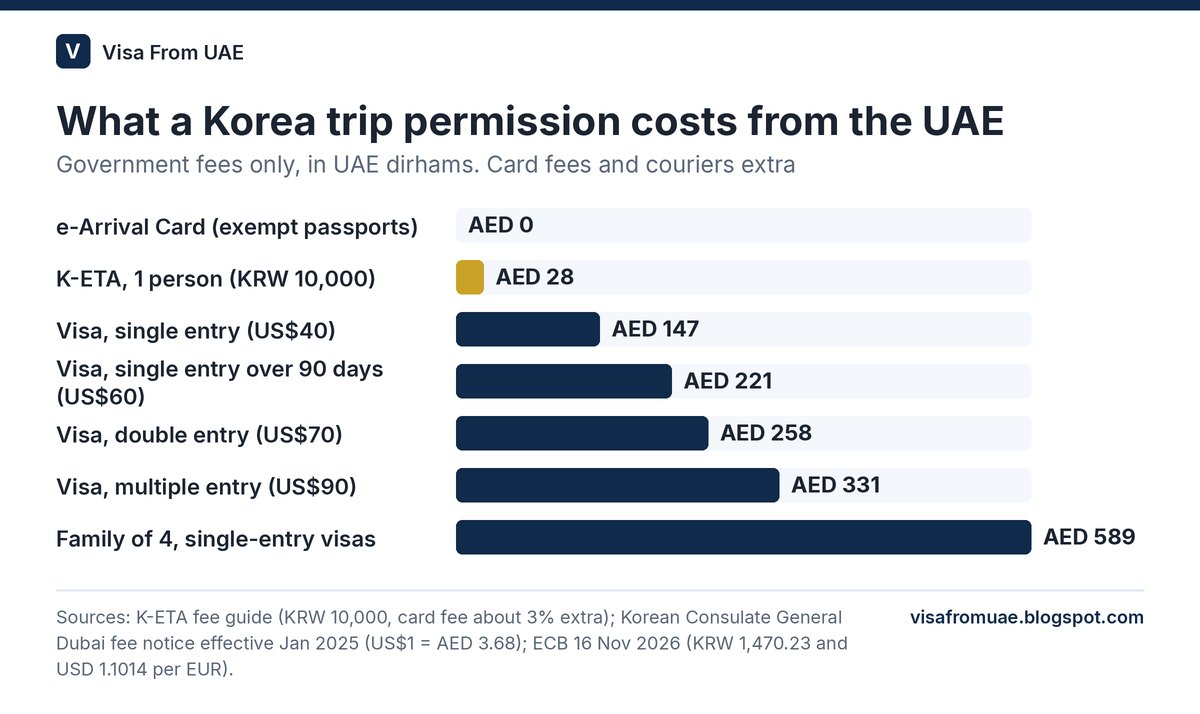
- Fee: KRW 10,000 per person, plus a card processing fee of about 3%. At the European Central Bank rates of 16 November 2026, KRW 10,000 is about AED 27.50, so expect to pay about AED 28 on a UAE card. It is not refunded if you are refused.
- Time: the portal says "generally within 72 hours", with no paid express option. The Dubai consulate advises applying two weeks before you fly, because some files take longer.
- Validity: three years for applications made after 3 July 2023, or until your passport expires if that is sooner. You can use it for many trips.
- New passport: if your passport is renewed, your K-ETA does not move to it. You apply again.
- Mistakes: you cannot edit a submitted application. If the passport details are wrong, the consulate says entry will be refused, so you apply again and pay again. Travel details such as your hotel address and dates can be updated on the portal after approval, and the portal says you must update them if they change.
- If refused: the Dubai consulate advises you not to keep reapplying unless something has changed, and to apply for a visa through the consulate instead.
What you need: your passport, an email address, a photo, and a card that works for online payments abroad. If the payment fails with a 3DS error, the portal's FAQ points you to your bank, which is common with UAE debit cards that have international online payments switched off.
The e-Arrival Card
Korea replaced the paper arrival card with an online form. The Korean Embassy in Abu Dhabi posted its notice on 24 February 2025. It is free, and it is filed at e-arrivalcard.go.kr in the days before you land; travel sites and airlines put the window at three days before arrival.
Who files it: the exempt passports, children and over-65s who skip the K-ETA, and visa holders. If you have an approved K-ETA, the portal says you are exempt from the arrival card. That is the one perk that makes a K-ETA worth buying for some exempt travellers who visit often.
Where to apply for a Korea visa in the UAE
If your passport needs a visa, you apply in person. There is no visa on arrival and no general online tourist visa for UAE residents. Which office you go to depends mainly on which emirate issued your residence visa.
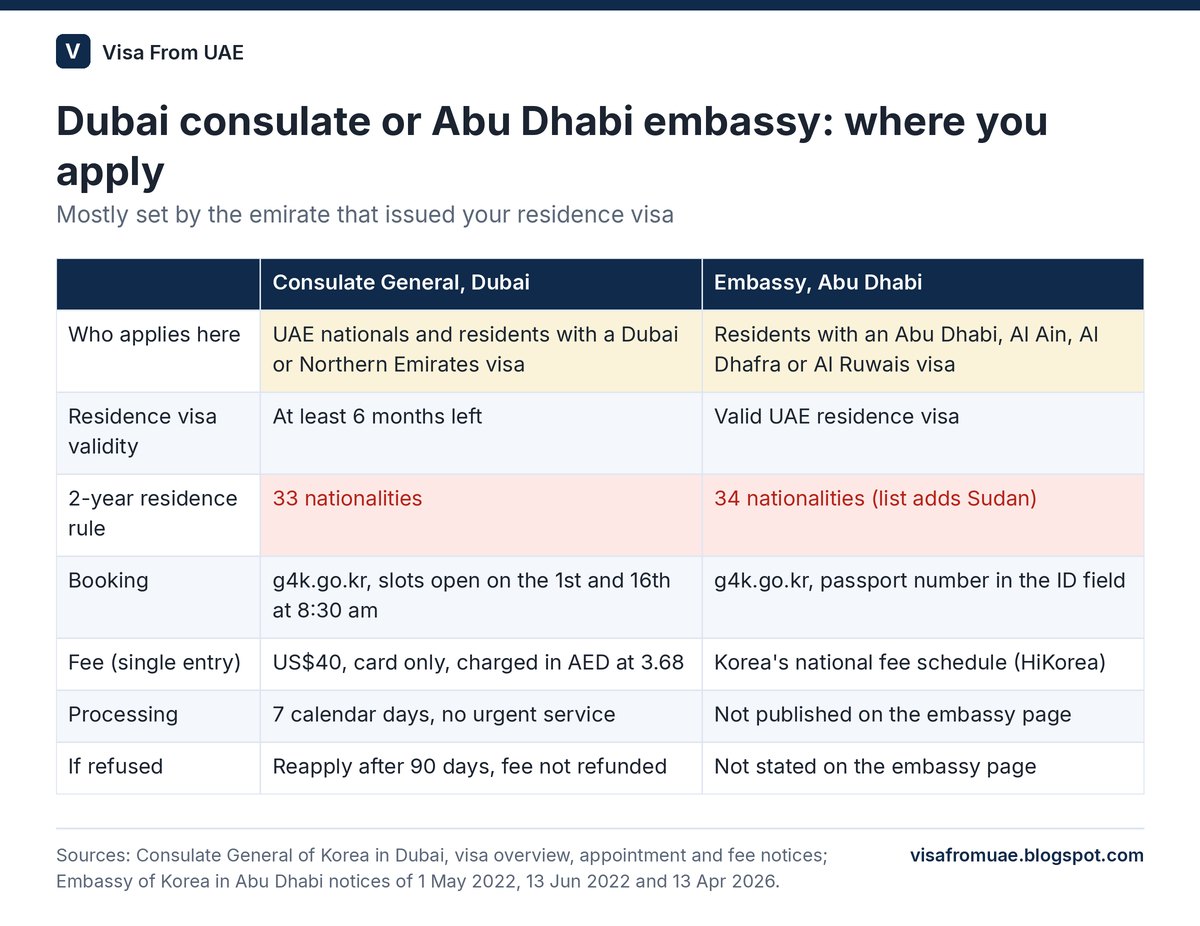
The Consulate General of Korea in Dubai
The consulate's visa overview says it accepts applications from:
- UAE nationals, and
- non-UAE nationals with a Dubai or Northern Emirates residence visa that has at least six months left.
It says that "those who hold residence visas from Abu Dhabi and Al Ain must apply for a Korean visa at the Embassy of Korea in Abu Dhabi". The consulate is at Villa 12, Street 29b, Jumeirah 2, Dubai, open Monday to Thursday 8:30 am to 5 pm and Friday 8 am to 1 pm. It asks for visa questions by email at dubaivisa@mofa.go.kr rather than by phone.
The Embassy of Korea in Abu Dhabi
The embassy's appointment notice says only holders of residence visas from Abu Dhabi, Al Ain, Al Dhafra and Al Ruwais can apply there. On 13 April 2026 it added a list of 13 exceptions for people whose visa was issued in another emirate. The useful ones for ordinary travellers are:
- You live in Abu Dhabi and your name is on the tenancy contract (or you have a hotel lease of at least six months).
- You hold a UAE Golden Visa, with family travelling with you.
- You or your family have visited Korea, or an OECD country (not counting emerging and developing ones), in the past five years.
- Your employer is listed on ADX or DFM, is government-invested, or is in the ADQ portfolio, and you travel on a C-3 visa.
- You are invited by a Korean company listed on KOSPI on a business visa, or you are the spouse or child of a Korean national.
So a Dubai-visa holder who lives in Abu Dhabi, or a Golden Visa holder from any emirate, can go to the embassy. Everyone else with a Dubai or Northern Emirates visa goes to Dubai.
The two-year rule for 33 nationalities
This is the rule that catches people out. Under Ministry of Justice guidelines, citizens of certain countries who apply in a third country (here, the UAE) must have held a UAE residence visa continuously for more than two years, on top of having six months left on the current visa. The Dubai consulate's tourist document list asks them to bring the original and a copy of their previous UAE visa as proof.
The Dubai list has 33 countries: Afghanistan, Bangladesh, Cameroon, China, Cuba, Egypt, Gambia, Ghana, India, Indonesia, Iran, Iraq, Kazakhstan, Kosovo, Kyrgyzstan, Macedonia, Mongolia, Myanmar, Nepal, Nigeria, Pakistan, Palestine, Peru, Philippines, Senegal, Somalia, Sri Lanka, Syria, Thailand, Ukraine, Uzbekistan, Vietnam and Yemen.
I compared it with the Abu Dhabi embassy's version (1 May 2022). That one lists 34 countries: the same 33 plus Sudan. Thailand, Kazakhstan and Peru are on both lists even though they are K-ETA countries. That is because the rule only bites when a citizen of those countries applies for a visa, for example for study or work.
The exceptions are where the two offices differ most:
- Dubai lists five: people invited by the Korean government or public bodies, diplomats and international organisation staff, spouses and minor children of UAE nationals, transit (C-3-10) or overseas Korean (F-4) visas, and holders of a Visa Issuance Certificate from the Ministry of Justice.
- Abu Dhabi lists eleven, and they are broader. They include Golden Visa holders, people who visited Korea or an OECD country in the past five years, employees of ADX or DFM listed and government-invested companies on a business trip, professionals such as doctors, lawyers, accountants and bank staff (with an NOC), a child travelling with a parent who meets the two-year rule, and humanitarian trips such as a family wedding or funeral.
In practice: if you are an Indian or Filipino resident with less than two years in the UAE, but you hold a Golden Visa or visited Europe or Japan in the last five years, read the Abu Dhabi notice carefully before you give up on the trip. If none of the exceptions fit, you will need to wait until you pass two years.
Korea visa fees in AED
The Dubai consulate's fee notice, effective January 2025, gives the standard fees for passports that are not listed separately:
- Single entry, under 90 days: US$40, about AED 147
- Single entry, over 90 days: US$60, about AED 221
- Double entry: US$70, about AED 258
- Multiple entry: US$90, about AED 331
The consulate charges in dirhams at US$1 = AED 3.68, by card only. Some nationalities pay a different fee under reciprocity arrangements, which the consulate publishes as a separate PDF, so check it if your nationality is unusual. A family of four on single-entry visas pays about AED 589. Nothing is refunded if you are refused.
Compare that with the K-ETA: about AED 28 for three years of trips. For an Emirati family of four with two children under 18, the whole permission cost is about AED 56.
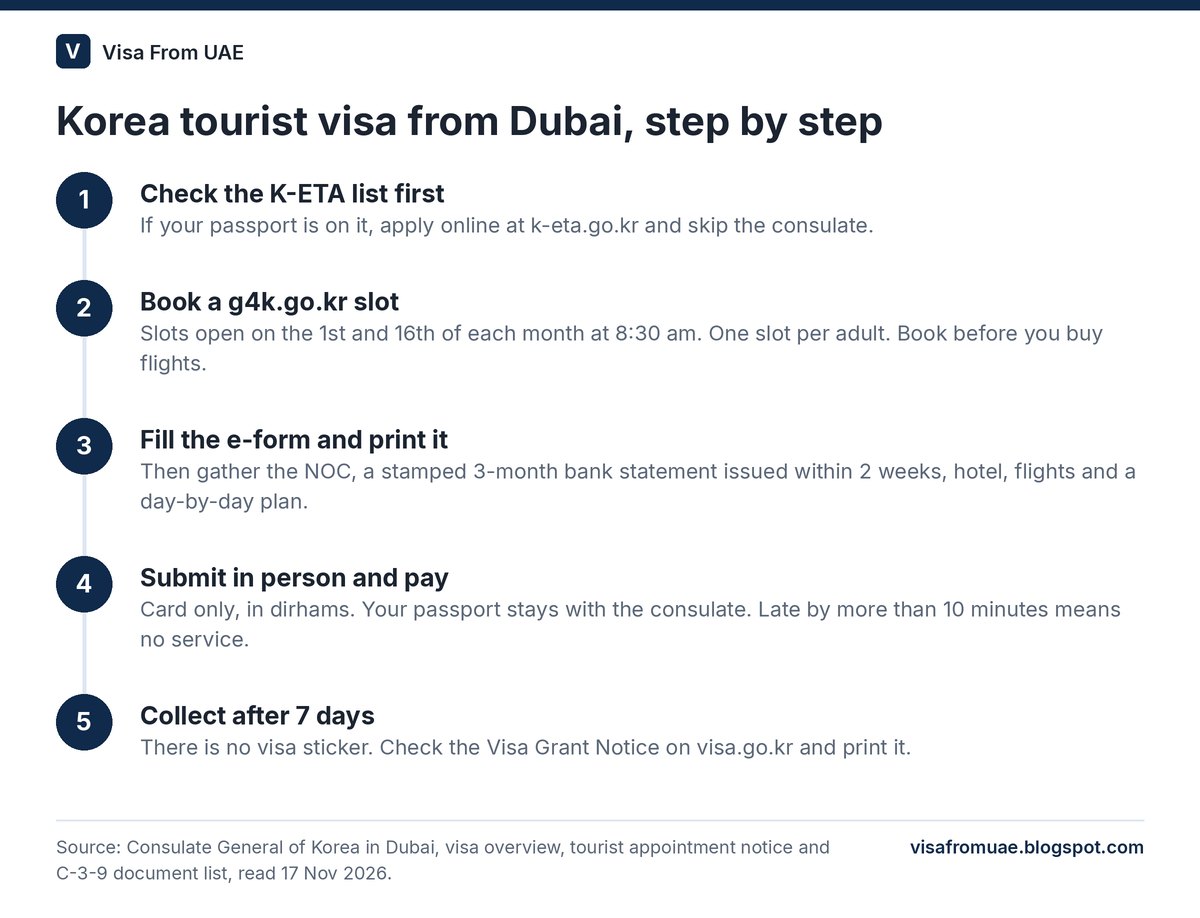
How to apply for a Korea tourist visa in Dubai, step by step
- Book an appointment on g4k.go.kr. Switch the site to English with the ENG button (the consulate says Google-translated pages will not work), choose "Reservation to a diplomatic mission", log in with email and phone verification, then pick Middle East, U.A.E, Consulate General of the Republic of Korea in Dubai, and the "Visa" service. In the comment box write your name, date of birth, nationality and purpose (TOURIST). The consulate says bookings without these details are cancelled automatically.
- Book early. On the 1st of each month at 8:30 am, slots open for the 16th to the end of that month. On the 16th, slots open for the 1st to 15th of the next month. If all dates show red, they are full. The consulate tells applicants to book before buying tickets. One slot per applicant, though a parent can add one child under 18 to their own slot. Non-tourist visas (business, study, medical) are booked by email to dubaivisaapp@mofa.go.kr.
- Fill the online visa e-form and print it. The consulate has a PDF guide on how to fill it in.
- Go in person, on time. Arrive more than 10 minutes late and you will not be seen. No walk-ins. You must be able to communicate in English or Korean, and all documents must be in English or Korean (Arabic documents need a translation, with the original).
- Pay by card and hand over your passport. The consulate keeps it for the whole processing time.
- Collect after 7 calendar days on the date on your receipt. There is no urgent service.
- Print your Visa Grant Notice. Korea stopped putting visa labels in passports on 1 July 2020. You check and print the visa on visa.go.kr.
Documents for a tourist visa (C-3-9) in Dubai
This is the consulate's list, in its order, with what each item really means:
- Printed e-form, filled online.
- Passport, original and copy, valid at least six months from your travel date.
- UAE residence visa copy, valid at least six months from the application date, "no exception". If your visa is electronic, download it from the ICP UAE app and print it.
- Emirates ID, original and copy.
- Previous UAE visa, original and copy, if you are from one of the 33 two-year countries.
- NOC from your UAE sponsor, with your full name, passport number, nationality, position and salary, the detailed purpose of the trip, and the signatory's name, title and contact, stamped and signed. If your sponsor is a person (husband, father, or an employer of a domestic worker), add their passport copy. Golden Visa, partner and self-sponsored visa holders still give a letter explaining the trip.
- Bank statement: the last three months, original, with the bank's physical stamp, from a personal account, and issued within the last two weeks. Payslips or a home-country statement can help. If someone else is paying, add their support letter, their stamped statement, their passport copy and proof of relationship (birth or marriage certificate, or the MOHRE contract for a domestic worker). The consulate says relationship proof is needed even when the payer is also your visa sponsor.
- Day-by-day schedule of where you will go.
- Hotel booking for the whole stay with your name, hotel address and booking reference. Agoda or Booking.com confirmations are fine if every detail shows. If you are staying with someone, bring their invitation letter, tenancy contract and Korean ID or residence card copy.
- Confirmed return flight with your name, flight numbers, dates and booking reference, including any domestic flights inside Korea.
Two practical warnings. The company letter must be dated within one month and the bank statement within two weeks, so do not prepare them too early. And the consulate keeps every document except your passport, approved or refused, so bring copies of anything you need back.
There is no fixed minimum bank balance. The consulate asks you to show "financial stability", which in practice means a steady salary going in and enough left for the trip. Our guide to bank statements for visa applications from the UAE explains what consulates usually read into a statement.
If your visa is refused
The Dubai consulate says the fee is not refunded, documents are not returned, and you can only reapply after 90 days from the refusal. Use the time to fix what was weak: a short UAE residence history, a thin or recently topped-up bank statement, or a vague itinerary.
The consulate also published a warning on 31 July 2024 about travel agencies. It said it had received "numerous complaints" about agency services and fees, that it has no link with any agency, and that applying directly is "often the simplest and most cost-effective method". Unlike Singapore, where you must use an authorised agent, Korea lets you walk in with your own file.
Visa-free options for visa passports: transit and Jeju
30 days in transit with a US, Canada, Australia, NZ or European visa
Korea runs a visa-free transit program (B-2) that the Dubai consulate describes in a 2023 notice. If your passport normally needs a Korean visa, you can stay up to 30 days without one when you are passing through Korea to or from the US, Canada, Australia or New Zealand, or one of 32 European countries, and you hold a valid visa or residence for that country. For the US, Canada, New Zealand and Europe the visa must be a sticker in your passport. Australian visas are checked on VEVO. You also need an onward ticket leaving within 30 days.
The catch for UAE residents: Dubai to Seoul and back to Dubai does not count. The consulate's wording is that if you visit only Korea and return to the country you left from, you need a visa. Dubai to Seoul to Los Angeles with a US visa can work. Twenty-three nationalities are excluded, including Pakistan, Bangladesh, Nepal, Sri Lanka, Egypt and Nigeria. India and the Philippines are not on that exclusion list.
Jeju Island
Jeju has its own visa-free entry for many visa-required nationalities, but only if you fly straight into Jeju from abroad and stay on the island. The same 23 nationalities are excluded. There is no direct flight from the UAE to Jeju, so it usually means connecting through another country, which makes it a niche option rather than an easy shortcut. K-ETA passport holders need their K-ETA for Jeju too, since September 2022.
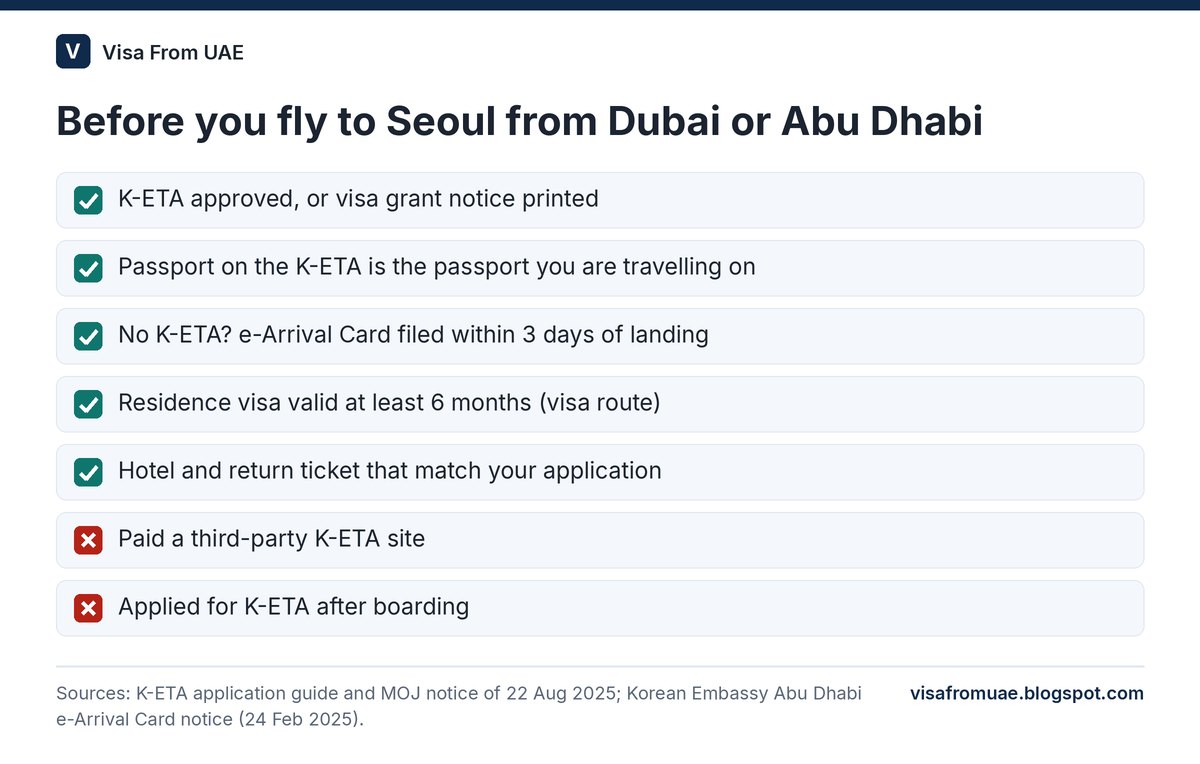
Before you fly: a short checklist
- K-ETA approved, or Visa Grant Notice printed from visa.go.kr.
- The passport on the approval is the passport in your hand. A renewed passport needs a new K-ETA or visa.
- No K-ETA (exempt passport, child, over 65, or visa holder)? e-Arrival Card filed before you land.
- Hotel and return flight match what you told the K-ETA portal or the consulate. Update the K-ETA travel details if they changed.
- For Saudi, Omani and Bahraini passports: a return date within 30 days.
Frequently asked questions
Do UAE residents need a visa for South Korea?
It depends on your passport, not your residence. Emiratis and other GCC nationals need a K-ETA. Most Western passports need nothing but the e-Arrival Card until 31 December 2026. Indian, Pakistani, Filipino, Egyptian, Bangladeshi, Sri Lankan and Nepali passport holders need a visa from the Korean consulate in Dubai or the embassy in Abu Dhabi.
Is there a Korean consulate in Dubai?
Yes. The Consulate General of the Republic of Korea in Dubai is at Villa 12, Street 29b, Jumeirah 2. It takes visa applications from UAE nationals and from residents whose visa was issued in Dubai or the Northern Emirates.
Can I apply for a Korea visa through an agent in Dubai?
The consulate does not appoint or endorse any agency, and it advises applying directly. You must still go in person to submit, and you must speak English or Korean at the counter.
How long does a Korea visa take from Dubai?
Seven calendar days from submission, according to the consulate. There is no urgent service, and your passport stays with them. Add the wait for an appointment, since new slots open only twice a month.
How much is the K-ETA in AED?
KRW 10,000 plus about 3% card fee, so about AED 28 at November 2026 rates. Only pay on k-eta.go.kr or the official app.
I am Indian with a US visa. Do I need a Korea visa?
For a holiday that starts and ends in the UAE, yes. If you are flying from Dubai to the US via Seoul, or back from the US via Seoul, the transit program can give you up to 30 days without a Korean visa, provided your US visa is a valid sticker in your passport.
I have lived in Dubai for one year. Can I still apply?
If you are from one of the 33 two-year countries, the Dubai consulate will want proof of two years' continuous UAE residence. Check the Abu Dhabi embassy's exceptions: Golden Visa holders, recent travellers to Korea or OECD countries, and some employees of listed companies can apply there with less than two years.
Will the K-ETA exemption for UK and US passports continue in 2027?
Nothing had been announced on the K-ETA portal as of 17 November 2026. The current exemption ends on 31 December 2026 (Korean time). If you travel after that, check the portal, or apply for a K-ETA now so you are covered either way.
More trips from the UAE
- Japan visa from Dubai and Abu Dhabi: eVisa or sticker, fees in AED
- Singapore visa from the UAE: who needs one, fees and the V39A letter
- Thailand visa from the UAE: the new 30 day rule and e-Visa fee in AED
- China visa from the UAE: fees, 30 day visa-free list and transit
- Australia visa from the UAE: Visitor 600, ETA or eVisitor
- All Visa from UAE guides
Sources
- K-ETA (Ministry of Justice): Eligible countries and allowed period of stay, and who is exempt from applying
- K-ETA: Application guide (72 hours, 3-year validity, new passport, arrival card exemption)
- K-ETA: Application fee guide (KRW 10,000, about 3% card fee, non-refundable)
- K-ETA: Notice on extension of the temporary exemption to 31 December 2026 (23 December 2025)
- K-ETA: Validity extended to 3 years and exemption for ages 17 and under and 65 and over (from 3 July 2023)
- Korean Embassy in Singapore: List of 22 countries and regions temporarily exempt from K-ETA (29 March 2023)
- Consulate General of Korea in Dubai: How to apply for a Korean visa (who can apply, processing, fees, contact)
- Consulate General of Korea in Dubai: Required documents for tourist visa (C-3-9)
- Consulate General of Korea in Dubai: Two-year UAE residence requirement for 33 nationalities
- Consulate General of Korea in Dubai: How to book a tourist visa appointment on g4k.go.kr
- Consulate General of Korea in Dubai: Visa fee per nationality (effective January 2025)
- Consulate General of Korea in Dubai: Notice on the use of travel agencies (31 July 2024)
- Consulate General of Korea in Dubai: Visa-free entry for third-country transit passengers (B-2)
- Embassy of Korea in Abu Dhabi: Exceptional acceptance of applications from other emirates (13 April 2026)
- Embassy of Korea in Abu Dhabi: Two-year residence requirement for 34 nationalities and exceptions
- Embassy of Korea in Abu Dhabi: How to make an appointment (Abu Dhabi, Al Ain, Al Dhafra, Al Ruwais)
- Embassy of Korea in Abu Dhabi: Notice regarding K-ETA applications (22 August 2025)
- Embassy of Korea in Abu Dhabi: Implementation of the e-Arrival Card system (24 February 2025)
- European Central Bank reference rates, 16 November 2026 (KRW 1,470.23 and USD 1.1014 per EUR); AED pegged at 3.6725 per USD
Rules were read on 17 November 2026. Korean mission notices are often dated years back but still in force, and they can change without much warning, so check the consulate, embassy and K-ETA pages above before you book. The decision to issue a K-ETA or visa, or to let you in, belongs to the Korean authorities. This guide is general information, not legal or immigration advice. See our Disclaimer.
Last updated: November 17, 2026