You walk out of the interview with your passport still in the consulate's hands, or worse, handed back with a sheet of paper you did not expect. It says "221(g)" at the top. The officer was polite, said something about "additional review", and called the next number. Then you open the CEAC status page that night and it says Refused.
That sequence is the most common US visa scare I hear about from people living in Dubai and Abu Dhabi, and it usually means something less final than it looks. For this guide I read the law itself (section 221(g) of the Immigration and Nationality Act), the two State Department regulations that control what happens after a refusal, the August 2026 visa bond rule in the Federal Register, and a federal court ruling from 22 October 2026 that tells you more about realistic waiting times than any forum thread. I also wrote a small script that pulls those texts from the official eCFR and US Code sources and checks the exact wording, so the numbers below are quoted, not remembered.
Short answer: A 221(g) is a temporary refusal. Your case is on hold because the officer needs a document or extra checks before deciding. CEAC shows "Refused" during that hold, and that is normal. If your slip lists documents, send exactly those, once. If it says administrative processing, there is no fee or form to speed it up; a polite email after about 60 days is reasonable. The regulations mention 120 days and a one-year window, but a US court ruled in October 2026 that even 848 days of processing was not unlawfully long. And for UAE residents in 2026, routine visa interviews inside the UAE have been badly disrupted since March, so check where your case actually sits before you plan anything.
What 221(g) actually is
Section 221(g) is the part of US immigration law that tells a consular officer when he cannot issue a visa. The text is short. No visa shall be issued if (1) it appears from the application or the papers that the person is ineligible, (2) "the application fails to comply" with the law or the regulations, or (3) the officer "knows or has reason to believe" the person is ineligible.
The second ground is the one that catches most people. An application that is missing something the officer needs (a document, a security clearance, an answer from another agency) does not yet comply, so the officer refuses it under 221(g) instead of issuing. It is the legal way of saying "not yet".
That is very different from a 214(b) refusal, the one most UAE residents fear. Under 214(b) the officer has decided you did not prove you will return home after the trip. That decision is final for that application and you would need to apply again with a stronger case. A 221(g) is still open. The State Department regulation for visitor and other temporary visas, 22 CFR 41.121, lists 221(g) as one of the legal grounds for a refusal and then sets out how such refusals are reviewed.
Why your status says "Refused"
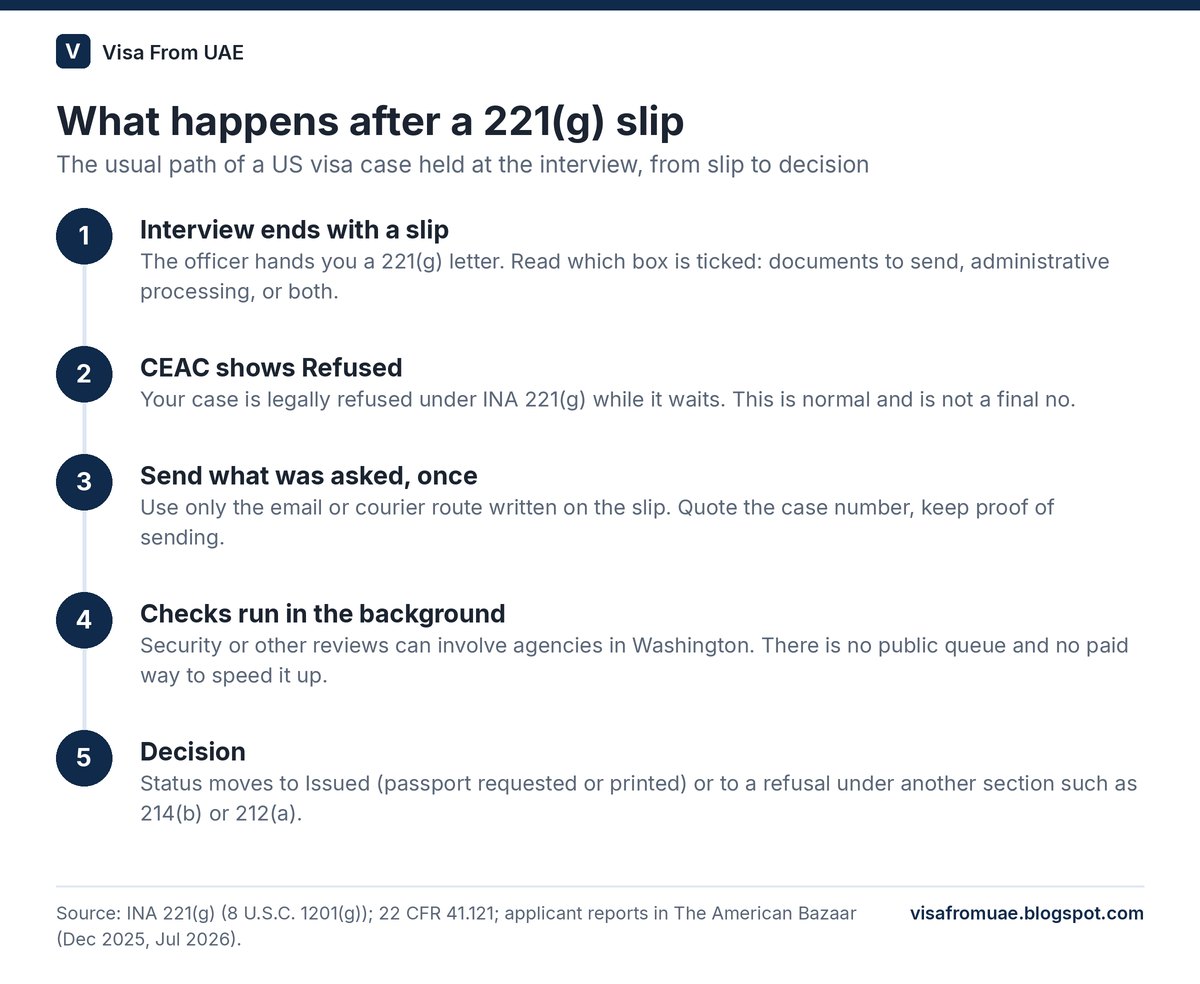
This confuses almost everyone, so it is worth repeating: under the regulation, the officer must "issue the visa, refuse the visa" or, in rare cases, discontinue granting it. There is no third box called "pending". So a case on hold is technically a refusal under 221(g), and the online status page shows it that way.
Real cases show how normal this is. In December 2025 an H-1B applicant in Chennai described being asked whether his social media accounts were public, receiving a white 221(g) notice, and seeing his CEAC status as "refused". In a later update he reported that his wife's case at the Hyderabad consulate had moved "from REFUSED to APPROVED". The status word did not tell either of them anything about the outcome.
Read your slip: documents, administrative processing, or both
The slip is the only document that tells you what is actually going on, so read it slowly before you email anyone or pay anyone. Most slips have tick boxes. The two that matter:
- Documents requested. The officer wants something specific: a bank statement, an employer letter, a CV, a list of publications, a previous petition document. These cases can usually be fixed by you.
- Administrative processing. The officer, or someone in Washington, needs to run checks before deciding. You usually cannot fix these by sending paper.
Sometimes both are ticked. In July 2026 an H-1B renewal applicant in Hyderabad was asked for his 2025 W-2 and his current Labor Condition Application. The officer noticed the salaries did not match (he had a raise in September 2025, which the newer LCA showed but the W-2 did not). He got a white 221(g) slip with administrative processing marked, the consulate kept his passport, and a second officer asked him to email his previous LCA. He sent it the same day with a year of payslips and an explanation. That is the right reflex: answer exactly what was asked, completely, and with a short explanation of any mismatch.
What about the slip colours?
Forums are full of "white slip versus yellow slip versus pink slip" threads. Reports describe 221(g) notices in white, blue, pink and yellow. The trouble is that colours are a local printing choice and vary between posts and over time. I would not try to read your future from the colour. Read the boxes and the handwritten or typed instructions instead, because those are what the officer actually decided.
Did they keep your passport?
Some posts keep the passport during processing, others hand it back and ask for it later. Neither one is a hidden signal of approval. If the post kept your passport and you need it for travel inside the region (for example a GCC trip or an urgent trip home), contact the post through the route printed on your slip and ask how to get it back temporarily. Do not just book a flight and hope.
Why cases go into administrative processing
The government does not tell you the reason, and officers often cannot. Immigration attorney Vasanth Vaidyanathan lists the usual triggers in his explainer on administrative processing:
- a name that matches or resembles a name in a security database, so identity has to be confirmed;
- work or study in sensitive technology fields that trigger export control checks;
- nationality of a country the US treats as a state sponsor of terrorism (he names Iran, Syria and North Korea);
- inconsistencies in documents, job history or earlier immigration records;
- earlier refusals, overstays or other violations.
Two newer triggers matter in 2026. The first is the online presence review. According to Gulf News, a State Department announcement dated 18 September 2026 extended the social media screening to I, TN and TD visas from 1 October 2026. It already applied to F-1 and M-1 students, H-1B, H-3 and certain H-4 applicants, J-1 and J-2 exchange visitors, K fiancé visas, Q, R, S, T and U visas. Applicants in those categories are told to set every social media profile to "public". When the H-1B screening started in December 2025, reports of 221(g) slips after social media questions came almost immediately.
The second is policy holds that have nothing to do with your file, covered further down.
How long does 221(g) administrative processing take?
This is the question in nearly every search, and the honest answer is that nobody publishes a queue. What I can give you is the set of markers that actually exist in US law, and what one court did with them this year.
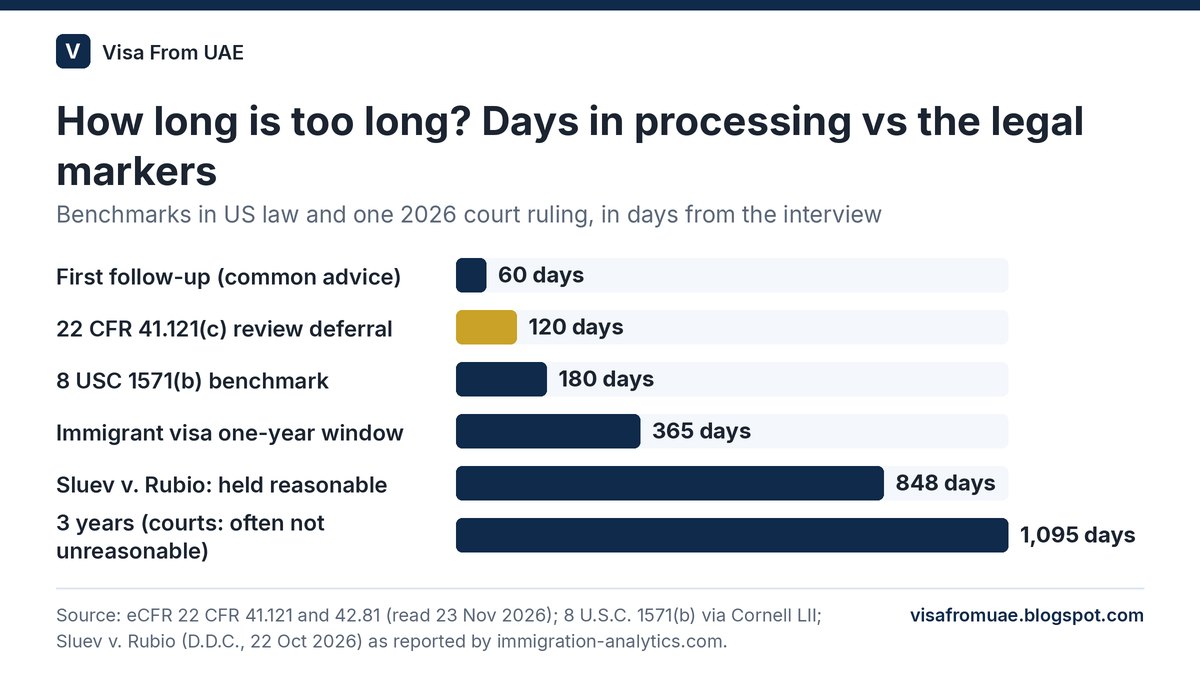
Day 60. Vaidyanathan writes that the State Department says most administrative processing cases are resolved within 60 days of the interview, and that this is not a deadline. I could not load the State Department's own page from our server to check its current wording, so treat 60 days as the point where a polite follow-up becomes reasonable, not as a promise.
Day 120. This one is in the regulation itself. 22 CFR 41.121(c) says that when a refusal "may be overcome by the presentation of additional evidence, and the applicant has indicated the intention to submit such evidence, a review of the refusal may be deferred for not more than 120 days." My script confirmed the wording in the eCFR text in force on 1 November 2026; the eCFR version history shows the section was last amended on 22 April 2019. It is a rule about supervisory review inside the consulate, and it is not written as a deadline for you.
Day 180. In 8 U.S.C. 1571(b) Congress said it is "the sense of Congress" that immigration benefit applications should be completed within 180 days. Courts in Washington treat that as an aspiration, not a binding limit.
Day 365. For immigrant visas only, 22 CFR 42.81(e) says that if you bring further evidence "within one year from the date of refusal", the case "shall be reconsidered" and "an additional application fee shall not be required". Miss the year and you may be paying again.
The October 2026 ruling that resets expectations
On 22 October 2026 Judge Amit P. Mehta of the federal court in Washington ruled in Sluev v. Rubio. A student admitted to Dartmouth interviewed at the US Embassy in Astana on 24 June 2024, sent his CV and publication list two days later, and was still in administrative processing when the judge ruled. According to the report by immigration-analytics.com, the judge held that 28 months "is within the range of reasonableness", noted that delays of three to five years "are often not unreasonable", and dismissed the case.
I counted the days: 26 June 2024 to 22 October 2026 is 848 days, about 4.7 times the 180 day benchmark. What made the case interesting is that the same judge had refused to dismiss it in February 2026, partly because the student relied on the 120 day line in 41.121(c). Getting into court was possible. Winning on the clock was not.
So if your case is two months old, you are not yet in "something is wrong" territory by any legal measure. If it is a year old, you may have a strong personal story, but the courts in Washington have just shown that time alone may not be enough.
What to do from the UAE while you wait
1. If documents were requested
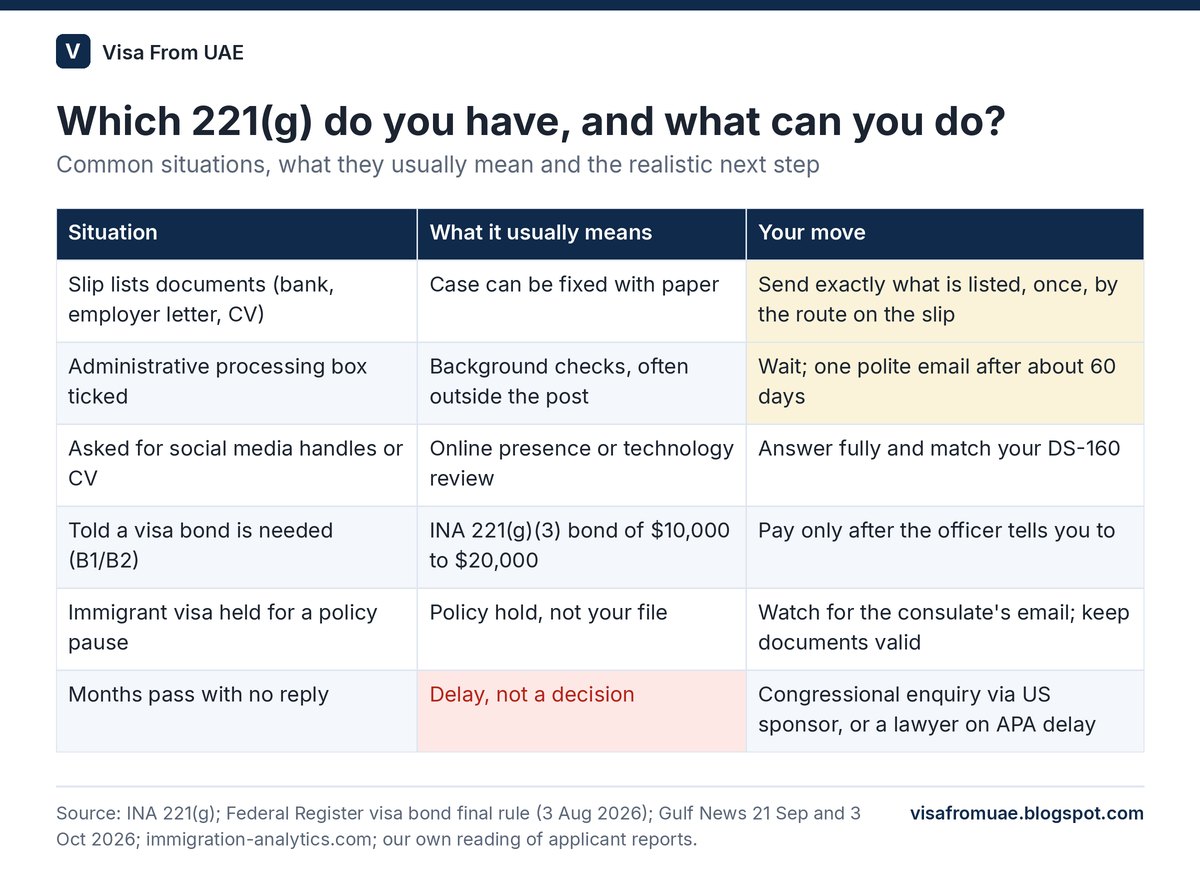
Send exactly what the slip asks for, by the exact method it gives (some posts use an email address, others a courier drop-off). Put your case number and full name in the subject line. Send it once, in one complete package, and keep the proof. If something genuinely cannot be obtained, say so and explain why, rather than sending a near substitute without comment.
If your documents show something that looks inconsistent, such as two salaries, a job title that changed, or a different address, add a short plain explanation with evidence. The Hyderabad case above is a good model: previous LCA, payslips, one paragraph explaining the raise.
2. If it is administrative processing
Wait. There is no premium service, and no agent in Dubai can buy a faster security check. After roughly 60 days, one polite email to the post that interviewed you is reasonable: case number, interview date, the type of visa, and if there is a real deadline (a course start date, a medical appointment, a court date), the evidence for it. Then wait again. Sending the same email every week does not move a security review.
If your sponsor or employer is in the US, a congressional enquiry through their member of Congress is a route many US-based sponsors use to get a status confirmation. It does not change the decision, and it does not make Washington skip a check.
3. Should you file a lawsuit?
For long delays, US lawyers file suits under the Administrative Procedure Act and the Mandamus Act asking a court to order the government to decide (not to issue). Vaidyanathan notes that courts rarely see delays under six months as unreasonable, that filing after only three months is usually premature, and that a suit can lead to closer scrutiny and sometimes a refusal rather than an approval. Since the Sluev ruling, anyone in Washington's federal court should also expect the government to argue that two years or more is still reasonable. This is a decision for a US licensed immigration lawyer, not for a visa agent.
4. Do not reapply over the top of it
A new DS-160 and a new interview while the old case is pending usually wastes a fee and an appointment slot, because the first case does not disappear and the same checks follow your name. The exception is when the post or a lawyer tells you to, for example after a final decision under another section.
The 221(g) visa bond: a newer reason for a hold
Some UAE residents now get a 221(g) for a reason that is about their passport, not their file. Section 221(g) contains a bond provision for visitors and students, and on 3 August 2026 the State Department made its visa bond program permanent through a final rule in the Federal Register. Under it, a consular officer can require certain B-1/B-2 applicants who are otherwise eligible to post a bond of $10,000, $15,000 or $20,000 before the visa is issued. That is roughly AED 36,700, 55,100 or 73,500 at the fixed rate of AED 3.6725 to the dollar.
The rule says the covered countries are announced on travel.state.gov, with 15 days' notice for additions. Gulf News reported on 3 October 2026 that the updated list covered 50 countries, that Indian passports are not included, and that Bangladesh, Bhutan and Nepal are. The bond is posted through Form I-352 on Pay.gov, and the State Department warned applicants not to pay before a consular officer tells them to. Paying the bond does not guarantee the visa, and the money comes back when the bond conditions are met.
If you hold a passport from a listed country and live in Dubai, expect the bond conversation to be part of the interview, and do not let anyone sell you a "bond guarantee" in advance.
Immigrant visas and the 2026 policy pauses
If you are a UAE resident waiting for a green card interview (a family or employment immigrant visa), you may have been caught by holds that had nothing to do with your documents.
In January 2026 the State Department suspended immigrant visa processing for nationals of 75 countries. Immigration-analytics.com's list includes Pakistan, Bangladesh, Nepal, Egypt, Nigeria, Iran, Iraq, Yemen and Russia, and the measure also covered people born in those countries. Those are common passports in the UAE. Gulf News reported that a federal judge struck the suspension down on 21 August 2026, ruling that it went beyond the Secretary of State's authority. Soon after, the State Department paused immigrant visa interviews worldwide while consular officers were trained on new public charge guidance, Khaleej Times reported on 27 August.
For a case refused under 221(g) because of a policy pause, the useful facts are the one year reconsideration window in 42.81(e) and the no new fee rule. Keep your medical, police certificates and civil documents valid, watch for the consulate's email, and if you are approaching a year since the refusal, ask the post in writing how your case will be reconsidered.
The UAE problem in 2026: where is your case?
Here is the part most global 221(g) guides miss. For most of 2026 the US missions in the UAE have been working under the strain of the regional conflict. In July, Khaleej Times quoted a US Embassy Abu Dhabi spokesperson saying that while the embassy and the Dubai consulate are open, "routine visa processing is not available in the United Arab Emirates at this time", and that applicants should book interviews in their country of residence or nationality. Gulf News reported on 14 July that both missions were on ordered departure status, with non-emergency staff relocated outside the UAE.
By 7 November 2026 travel agents told Khaleej Times that some applicants faced waits of nearly a year for a regular US visa interview, and in August agents said the B1/B2 dates they could see ran to August 2027.
What this means for a 221(g):
- If you interviewed in Abu Dhabi or Dubai before the suspension and are still in processing, your case sits with that post. I found no public statement on how pending administrative processing cases are being handled during the ordered departure. Use the contact route on your slip, keep it short, and be patient.
- If you interviewed in your home country (many Indian and Pakistani residents of the UAE did this year) your 221(g) belongs to that consulate. Documents go to that post, not to the US Embassy in Abu Dhabi.
- Your UAE residence visa must stay valid. If it lapses while the case is pending, your proof of a stable life and job outside the US gets weaker, and that is part of what the officer weighs.
If you are planning a new application rather than chasing an old one, read our US visa from Dubai and Abu Dhabi B1/B2 guide and the US visa renewal and interview waiver guide first.
Common mistakes I keep seeing
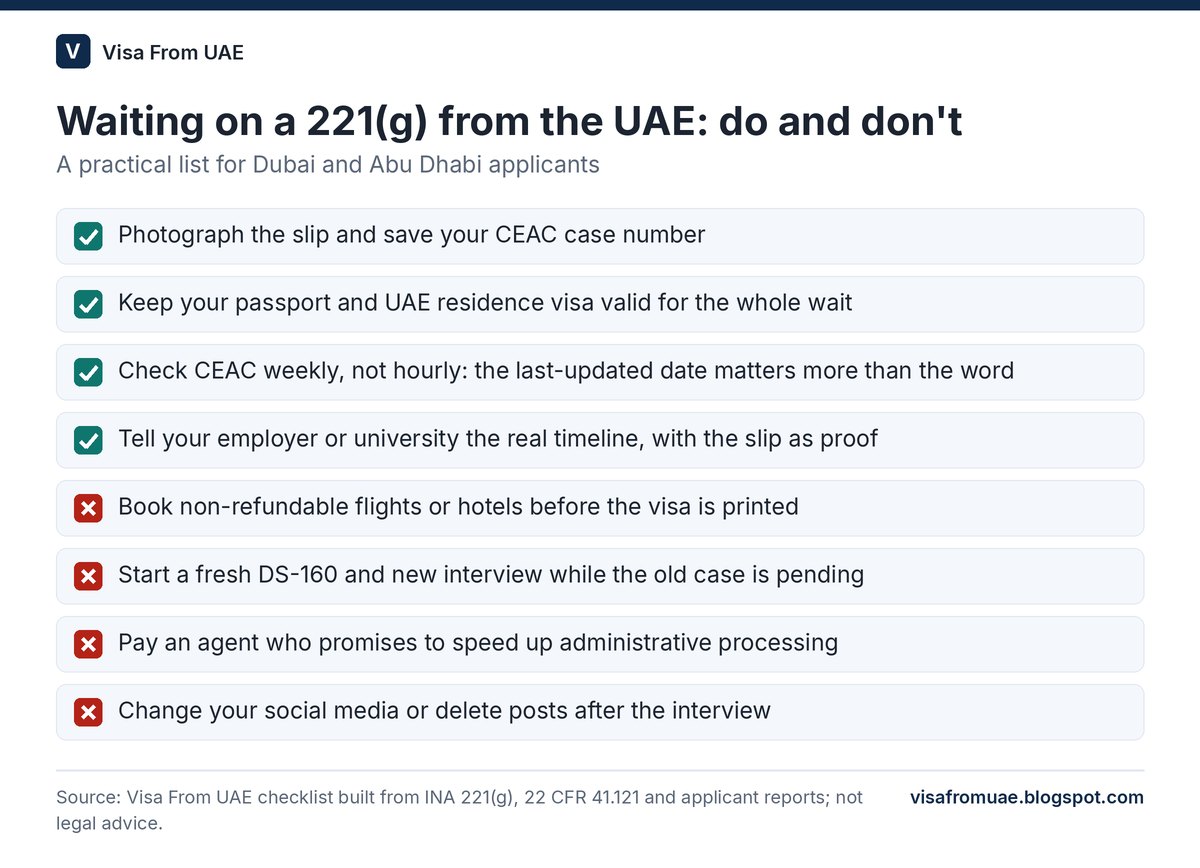
- Treating "Refused" as the end. People re-book holidays and resign from planning, then the case is issued a month later.
- Sending everything they own. A 60 page bundle in reply to a request for one employer letter makes the officer's job harder, not easier.
- Cleaning up social media after the interview. If the officer reviewed your profiles, making them private or deleting posts afterwards creates exactly the kind of inconsistency that keeps a case open.
- Paying fixers. Nobody outside the US government can see inside a security advisory review, let alone speed it up.
- Booking non-refundable travel. Until the visa is printed in your passport, any date is a guess.
Frequently asked questions
Is a 221(g) a rejection?
Legally it is a refusal, but a temporary one. The law refuses issuance until the application complies or checks are done. Many 221(g) cases end in a visa. A 214(b) refusal is the final kind.
How long does 221(g) administrative processing take?
There is no fixed time. Attorneys cite the State Department's statement that most cases finish within 60 days. Some take months or years, and in October 2026 a US court ruled that 848 days was not unreasonably long.
My CEAC status changed from Refused to Issued. What now?
Watch your email and the appointment account for the post's instructions on passport submission or collection, and follow them exactly. Do not book travel until the visa is physically in your passport and the details are correct.
Can I travel to the US on my old visa while a 221(g) is pending?
If you still hold a valid, unexpired visa, ask a US licensed lawyer before you fly. A pending refusal on a new application is on your record, and the officer at the border decides admission, not the visa alone.
Do I pay the visa fee again after a 221(g)?
For immigrant visas, 22 CFR 42.81(e) says no additional application fee is required if you bring further evidence within one year of the refusal. For other visas, follow the instructions on your slip.
Can I apply for a Schengen or UK visa while my US case is in 221(g)?
Yes. A pending US case does not stop other applications, and a 221(g) is not a 214(b) style refusal. If a form asks about refusals, answer honestly and explain it was a temporary 221(g). For other refusals, see our guides on UK visa refusals and Schengen visa rejections.
More guides for UAE residents
- US visa from Dubai and Abu Dhabi: B1/B2 guide
- US visa renewal from UAE: interview waiver rules
- Canada visitor visa refused from UAE
- UK visa refused? Applying again from the UAE
- Visa-free countries for UAE residents
Sources
- 8 U.S.C. 1201 (INA section 221), subsection (g), Cornell Legal Information Institute (read 23 November 2026)
- 22 CFR 41.121 Refusal of nonimmigrant visas, eCFR (text in force 1 November 2026; last amended 22 April 2019)
- 22 CFR 42.81 Procedure in refusing immigrant visas, eCFR (text in force 1 November 2026)
- 8 U.S.C. 1571(b), Cornell Legal Information Institute
- Federal Register: Visas: Visa Bond Program, final rule, 3 August 2026
- Immigration Analytics, 25 October 2026: Visa administrative processing, 28-month F-1 wait not unreasonable (Sluev v. Rubio)
- Immigration Analytics (Vasanth Vaidyanathan): Understanding US visa administrative processing (221g)
- Immigration Analytics: Understanding mandamus for visa delays
- Immigration Analytics, 14 January 2026: Immigrant visa processing suspended for 75 countries
- The American Bazaar, 17 December 2025: H-1B applicant recounts social media questions and 221(g)
- The American Bazaar, 23 July 2026: H-1B renewal applicant gets 221(g) over salary difference
- Gulf News, 21 September 2026: US visa applicants face new social media rule from October 1
- Gulf News, 3 October 2026: US visa bond of up to $20,000 applies to 50 countries
- Gulf News, 26 August 2026: US visa interviews disrupted worldwide for consular officer training
- Gulf News, 14 July 2026: US Embassy in Abu Dhabi, Consulate in Dubai halt consular services
- Khaleej Times, 21 July 2026: US visa appointment delays put UAE students' university plans at risk
- Khaleej Times, 27 August 2026: US visa appointments paused worldwide, what UAE applicants need to know
- Khaleej Times, 7 November 2026: US, Europe visa delays prompt UAE residents to rethink winter travel
Laws and regulations were read from eCFR and the Cornell LII US Code on 23 November 2026 and checked with our own script. The State Department's travel.state.gov and embassy pages could not be loaded from our server, so check them yourself before acting. Dirham amounts use the fixed rate of AED 3.6725 per US dollar. This guide is general information, not legal advice; for a long delay or a lawsuit, speak to a US licensed immigration lawyer. See our Disclaimer.
Last updated: November 23, 2026