If you fly from Dubai or Abu Dhabi to Europe this winter, nobody will stamp your passport at the Schengen border. Since 10 April 2026 the stamp has been replaced by the Entry/Exit System, or EES: a database that records your face, in many cases your fingerprints, and the exact date and place of every entry and exit. It counts your days for you, and it flags you as an overstayer automatically if the count goes over.
Most of what you find online about EES is written for British and American tourists. People living in the UAE are in a different spot, because most of us travel on a Schengen visa rather than visa free, and that changes what the border takes from you and which number of days applies. On 22 November 2026 I read the EES Regulation itself, the European Commission's pages, the UK government's travel advice and this month's reports on travellers wrongly flagged as overstayers, and I ran the 90/180 count on four example trips to see what a missing exit record does to your file.
Short answer: EES applies to every UAE resident who visits the Schengen area for a short stay, whatever their nationality, unless they also hold a Schengen residence permit or long-stay visa. Your UAE residence visa does not exempt you. It is free and there is nothing to apply for before you fly. If you travel on a Schengen visa, the EES file holds your face photo, because your fingerprints were already taken at VFS. Emiratis and other visa-free passport holders give a face photo and four fingerprints. Children under 12 give no fingerprints. Keep your boarding pass every time you leave Europe: if your exit is not logged, the system keeps counting days as if you never left.
What EES is, and what changed for travellers from the UAE
The Entry/Exit System is an EU database run by eu-LISA, the agency that also runs the visa database. Each time a non-EU traveller crosses an external border for a short stay, it records the name, travel document details, biometrics, and the date and place of entry and exit. It also records refusals of entry. In the Commission's words, it "replaces the stamping of passports allowing the automatic detection of overstayers".
The timeline, from the Commission's own page:
- 12 October 2025: progressive start. Border points switched on in stages and stamps were still used alongside.
- 10 April 2026: the system became fully operational and stamping ended.
- 6 September 2026: the emergency option to suspend EES at busy border points expired.
- Mid September 2026: according to press reports, nine countries (Belgium, France, Germany, Greece, Italy, Malta, the Netherlands, Portugal and Switzerland) were informally allowed to keep pausing biometric collection when queues build up, with no end date. Spain did not ask for this.
EES runs in 29 countries: every EU country except Cyprus and Ireland, plus Iceland, Liechtenstein, Norway and Switzerland. Bulgaria and Romania use it. Cyprus and Ireland do not, so a trip there from Dubai still works the old way, with each country's own rules.
What changed in practice for us is small at the counter and big in the background. You still show your passport and visa, the officer can still ask about your hotel, money and return flight, and you still need a valid visa if your nationality needs one. What is new is that your file follows you. Every entry and exit is now in one EU system that every Schengen border guard can see, so the 90/180 day count is no longer something an officer works out by flipping through stamps. It is calculated for them.
Who has to register: UAE residence does not exempt you
The question I see most from people in the UAE is whether their Emirates ID or residence visa changes anything. It does not. The EES Regulation applies to "third-country nationals admitted for a short stay", which means anyone who is not an EU, EEA or Swiss citizen, visiting for up to 90 days. Where you live does not matter. The list of people it does not apply to, in Article 2(3), is short:
- holders of a residence permit issued by a Schengen country, and holders of a long-stay national (D) visa;
- non-EU family members of an EU citizen who hold an EU residence card;
- nationals of Andorra, Monaco and San Marino, and Vatican passport holders;
- a few special categories such as diplomats and cross-border workers covered by separate rules.
So an Indian engineer in Dubai, a Filipino nurse in Abu Dhabi, an Emirati family going to Switzerland and a British teacher living in Sharjah are all in EES when they visit for a holiday. The one UAE resident who is not is someone who also holds, say, a German residence permit or a French long-stay visa. The UK government's advice puts it simply: carry documents that confirm your status if you are exempt.
What the border records for you, by passport
This is the part most guides get wrong for UAE readers. They say "everyone gives fingerprints". The Regulation splits travellers into two groups and records different things for each.
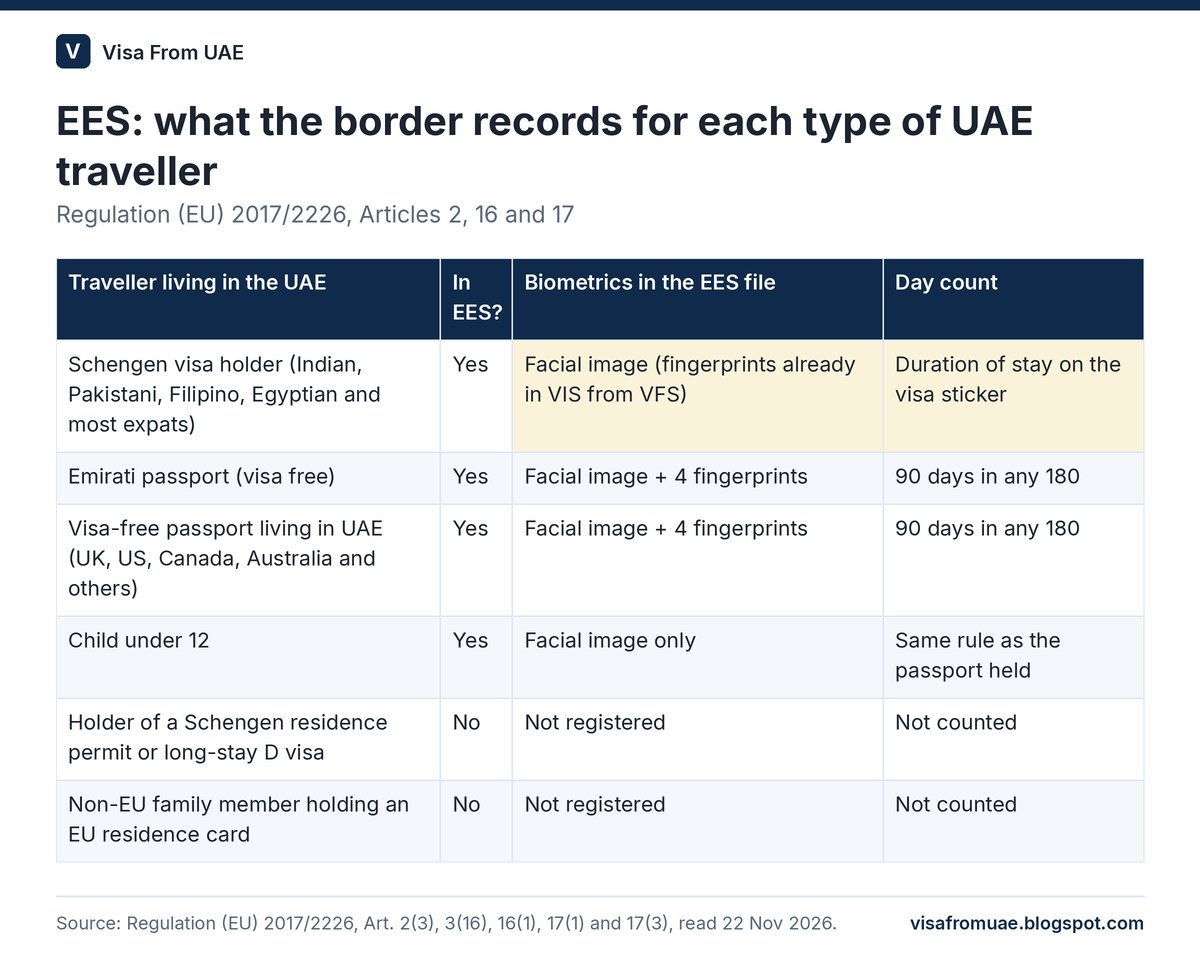
If you need a Schengen visa (most expats in the UAE: Indian, Pakistani, Filipino, Egyptian, Bangladeshi, Sri Lankan, Nepali, Jordanian and many more), Article 16 lists what goes into your EES file: your name, date of birth, nationality, passport details and "the facial image". Fingerprints are not on that list. The reason is that your fingerprints were already taken at VFS or BLS when you applied and are stored in the Visa Information System, which the border can check. Each entry record also stores your visa sticker number, the type of visa and "the end date of the maximum duration of the stay as authorised by the short-stay visa".
If you are visa free (Emirati citizens, who have not needed a Schengen visa since 2015, and UAE residents with UK, US, Canadian, Australian or other visa-free passports), Article 17 adds fingerprints: "the four fingerprints of the index, middle finger, ring finger and little finger from the right hand where present, and otherwise from the left hand". That is the answer to the common search "EES fingerprints which hand".
Children under 12 are exempt from fingerprints under Article 17(3). They still have a face photo taken. People who physically cannot give fingerprints are also exempt; if the problem is temporary, the border notes it and takes the prints on the next crossing.
A practical point that follows from this: if you are an Emirati or hold a visa-free passport, there is no VFS appointment where your biometrics were captured in advance, so your first crossing creates the whole file at the border. That is why the first entry is the slow one. Visa holders still have their face photo taken and their visa checked, so they are not much quicker on a first trip.
Your first crossing, step by step
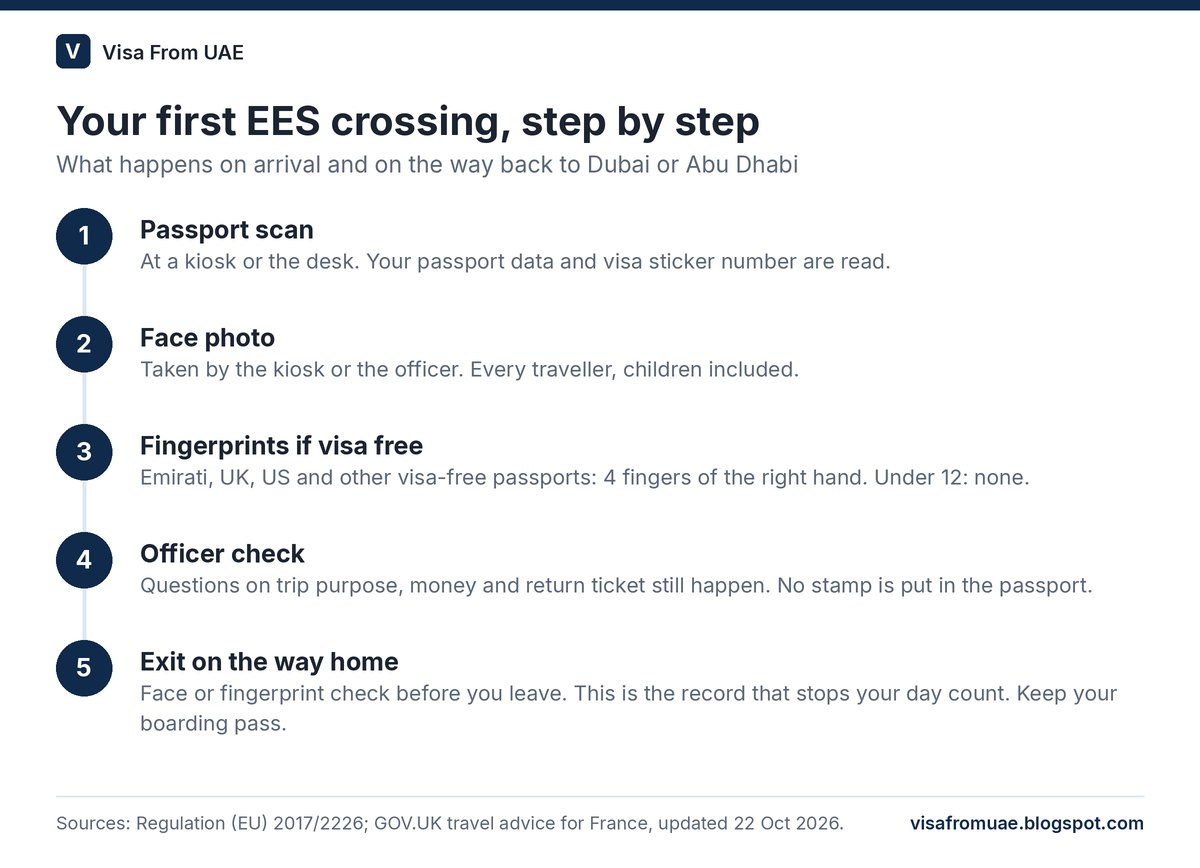
On arrival you either go to a self-service kiosk or straight to the officer, depending on the airport. Your passport is scanned, your photo is taken, and fingerprints are taken if your passport is visa free. Then the officer does the normal entry check. GOV.UK's advice for France says you may be asked to register at a special booth before reaching the desk, that children aged 11 or younger will not have fingerprints scanned but can have a photo taken, and that "there is no cost for EES registration".
On the way back to Dubai or Abu Dhabi, the exit check happens at passport control before your gate. GOV.UK warns to allow extra time because "EES checks may take place before boarding". This is the step people rush, and it is the step that matters most, because a missing exit record is the main cause of the overstay errors in the news this month.
After the first crossing, your file stays valid for three years from your last exit, so later trips only need a quick face or fingerprint match. Some countries also let you pre-register at kiosks or through the EU's Travel to Europe app; Biometric Update reported in September that Sweden and Portugal offer the app route. Check what your arrival airport offers rather than assuming.
Queues: what to expect this winter
EES has not run smoothly. Airports Council International Europe and Airlines for Europe reported border waits of up to five hours at peak times in October and asked the Commission for a six point action plan. The Commission's migration commissioner told Brussels Airport and member states to fix the queues before Christmas. In France, the interior ministry kept flexibility on pre-registration kiosks until the end of the year, according to Connexion France as reported by Biometric Update.
What this means for a trip from the UAE:
- On arrival, a long queue costs you time but nothing else. Do not book a tight onward train or a connecting flight on a separate ticket right after landing.
- On departure, a long queue can cost you the flight. For flights back to Dubai or Abu Dhabi, arrive earlier than you used to, especially from big hubs in the nine countries above where checks may be on one day and paused the next.
- If you connect inside Schengen (Dubai to Munich to Vienna, for example), the EES entry happens at your first Schengen airport, Munich. Allow for that in the connection time.
The 90/180 rule under EES, with tested examples
EES did not change the rule. It changed who does the maths. The rule is still a maximum of 90 days in any 180-day period, where you count back 180 days from each day you are in the Schengen area. The European Commission's short-stay calculator page adds a line UAE visa holders should read twice: "If you hold a short-stay visa, check the period of authorised stay which is printed on the visa sticker. If it is shorter than 90 days, don't use this calculator." Your sticker's "duration of stay" box is your real limit, and EES records it.
I wrote a small script that counts days the way that page describes (the entry day and the exit day both count) and ran four cases. These are worked examples, not anyone's real record.
Example A: a Dubai resident with a multiple entry visa
Three trips in 2026: 1 to 14 February, 10 to 30 April and 1 to 20 July. On 20 July the count is 55 days in the last 180. On 15 August it has fallen to 41, because the February trip has dropped out of the window. Entering again on 15 August, the longest stay that stays inside the rule is 49 days. Entering on 18 December, the full 90 days is open again, as long as the visa itself allows it.
Example B: the same trips, with one exit not recorded
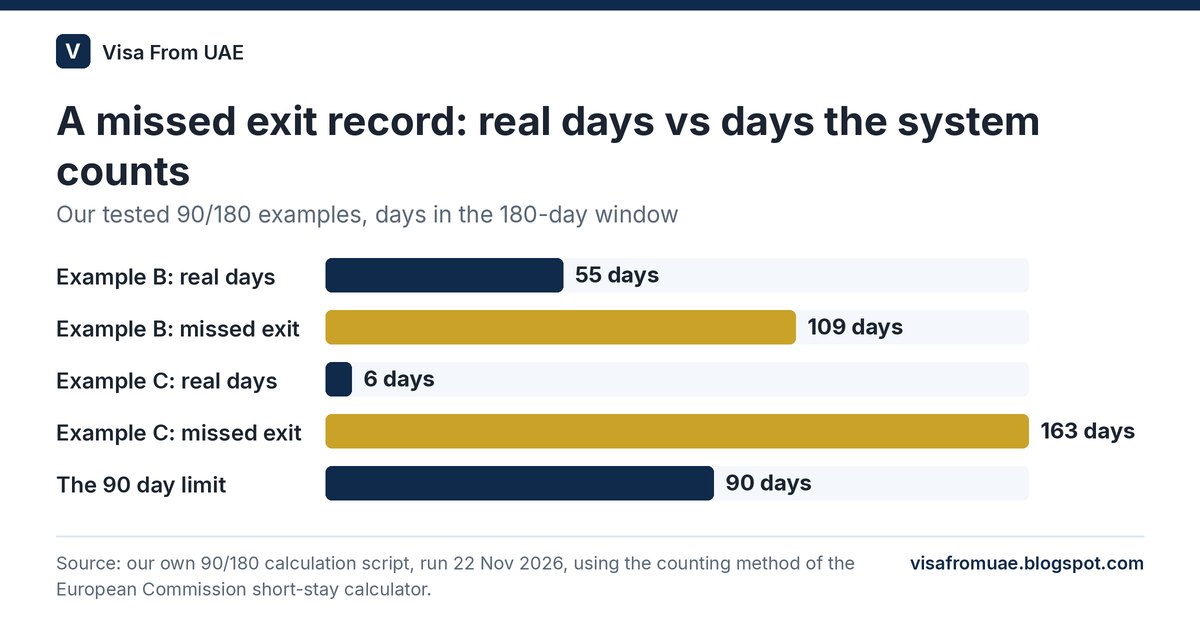
Now say the exit on 14 February was never logged. The system sees one stay running from 1 February until the next entry on 10 April. On 20 July it shows 109 days instead of 55, and by its count the traveller went over 90 on 2 July the second day of a trip that was perfectly legal.
Example C: one short trip, then a missed exit
A five night trip, 10 to 15 May, with the exit at the airport not logged. Nothing happens until the next trip in October. By 19 October the system counts 163 days against a real total of 6, and it has flagged an overstay from 8 August. This is the same pattern as the case Which? reported on 10 November: the author Jojo Moyes left Portugal in May, her exit was not logged, and at Marseille in October she was told she faced a fine of up to EUR 10,000 and a two year ban if she came back before it was fixed.
Example D: an Emirati who stays 60 days in summer
An Emirati citizen spends 1 June to 30 July in Europe, which is 60 days. Entering again on any date from 1 August to 28 October, the longest allowed stay is 30 days. Entering on 29 October or later, it jumps straight to 90 days, because by the time a 30 day stay would run out, the June days start dropping out of the window one by one. One day's difference in the entry date is worth two extra months. EES will calculate this at the border, but it is far better to know it before you book.
Wrongly flagged as an overstayer: how to fix it from the UAE
EES does not send you a message when your record is wrong. You find out when you check it yourself or when a border guard tells you. Euronews reported on 11 November that Which? had heard from dozens of readers with missing exit records, and other cases include travellers rejected at eGates because they ended up with more than one EES file. So:
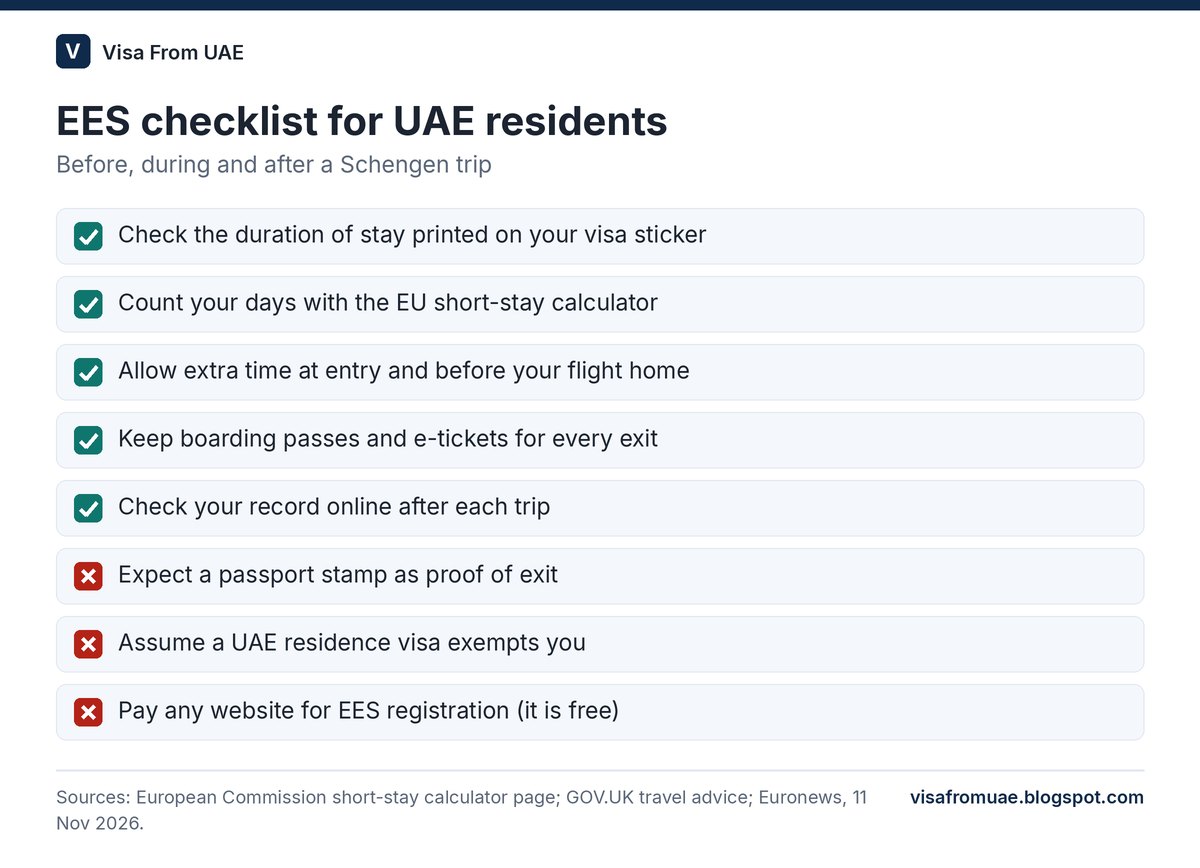
- Check your record after each trip. The official EES website has a tool to check how many days you have used in the last 180. If it shows the wrong number or says your data is incomplete, act before your next trip, not at the airport.
- Collect proof of exit. A boarding pass, e-ticket and receipt for the flight home, your UAE entry record if you have one, and anything else that shows the date you left. Save PDFs or screenshots, because airline apps do not keep them forever.
- Write to the right authority. The EES site lists the data protection contact for each country. Under Article 52 of the Regulation, you can send your request to the competent authority of any Schengen country, not only the one where the mistake happened. Include a passport copy and your proof of exit.
- Know the deadlines. The country must reply within 45 days of receiving your request. If it has to ask the country that entered the data, it must contact it within seven days, and that country then has 30 days to check. If the data is wrong, you must be told in writing that it was corrected.
- If you are at the border with a wrong record, GOV.UK's advice is to "raise this with border officials and be prepared to provide supporting evidence if requested". Ask the officer to correct it there. Article 35 lets any Schengen country fix data that is shown to be inaccurate.
Why this matters more for UAE residents than for a British tourist: a recorded overstay is the kind of thing that comes up in your next Schengen visa application from Dubai, and refusals are already common enough. Data on overstayers is kept for five years under Article 34(3), against three years for a normal record. Our guide to Schengen visa refusals from the UAE explains how prior stays are assessed.
What EES numbers show so far
The Commission's figures for the first six months, reported by The Local on 20 May 2026: more than 108.5 million entries and exits of non-EU nationals recorded, 43,728 people refused entry, and 8,739 of those refusals linked to overstays. The largest group, 16,383, were refused for having no "appropriate justification" for their stay, which is the same weakness that gets visa applications refused: a vague purpose, no hotel, or not enough money. 6,141 had no valid visa or residence permit.
For a UAE resident the takeaway is that the border now has better data than the consulate that gave you the visa. If your visa says 15 days and you stay 17, it will be seen the day you leave.
EES and ETIAS are not the same thing
ETIAS is the separate online travel authorisation for visa-free travellers, similar to the US ESTA or the UK ETA. It is not running yet. The Polish embassy in Abu Dhabi's notice of 1 October 2026 says its launch "is planned for 2027" and "the date of the entry into operation will be communicated at a later stage". When it starts, an ETIAS will be valid for three years or until the passport expires.
For UAE residents this splits cleanly:
- Schengen visa holders will never need ETIAS. The visa does that job.
- Emiratis and other visa-free passport holders will need ETIAS once it starts, on top of EES. Until then, they need nothing in advance.
- Nobody needs to pay a website for EES. It is free and happens at the border.
Common mistakes I keep seeing
- Thinking a UAE residence visa or Golden Visa exempts you. It does not. Only a Schengen residence permit or long-stay visa does.
- Counting 90 days when your visa says less. A first visa from the UAE is often issued for the trip dates only. The sticker's duration of stay is your limit.
- Throwing away boarding passes. With no stamps in your passport, they are your only private proof of the date you left.
- Booking tight connections. Your first Schengen airport is where EES registration happens, and queues there are not predictable.
- Forgetting the old passport after a renewal. A new passport has a new number, and Which? has reported travellers ending up with more than one EES file, which made eGates reject them. If you renewed in the UAE since your last trip, carry the old passport too.
Frequently asked questions
Do I need to register for EES before I leave Dubai?
No. GOV.UK's advice says you do not need to take any action before you arrive at the border. Registration happens at your first Schengen entry. Some countries offer optional pre-registration at kiosks or through the Travel to Europe app.
Does EES apply if I have a multiple entry Schengen visa?
Yes. Every entry and exit is recorded, and the visa's duration of stay and the 90/180 rule are checked against your record. See our guide to the Schengen visa cascade for UAE residents.
Will I get a passport stamp at all?
Not at the countries running EES, since 10 April 2026. Cyprus and Ireland are outside EES and follow their own rules.
How long does the EU keep my EES data?
Three years from your last exit for a normal record, and five years if there is no exit after your authorised stay ended (Article 34).
Do children have to give fingerprints?
Not under 12. They still have a face photo taken.
Can a missed exit get my next Schengen visa refused?
It can cause questions, which is why you should fix it as soon as you notice. Ask for a written correction and keep it with your travel documents for the next application.
Does EES change the documents I need for a Schengen visa from the UAE?
No. The checklist at VFS or BLS is the same. Our Schengen visa guide for UAE residents covers documents, fees and steps, and the processing time guide covers how early to apply.
More guides for UAE residents
- Schengen visa from Dubai and the UAE: documents, fees and steps
- Schengen visa cascade: multiple entry visas for UAE residents
- Schengen visa rejected in the UAE: reasons and appeals
- Dummy ticket for a Schengen visa from UAE
- Travel insurance for a Schengen visa from UAE
- Easiest Schengen visa from the UAE, by refusal data
Sources
- European Commission, Migration and Home Affairs: Entry/Exit System (EES), page dated 10 April 2026
- EU official EES website (Travel to Europe)
- EES website: contact details for data protection matters
- European Commission: short-stay calculator (90/180 rule)
- Regulation (EU) 2017/2226 (EES Regulation), Article 2: scope
- EES Regulation, Article 3: definitions (fingerprint data)
- EES Regulation, Article 16: data of visa holders
- EES Regulation, Article 17: data of visa-exempt travellers
- EES Regulation, Article 34: data retention
- EES Regulation, Article 35: amendment of data
- EES Regulation, Article 52: right of access and rectification
- GOV.UK foreign travel advice, France: entry requirements (updated 22 October 2026)
- Embassy of Poland in Abu Dhabi: Introduction of ETIAS in 2027 (1 October 2026)
- Euronews, 11 November 2026: EES errors and travellers incorrectly flagged as overstayers
- Which?, 10 November 2026: EES exit not recorded
- Biometric Update, 14 September 2026: EU lets 9 Schengen countries delay full EES biometric checks
- The Local, 20 May 2026: EES figures for the first six months
Rules were read on official EU and government pages on 22 November 2026. The arrangement letting nine countries pause biometric checks is based on press reports, as no official EU text has been published. The 90/180 examples were calculated with our own script and are illustrations, not legal advice. Always check your own record on the official EES website. See our Disclaimer.
Last updated: November 22, 2026