"How long does a Schengen visa take from Dubai?" sounds like a question with one answer. It has three. There is the number in EU law, there is the number each embassy prints on its VFS or BLS page, and there is the wait nobody prints: the weeks you spend trying to get an appointment in the first place. Most pages that rank for this search give you only the first one, "15 days", and leave you to find out the rest at the visa centre.
On 19 November 2026 I went through the official processing time line on the UAE page of every Schengen country that publishes one, plus the Dutch government's live figure, the Swiss embassy's own page and the BLS page for Spain. Then I pulled the European Commission's consulate statistics to see which offices in the UAE carry the heaviest load. Below is what each embassy actually commits to, where the pages contradict themselves, and how far ahead you really need to apply. If you are new to Schengen visas, our Schengen visa from Dubai and the UAE guide covers documents and fees first.
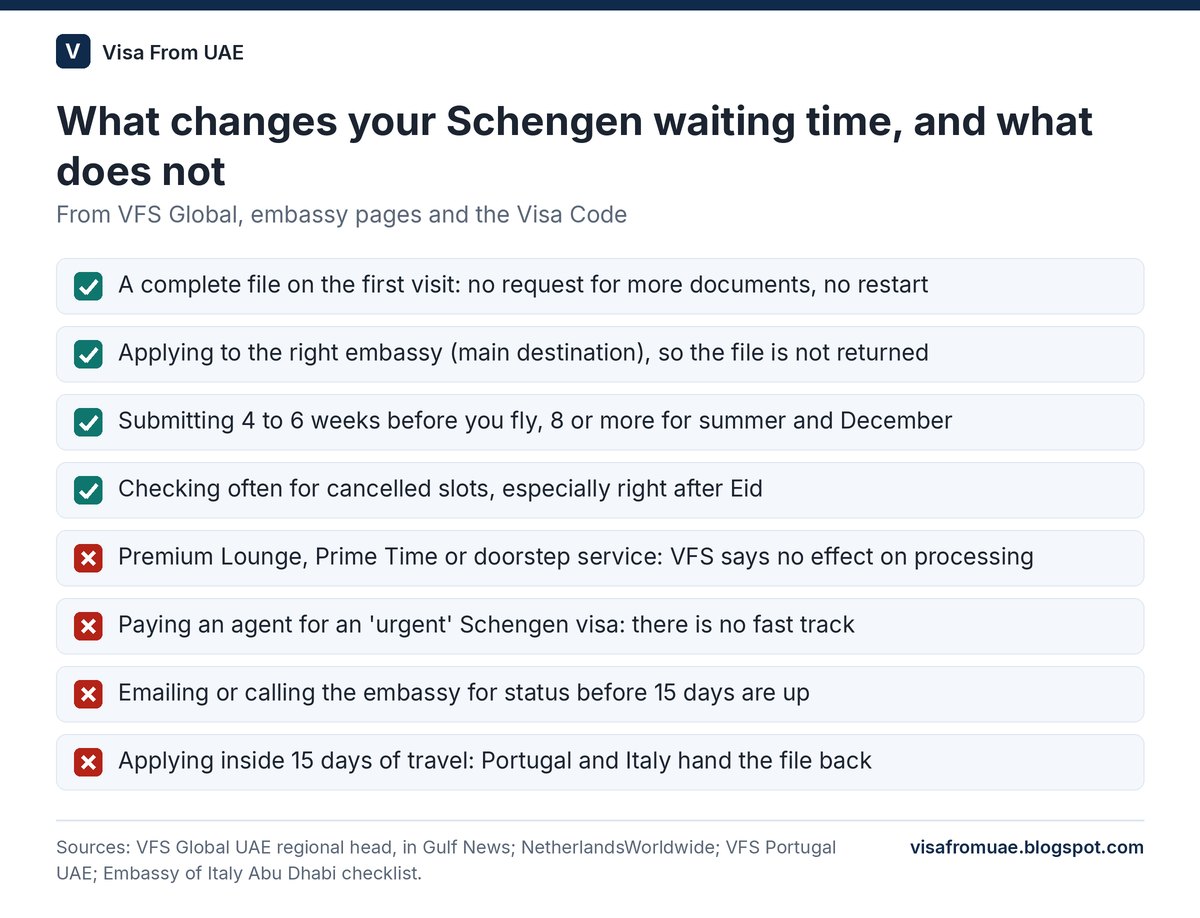
Short answer: by law a consulate must decide within 15 calendar days of a complete application, and it can stretch that to 45 days in individual cases. In the UAE most embassies say 15 days, but the Netherlands currently says 18 to 21 days and Spain says a minimum of 3 weeks. Several pages count working days, which turns 15 into about three calendar weeks. The bigger wait is usually the appointment: in October 2026 travel agents told Khaleej Times slots were 45 days to two months out for some countries. Apply as early as six months ahead, and at the latest four to six weeks before you fly, or eight weeks or more for summer, Eid and December. There is no fast track for Schengen visas.
The rule: 15 days, up to 45
All Schengen embassies work under the same law, the EU Visa Code (Regulation 810/2009, changed in 2020 by Regulation 2019/1155). Three articles decide your timeline:
- Article 9: you can apply up to six months before your trip, and as a rule no later than 15 calendar days before it.
- Article 23: the consulate decides within 15 calendar days of the date your application is lodged and accepted as complete. In individual cases, "notably when further scrutiny of the application is needed", it can extend that to a maximum of 45 calendar days.
- Article 22: for some nationalities, other Schengen states must be consulted before a visa is issued. They have seven calendar days to reply, and that time sits inside the 45.
Two details matter here. The clock runs in calendar days, so weekends count. And it starts when the embassy has an admissible file, not when you book the appointment. Before 2020 the outer limits were 30 days and, in exceptional cases, 60. Some UAE pages still quote those old numbers, as you will see below.
What each embassy says for UAE applicants
Every VFS Global country page for the UAE has a "Processing Time" tab. I read them all on the same day and copied the exact wording. Where VFS has no page for a country, or the page did not load for me, I used the embassy's own page or what we found for our country guides earlier this month.
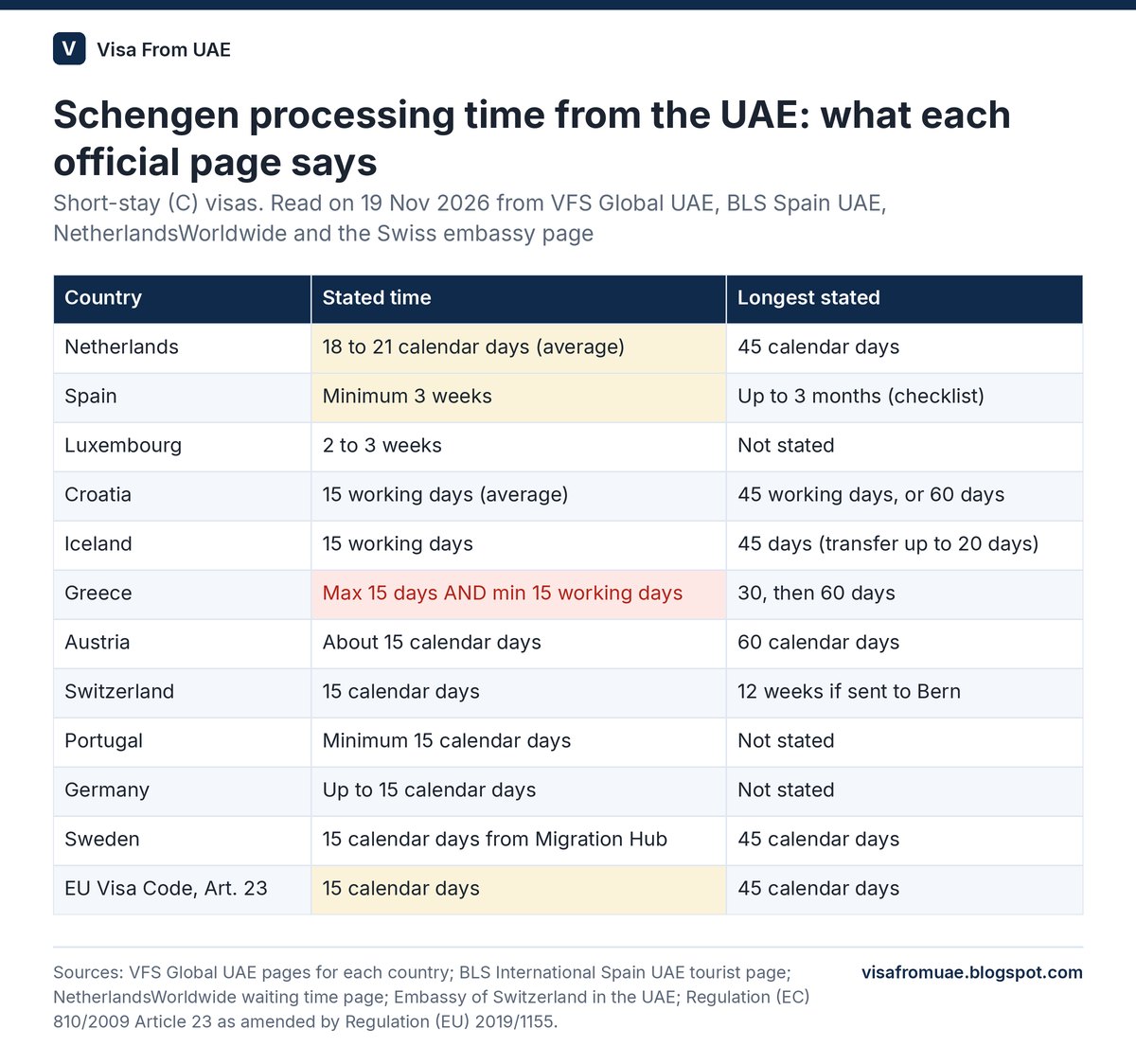
What the table hides is in the small print:
- Netherlands: NetherlandsWorldwide, the Dutch government site, lists the average for a Schengen visa as 18 to 21 calendar days, and on 19 November it carried a warning that "it is peak season" and times "may be longer than usual". The VFS Netherlands page still says 15. Trust the government figure. The Dutch also say not to contact them about status until 45 days have passed, and that their email only tells you the passport is ready, not whether the visa was granted. Our Netherlands visa guide has the rest.
- Spain: the BLS page says that "as per the instructions received from Embassy of Spain minimum processing time is 3 week", that applications must go in at least 3 weeks before travel, and that the day you submit does not count. The embassy's own checklist goes further and says the process can take up to three months under Spanish rules. See our Spain visa from Dubai and Abu Dhabi guide.
- Switzerland: the embassy page says 15 calendar days, but cases sent to the authorities in Switzerland "may take up to 12 weeks". That is longer than the 45 days in the Visa Code, and the page does not explain the gap.
- Greece: one section of the VFS page says "maximum 15 days", a few lines later the tourism tab says "minimum 15 working days", and both mention 30 and 60 days, which are the pre-2020 limits.
- Croatia (Consulate General in Dubai): an average of 15 working days, extendable to 45 working days, and up to 60 days if documents are missing. It also names the slow periods: Eid, July and August, UAE national holidays, Christmas and New Year.
- Iceland: the VFS page now carries a notice that "due to ongoing unrest in the region, the transfer of visa applications may take up to 20 days", and that the overall processing time "has been extended up to 45 days". If Iceland is your main destination, treat 45 days as the plan, not the worst case.
- Sweden: 15 calendar days, but counted "from the date the Migration Hub receives the application". Your file leaves the UAE to be decided, so transit time comes on top.
- Austria says about 15 calendar days and up to 60 when more documents are needed. Slovakia says 15 calendar days minimum and up to 30. Hungary says a minimum of 15 calendar days and sends files to the embassy the next working day. Estonia says at least two weeks. Luxembourg says 2 to 3 weeks from the date the embassy receives the file.
- Germany (Consulate General in Dubai): "up to 15 calendar days". Portugal: "a minimum of 15 calendar days", and no file is accepted with fewer than 15 days before travel. France, through France-Visas: allow at least 15 days, and there is no fast track. Italy: both missions' checklists give 15 calendar days, extendable to 45.
Almost every page ends with the same sentence: because of the minimum processing time, VFS cannot guarantee your passport back by a particular travel date. They mean it.
Working days versus calendar days
Croatia, Iceland and one Greek tab count in working days. Embassies in the UAE work Monday to Friday, so 15 working days is three full weeks, or 21 calendar days, before you add any public holiday. A file handed in on a Thursday afternoon reaches most embassies on Friday or the following Monday, and the day of submission is not counted at all at BLS and some VFS desks. So "15 days" on a working-day page is closer to 22 or 23 days from the moment you leave the visa centre.
Which offices are busiest (our analysis)
The EU does not publish processing times by consulate. What it does publish is how many applications each office receives. I added up the UAE rows in the European Commission's statistics for 2023 and 2025 and divided each office's 2025 total by roughly 250 working days.
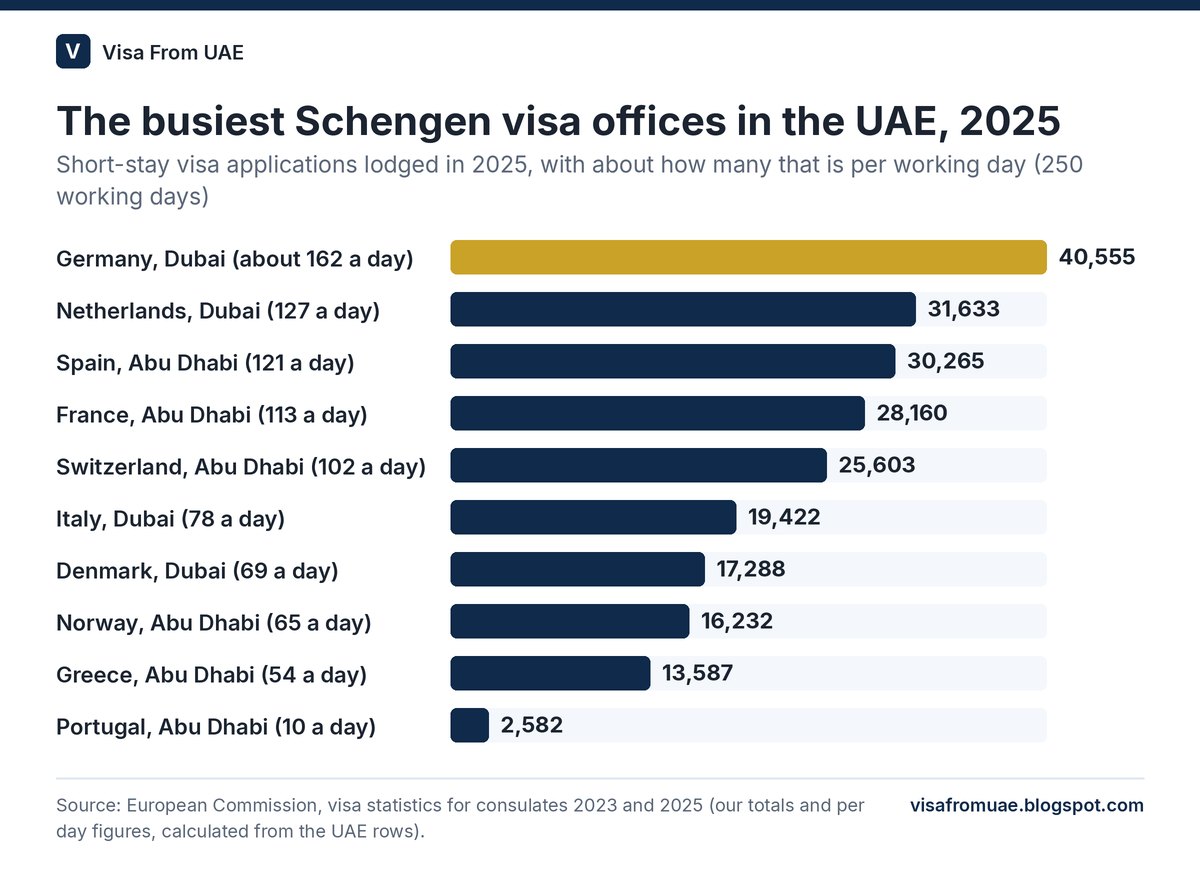
Three things come out of the numbers:
- Demand keeps rising. Schengen offices in the UAE received 240,822 short-stay applications in 2023 and 302,144 in 2025, up 25% in two years. Germany's consulate in Dubai alone went from 26,024 to 40,555.
- Five offices take more than half the load. Germany in Dubai, the Netherlands in Dubai, Spain, France and Switzerland in Abu Dhabi handled 156,216 applications in 2025, about 52% of the total. These are the countries where appointment waits are most often reported, and two of them (Netherlands and Spain) are the ones that openly plan for more than 15 days.
- Small offices are not automatically faster. Portugal received about 10 files a working day in 2025, but its page still promises only "a minimum" of 15 days. A small team can also mean fewer appointment slots, so a quiet office may be just as hard to book.
Volume is only a rough guide. Staffing, the share of nationalities that need consultation and how complete files are all change the real time, and the EU does not publish any of that. If you are choosing between two countries you will genuinely visit, our easiest Schengen visa from the UAE post compares refusal rates for every office.
The wait nobody prints: getting an appointment
For most people in Dubai and Abu Dhabi, the decision is not the slow part. The appointment is. On 11 October 2026, Khaleej Times quoted Subair Thekepurathvalappil of Wise Fox Tourism: "for some Schengen countries, appointments are available after 45 days, while for others, the wait can stretch to two months." That was in the run-up to the National Day holiday, and agents said many residents were switching to Georgia, Thailand and other places with quick visas.
VFS Global says it does not control this. Its UAE regional head, Monaz Billimoria, told Gulf News that slots "are released as per the instructions of the respective client governments and are reflected on our website in real time", and told The National that processing timelines and decisions "are the sole prerogative of the embassies/consulates, and vary from case to case." The National's 2025 report described residents who tracked appointment lists from January and still found nothing for summer.
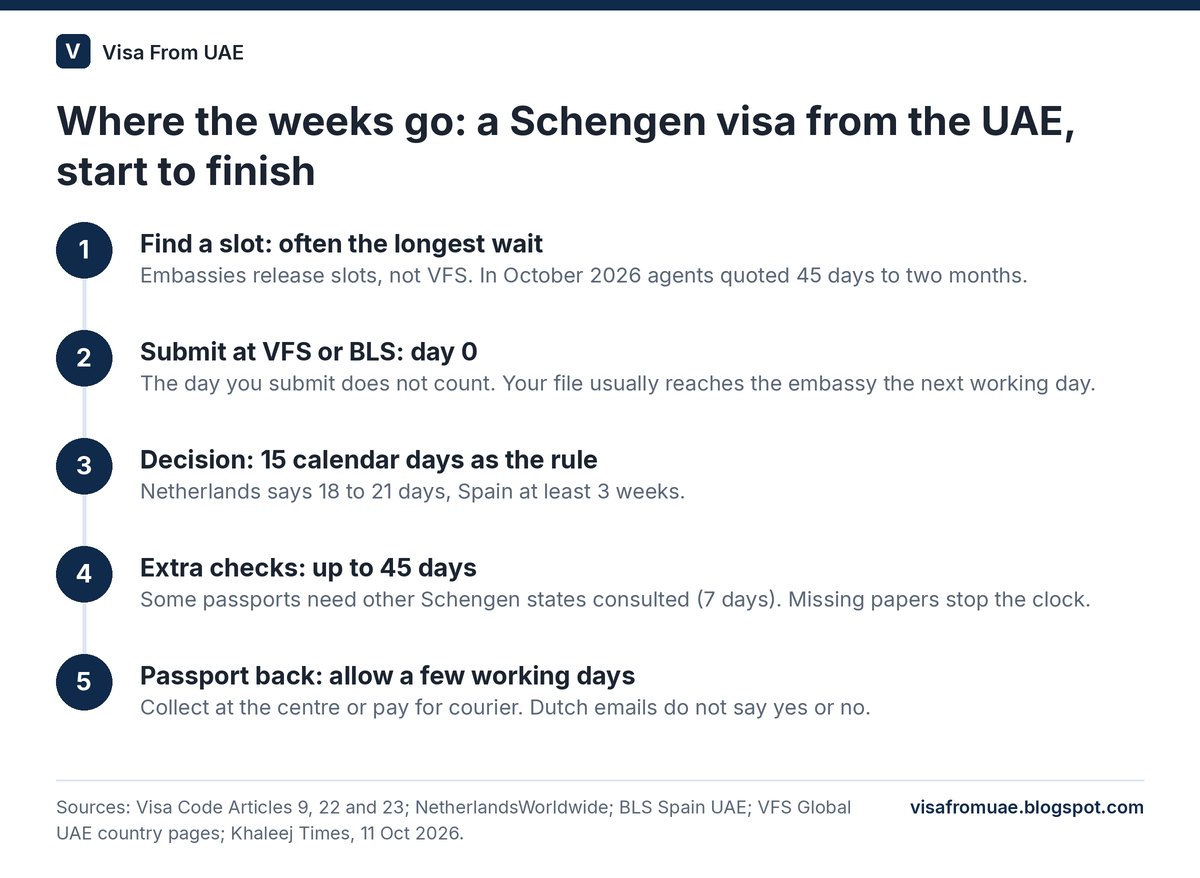
Put the two waits together and a realistic timeline from the day you start looking looks like this:
If no country you can legitimately apply to has a slot, do not book with the wrong embassy just to get a date. A file lodged with a country that is not your main destination can be refused, and that refusal stays on your record in the Visa Information System. Our Schengen appointment not available guide covers what does work.
Why some files take longer
Your passport needs prior consultation
Under Article 22, some Schengen states ask to be consulted before anyone else issues a visa to certain nationalities. The VFS pages link the current list, and it has included Pakistani, Bangladeshi, Sri Lankan, Egyptian, Jordanian, Lebanese, Syrian, Iraqi, Iranian, Moroccan, Tunisian and Algerian passports. The consulted countries have seven calendar days to reply. In practice, if you hold one of these passports, plan on the long end of the range from day one. Check the list your embassy links before you plan, because each Schengen state chooses which nationalities it wants to be consulted on.
Something is missing
The 15 days start from an admissible application. If the embassy writes to ask for a document, the extra time comes out of the 45 day allowance. The Croatian and Austrian VFS pages both stretch the time to 60 days when documents are missing, and Latvia's page says the applicant "must accept responsibility for any delay" when a file comes back for missing or wrong information. The fix is boring but it works: follow the checklist for your exact country and purpose, in the order it asks, with every page it asks for. Our Schengen bank statement rules page covers the document most often queried.
You are called for an interview
Every embassy can call you in. Finland and Iceland mention it in their processing text, and the Portuguese checklist says it can happen. It adds days, not weeks, as long as you answer quickly.
The season
Summer is the worst time. Croatia's page lists Eid, July and August, UAE national holidays, Christmas and New Year as periods that "may extend" processing, and the Dutch government had a peak season warning up on 19 November. December is busy because of National Day, Christmas and school holidays falling together.
Things that do not speed it up
There is no paid express service for Schengen visas from the UAE. Billimoria told Gulf News: "There is no fast-track service for Schengen visas." The Premium Lounge, Prime Time slots and doorstep service "are optional and have no impact on processing timelines or visa decisions". Switzerland handles urgent cases only for "high Swiss interests", such as political reasons or life-threatening medical treatment. Spain's BLS page has a declaration form for files submitted with short processing time, but that is you accepting the risk, not a faster track.
Agents who promise an "urgent Schengen visa in 5 days" cannot change how fast a consulate works. What some of them sell is appointment slots, and both VFS and the embassies have warned against paying anyone for those, because VFS bookings are free.
How far ahead to apply
Here is how I would plan, using the rules above:
| Your situation | Start looking for a slot | Submit no later than |
|---|---|---|
| Off-peak trip, Germany, France, Italy, Austria, Portugal | 8 to 10 weeks before | 4 weeks before |
| Netherlands or Spain as main destination | 10 to 12 weeks before | 5 to 6 weeks before |
| Passport on a prior consultation list | 12 weeks before | 6 to 7 weeks before |
| Summer, Eid or December trip, any country | As soon as the six month window opens | 8 weeks before |
| Iceland, or a Swiss host sponsoring you | 12 weeks or more | 7 weeks before (Iceland says up to 45 days) |
These are my planning margins built on the official figures and the appointment waits reported this autumn, not promises from any embassy. Each one leaves room for the full 15 days, a request for one more document and the trip back to the visa centre.
A worked example: say you want a week in Amsterdam from 1 July 2027. The six month window opens on 1 January 2027. The latest sensible submission date is mid May, five to six weeks before travel. That means looking for a VFS slot from early March, which is about when summer slots start to vanish. If your passport needs consultation, move every date two weeks earlier.
Flying in December 2026?
Today is 19 November. A flight on 20 December means you must submit by 5 December at the latest under the 15 day rule, and Portugal and Italy will hand back any file inside that line. With slots reported 45 days or more out in October, most people starting now will not make it unless a cancellation opens up. If you already hold a valid multiple-entry Schengen visa, check its dates and the 90/180 day count instead. Otherwise, a destination with an e-visa or visa-free entry for UAE residents may be the realistic plan for this holiday.
How to track your application
- VFS countries: use the "Track your application" link on the VFS page for your country with the reference number on your receipt. The status usually shows where your passport is, not what was decided.
- France: follow it in your France-Visas account.
- Spain: the BLS UAE site has its own tracking page.
- Netherlands: the government says you will get an email when it is done, and to call only after 45 calendar days.
Do not email the embassy on day 10 asking for an update. Germany and the Netherlands both ask applicants not to chase, and it does not move your file up the pile.
If the answer is a refusal
A refusal usually arrives on the same timeline as a visa: your passport comes back with a standard refusal form that ticks the reasons. You can appeal or apply again, and the appeal routes and deadlines differ by country. Our guide to a Schengen visa rejected in the UAE explains which is faster in each case.
Frequently asked questions
How long does a Schengen visa take from Dubai?
The legal standard is 15 calendar days from a complete application, extendable to 45. In practice most embassies in the UAE quote 15 days, the Netherlands 18 to 21 days and Spain at least three weeks. Add the appointment wait, which was 45 days to two months for some countries in October 2026.
How many days after biometrics will I get my Schengen visa?
Count from the day after you submit and give fingerprints. For a complete file with no consultation, two to three weeks is normal. Up to 45 days is still within the rules.
Which Schengen country is fastest from the UAE?
No embassy in the UAE officially promises less than 15 days for a short-stay visa. Germany says "up to 15 calendar days". Agency rankings of "fastest" countries are not based on any official data, so pick the country that is genuinely your main destination and focus on getting an early slot.
Can I pay for urgent Schengen visa processing in Dubai?
No. VFS Global says there is no fast-track service for Schengen visas, and its premium options do not change processing times. Switzerland takes urgent cases only for high Swiss interests or life-threatening medical reasons.
Can I apply less than 15 days before travel?
The Visa Code allows it only in justified urgent cases. In practice Portugal will not accept a file with fewer than 15 days before travel, and Italy's embassy in Abu Dhabi hands such files back and keeps the fee.
Why is my Schengen visa taking more than 15 days?
The most common reasons are a request for more documents, prior consultation for your nationality, an interview, or peak season. The embassy can take up to 45 calendar days without breaking any rule.
More Schengen guides for UAE residents
- Schengen visa from Dubai and the UAE: documents, fees and steps
- Schengen appointment not available in Dubai or Abu Dhabi
- Easiest Schengen visa from Dubai and Abu Dhabi: refusal rates by consulate
- Netherlands visa from Dubai and Abu Dhabi
- Spain visa from Dubai and Abu Dhabi
Sources
- Regulation (EC) No 810/2009, the EU Visa Code (Articles 9, 22 and 23) and Regulation (EU) 2019/1155 amending it (six month window, 15 and 45 day limits)
- NetherlandsWorldwide: waiting time after your visa application (18 to 21 calendar days, peak season notice)
- BLS International: Spain tourist visa in the UAE (minimum 3 weeks processing)
- Embassy of Switzerland in the UAE: Schengen visa procedure (15 calendar days, up to 12 weeks, urgent cases)
- VFS Global UAE country pages, processing time tabs: Germany, Netherlands, Greece, Portugal, Austria, Croatia, Iceland, Sweden, Denmark, Norway, Hungary, Slovakia, Estonia, Luxembourg, Finland, Malta, Lithuania, Latvia (all read 19 November 2026)
- France-Visas: United Arab Emirates and Consulate General of Italy, Dubai: tourism checklist, June 2026 (as read for our country guides in November 2026)
- European Commission: short-stay visa statistics by consulate, 2023 and 2025 (totals and per day figures are our calculation from the UAE rows)
- Khaleej Times, 11 October 2026: Schengen visa delays push UAE residents to seek alternatives for National Day trips
- Gulf News: VFS Global UAE regional head on appointment slots and no fast track
- The National, 12 August 2025: months-long wait for Schengen visas
Processing times were read on the official pages on 19 November 2026 and can change at any time, especially in peak season. Appointment waits come from news reports quoting travel agents and are not official figures. The decision on a visa, and how long it takes, belongs to each embassy. This guide is general information, not legal or immigration advice. See our Disclaimer.
Last updated: November 19, 2026