
Oman is the trip most UAE residents take on a whim. Someone in the group says "Hatta border, Friday morning?", the cars get loaded, and only at the border does anyone ask whether the Indian passport in the back seat needs anything different from the British one in the front. Sometimes nothing happens. Sometimes one person gets turned around while the others wait in the car park.
The confusing part is that the answers online disagree. Travel agents quoted in the UAE press say any resident gets a 14-day visa on arrival at the border. A 2022 Royal Oman Police statement said all GCC residents qualify, whatever their job. Oman's own eVisa portal, which I went through page by page on 23 November 2026, says something stricter: the GCC Resident Visa is for people whose job is on an approved list, with at least six months left on their residence. So for this guide I pulled every visit visa type the Royal Oman Police (ROP) lists, saved the condition pages, and wrote a small script that checks the fees, stay lengths and residence rules quoted below and converts them to dirhams. Then I matched that against the 2026 news on the free 14-day visa, the border fuel limit and car insurance.
Short answer: It depends on your passport first and your job second. If your passport is on Oman's free entry list (UK, US, EU and many others), you can enter free for 14 days. Most other UAE residents use the GCC Resident Visa: OMR 5 (about AED 48), single entry, 4 weeks plus a possible 1 week extension, but only if your job title is on the ROP's approved list and your UAE residence has 6 months left. Indian passport holders with a valid US, UK, Schengen, Canada, Australia or Japan visa have their own 10 or 30 day route. If none of that fits, you need a visa sponsored by an Omani hotel or tour company. Driving? Add about Dh35 UAE exit fee per person and, if your policy does not cover Oman, about Dh106 for border insurance.
Do UAE residents need a visa for Oman?
Emirati citizens do not. They cross with their ID like any GCC national. Everyone else living in the UAE does need some kind of permission to enter Oman, even if it is free and handed over at the counter. Your UAE residence visa alone is not a visa for Oman. What it does is open certain doors that a tourist flying in from abroad would not have.
The order that works in practice:
- Check your passport. If your nationality gets free entry, the rest of this guide is mostly about the border and the car.
- Check your job title. The title printed on your UAE residence and labour record decides whether you can use the GCC Resident Visa.
- Check your other visas. Some nationalities, including Indians, get a separate route if they hold a valid US, UK, Schengen, Canadian, Australian or Japanese visa.
- Only then look at sponsored visas through a hotel or licensed tour company.
The routes on the Royal Oman Police eVisa portal
The ROP runs Oman's visa system at evisa.rop.gov.om. Its "Know your Visa Type" section lets anyone browse the visa categories without logging in. Under "Visit Unsponsored visas" it lists 13 types, from a one-year multi-entry visit visa to a patient visa. For a UAE resident going on holiday, five of them matter.
- Free Entry for 14 Days (code 26O): for "a person holding a nationality from G1 Special" countries, with a companion version (26P).
- GCC Resident Visa (code 29): for foreign residents of GCC countries "provided they hold professions specified by the authority". Four sub-types: 29A (visa on arrival), 29B (family member or domestic worker travelling with an eligible resident), and 29C and 29D, the same two under the portal's EMB codes.
- Tourist Visit Visa 10 or 30 days for holders of certain visas (26N and 26M): for listed nationalities who hold a valid Schengen visa or a valid visa or residence from the US, UK, Canada, Australia or Japan.
- Dubai / Oman Common Visa (21A): for tourists who entered Dubai on a tourist visa and travel straight on to Oman.
- Ordinary Tourist Visit Visa 10 or 30 days (26A and 26B): for "Group 1" nationals.
Anyone who fits none of these goes through a sponsor, which in practice means an Omani hotel or tour operator applying for you.

The GCC Resident Visa, line by line
This is the visa most UAE expats end up using, so here is exactly what the ROP condition page for the visa on arrival version (29A) says, as I saved it on 23 November 2026:
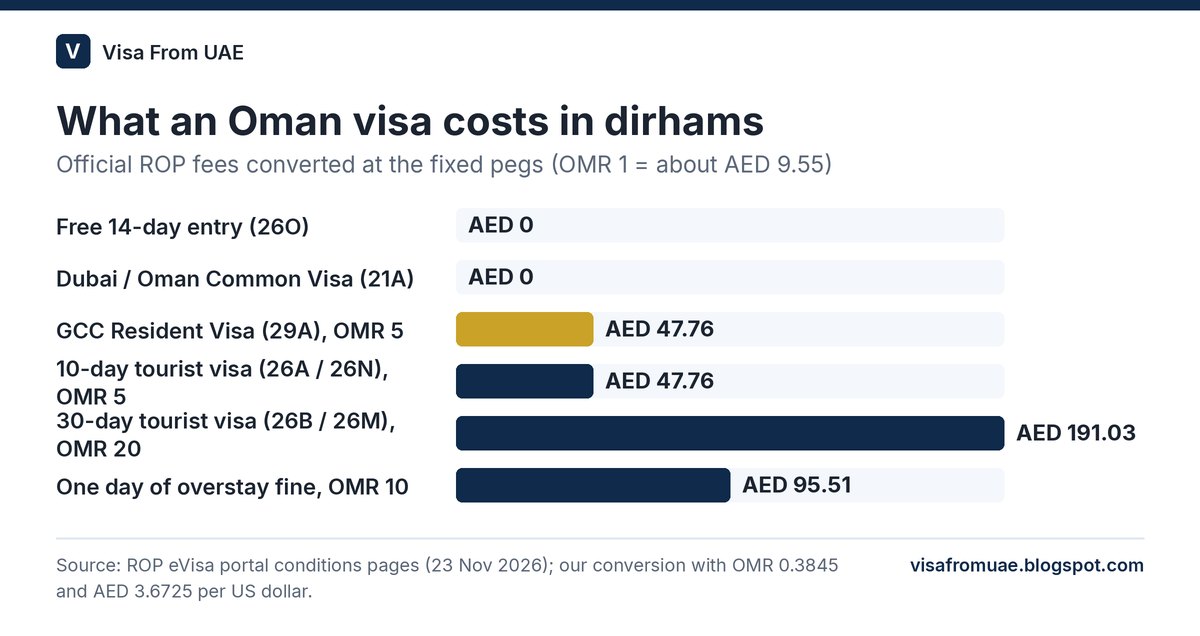
- Fee: "The fee for this visa is OMR 5.000." At the fixed currency pegs that is about AED 47.76.
- Stay: "Length of stay in Oman is 4 weeks", and "Extension of stay allowed is 1 week". You can do the first extension yourself; a second one means visiting a Directorate General of Passports office.
- Entries: single entry only. Leave Oman and come back, and you need a new visa.
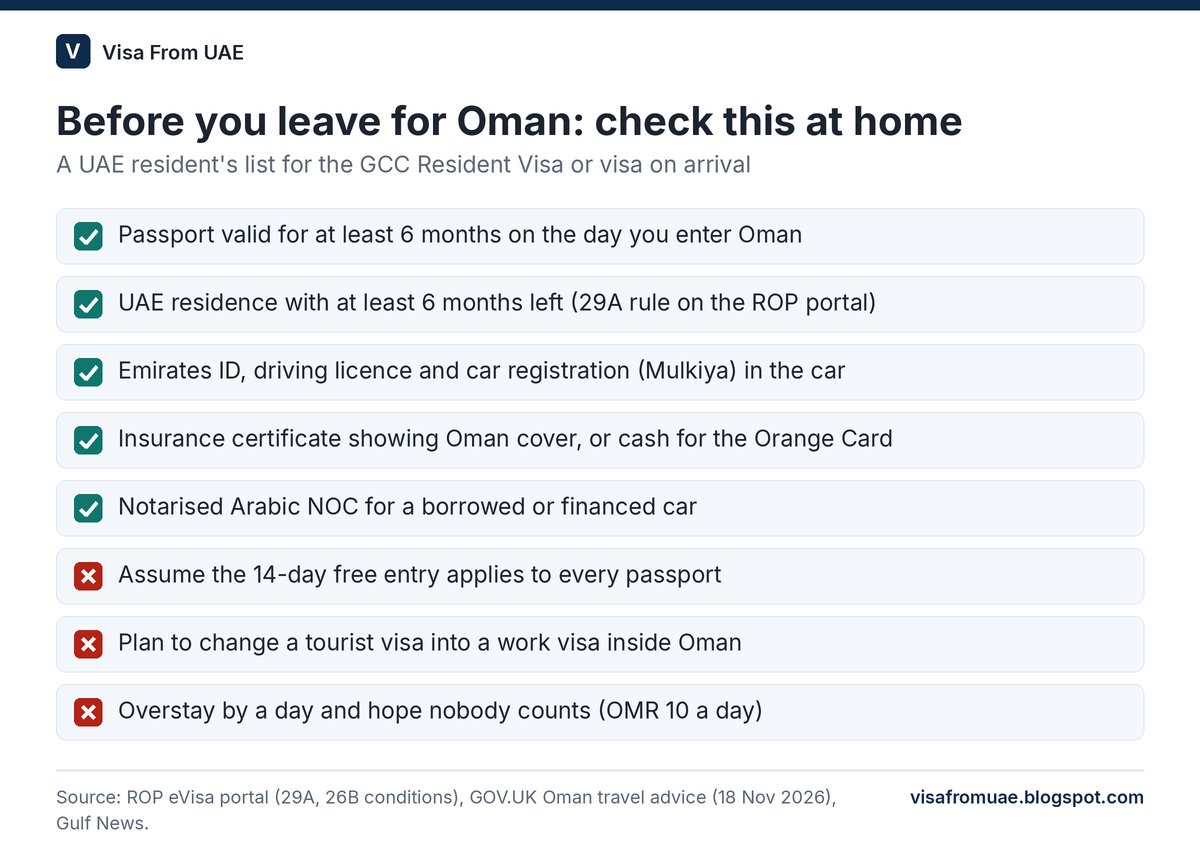
- Residence: "Must be a resident of a GCC country, with at least 6 months residency in the country remaining on entry to Oman."
- Job: "Must be on the list of approved professions."
- Passport: valid for at least 6 months on entry.
- Use by: the portal shows a use-by period of one month, so an advance visa has to be used within a month of issue.
- Documents: a digital photo and a copy of your passport.
The companion version (29B) has the same OMR 5 fee and four week stay, but the holder "must enter Oman with the eligible GCC resident", and must be a family member or domestic worker of that person. A copy of the main applicant's visa is part of the file. This is how a spouse whose own job title is not on the list, or who does not work, usually travels.
The approved professions problem
Here is where people get stuck. The portal says the list exists, but the public pages do not print it. And the public statements over the years do not agree with each other:
- In October 2022, an ROP spokesman told the Oman Observer that under a new decision "regardless of job categories, all GCC residents can obtain visas (either E-Visa or Visa on arrival depending on the nationalities)", and that the GCC residence needed at least three months left.
- In October 2025, Gulf News wrote that "only residents working in one of over 30 approved professions are eligible to apply online", and that others need a sponsored visa through an authorised agency.
- In November 2026, the live eVisa portal still says 29A applicants "must be on the list of approved professions" and need six months of residence left, not three.
When an official portal and an older statement disagree, plan on the stricter rule. The portal is what the officer at the counter is looking at. Because the list itself is not published, nobody outside the ROP can promise you that your title is on it, and that includes agents and forum posters. If your title is refused, the 29B companion route (travelling with an eligible family member) or a sponsored visa are the fallbacks.
The practical way to check is the eVisa application itself: when you register and pick the GCC Resident Visa, the form asks for your profession and the system decides. You can also call the ROP eVisa call centre. The portal lists 80080011 (toll free inside Oman) and +968 22848200 from outside Oman, 7 am to 9 pm Oman time, plus Info-omanevisa@rop.gov.om. One small trap: a widely shared 2026 newspaper guide prints the number as "+968 2284820", one digit short. Use the number from the portal.
Indian passport holders
Indians are the largest expat group in the UAE, so this comes up a lot. Indian citizens are not on Oman's free 14-day list. That leaves three routes:
- GCC Resident Visa if your job title is approved (OMR 5, four weeks).
- Tourist visa for holders of other visas (26N or 26M) if you hold a valid US, UK, Schengen, Canadian, Australian or Japanese visa. The portal's grant rule is "a valid Schengen Visa; OR a Valid Residency Visa or Multi-Entry Visa from Great Britain, Australia, U.S.A, Canada or Japan". The 10-day version costs OMR 5 and the 30-day version OMR 20 (about AED 191). Both need a hotel booking and a return ticket, and a copy of that other visa goes in the application.
- Sponsored visa through a hotel or tour company.
The Oman Observer reported in 2022 that India was one of 27 nationalities that get this visa-holder treatment, alongside Egypt, Jordan, Morocco, Uzbekistan, Azerbaijan, Armenia, Kazakhstan, Vietnam, Mexico and others. Moroccans have a twist: only a Schengen visa issued in Morocco counts. The portal's conditions refer to a separate list of allowed nationalities for 26N and 26M that is not on the public pages, so check during the application that your passport is still on it before you pay.
Pakistani, Filipino, Bangladeshi and other passports
For most other nationalities common in the UAE, the GCC Resident Visa is the main road, with a sponsored visa as the fallback. Two news items cause confusion:
- Oman and Pakistan signed a visa exemption agreement on 14 October 2026, but Gulf News reported that it "covers holders of diplomatic, special, service and official passports". Ordinary green Pakistani passports are not covered.
- Lists of "visa-free countries for UAE residents" often include Oman for everyone. That is only true if your passport or your job title qualifies.
What it costs in dirhams
Oman prices everything in rials. Both the rial and the dirham are pegged to the US dollar (OMR 0.3845 and AED 3.6725 per dollar), so the conversion does not move: OMR 1 is about AED 9.55. My script converts each fee from the portal's condition pages:
| Item | Official fee | In AED |
|---|---|---|
| Free Entry 14 days (26O) | Free | 0 |
| GCC Resident Visa (29A or 29B) | OMR 5 | 47.76 |
| 10-day tourist visa (26A, 26N) | OMR 5 | 47.76 |
| 30-day tourist visa (26B, 26M) | OMR 20 | 191.03 |
| Dubai / Oman Common Visa (21A) | Free | 0 |
| Overstay fine, per day | OMR 10 | 95.51 |
| UAE exit fee at a land border (per person) | about Dh35 | 35 |
| Orange Card car insurance at the border, 5 days minimum | about Dh106 | 106 |
A worked example: two adults on the GCC Resident Visa driving through Hatta pay 2 x 47.76 for visas plus 2 x 35 in exit fees, which is AED 165.51 before fuel and hotels. If their car policy does not include Oman and they buy the five day Orange Card at the kiosk, the border costs become AED 271.51.
The free 14-day visa from August 2026
On 2 August 2026, the Oman Observer reported that the ROP had added a new category to the tourist visas in the executive regulations of the Foreigners' Residency Law: a visa "for 14 days" for "nationals of countries determined by the competent authorities", which can be swapped before it expires for another tourist visa, and which was added to the fee schedule with a full exemption, "to become completely free". It took effect the day after publication in the Official Gazette.
On the portal this shows up as code 26O, "Free Entry for 14 Days (Person from G1 Special Countries)". The UK Foreign Office's Oman advice, updated on 18 November 2026, tells British visitors they "can visit Oman for up to 14 days without a visa", and the same applies to many Western passports.
What it does not do is make Oman free for every UAE resident. The visa is tied to nationality, not to where you live. If your passport is not on that list, the 14-day rule in a news headline does not apply to you, however long you have lived in Dubai.
Two things to keep in mind even if you qualify. The UK advice says Omani border control can ask for a return or onward ticket, a hotel booking and proof of travel health insurance. And 14 days means 14 days: if the trip stretches, switch to another tourist visa before day 14 rather than after.
Driving to Oman from the UAE
Most UAE residents go by road. The crossings that matter, by where you are heading:
- Hatta, into Al Wajajah: reached via the E44 from Dubai, the usual road for Muscat and the north.
- Khatmat Milaha: through Fujairah on the E99, towards Sohar and Muscat along the coast.
- Mezyad (Al Ain): the crossing people use for the long drive south to Salalah.
- Musandam: through Ras Al Khaimah to the Khasab side, or through Fujairah to Dibba. Musandam is part of Oman, so the same visa rules apply.
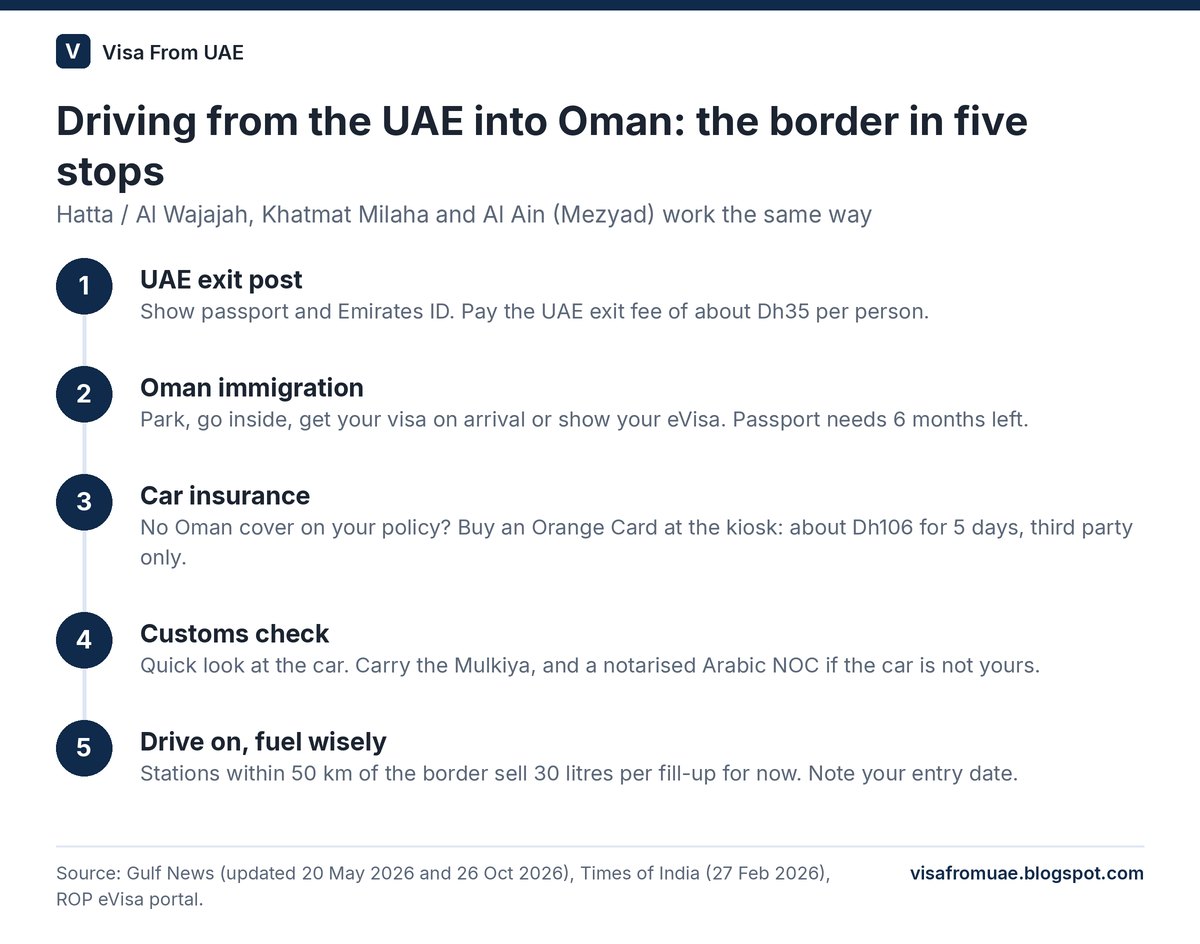
The process at each one is similar. You stop at the UAE exit post first, show your passport and Emirates ID, and pay the exit fee. Then you drive to the Omani post, park, and go inside to immigration, where the visa is issued or checked and your passport is stamped. Customs then takes a short look at the car.
Car insurance and the Orange Card
Your car must be insured in Oman. Many comprehensive UAE policies already include Oman; InsuranceMarket.ae's marketing chief told Gulf News that "major insurance companies in the UAE offer Oman coverage for free along with their comprehensive cover". Ask your insurer for the certificate before you leave, because "GCC cover" on a renewal email is not the same as a document the officer can read.
If you are not covered, you can buy the "Orange Card" at kiosks at the border. It is third party only ("in case of an accident, your car will not be covered", as the same insurer put it), the minimum term is five days, and it costs about Dh106. For a new or financed car, that gap matters more than the fee.
Borrowed, financed and rental cars
You can drive a car that is not registered to you, but you need a No Objection Certificate from the owner. Gulf News describes it as notarised, translated into Arabic, and showing the chassis number, registration details and your Emirates ID number. Banks treat a financed car the same way: the bank is the owner on paper, so ask for its letter well before the weekend. For rentals, check before you sign: Gulf News notes that cross-border trips usually cost extra, and a multinational rental firm with branches in Oman is easier to deal with if the car breaks down.
The 30-litre fuel limit near the border
Since late October 2026, Oman has limited fuel sales to 30 litres at petrol stations within 50 km of the border crossings. The Ministry of Commerce, Industry and Investment Promotion said the temporary step was to keep fuel available as demand rose at some border stations. Gulf News worked out that, at November prices, filling 30 litres of 95 or 91 in Oman saves roughly Dh53 to Dh54 compared with the UAE, before the cost of getting there. On a 100 km detour in a car that uses 8 litres per 100 km, about Dh32 of that disappears in fuel, and the Dh35 exit fee more than wipes out the remaining Dh21. So the fill-up is a bonus on a trip you were making anyway, not a reason to drive to the border.
Duty-free shops coming to the border
Decision No. 145 of 2026 by Oman's Inspector General of Police and Customs authorises duty-free markets at three land crossings, including Al Wajajah and Khatmat Milaha on the UAE border. They were announced in October 2026; I have not seen an opening date yet.
Flying instead
The visa logic is the same if you fly to Muscat or Salalah: free entry if your passport qualifies, otherwise the GCC Resident Visa or one of the tourist visas. Apply on the portal before you fly. The application has to be made while you are outside Oman, and Gulf News noted that approval normally takes at least four to five working days. Carry a printout and keep the confirmation email.
Visiting family on a Dubai tourist visa?
If parents or friends are in Dubai on a tourist visa and want a few days in Oman, look at the Dubai / Oman Common Visa (21A). The portal conditions are specific:
- The traveller must be a citizen of one of the "Dubai-Oman joint visa countries" and "must already hold a visit visa from Emirate of Dubai".
- They "must arrive in Oman from Dubai" at the Al Wajajah land crossing, at Muscat airport, or at a seaport.
- The Dubai visa "must still have 21 days validity remaining on entry to Oman".
- Stay is 21 days, single entry, no extension, and "there is no fee".
It does not help residents, only Dubai tourists. The condition names a visit visa from the Emirate of Dubai, so a visitor whose visa was issued elsewhere in the UAE should check before relying on it.
Rules once you are inside Oman
- Overstay: OMR 10 a day under the portal conditions, about AED 95.51. The UK advice says total fines can reach 500 rials (about AED 4,776), and that overstayers can be detained.
- No switching to work: tourist visa conditions say the visa "cannot be changed to a work visa while inside the Sultanate". An Oman Observer opinion piece in September 2026 said the ROP had permanently suspended conversions after tourist visas were misused by job brokers. If someone offers you a "tourist visa that turns into a job", walk away.
- Vapes and medicines: the UK advice says it is illegal to import or use e-cigarettes or vape products in Oman, and some prescription medicines are controlled. Leave the vape in Dubai and carry prescriptions.
- Regional security: the UK updated its Oman advice on 18 November 2026 to warn about regional tensions and short-notice airspace closures. Check the latest advice from your own government before a long trip.
Common mistakes I keep seeing
- Trusting a friend's experience. Your friend's British passport got free entry. Your Indian or Pakistani passport follows a different rule.
- Travelling with a UAE visa that expires soon. The GCC Resident Visa wants six months left on your residence when you enter Oman. Renewal season and road trip season often overlap.
- Not checking the job title. Promotions often do not reach the labour card. The officer sees the title in the system, not the one on your LinkedIn.
- Assuming "GCC cover" means Oman cover. Get the certificate, or budget for the third-party-only Orange Card.
- Forgetting the NOC for a borrowed or financed car. Without it you may be turned back at customs, after paying the exit fee.
- Counting days from the wrong date. The stay starts from the entry stamp. Fourteen days of free entry ends on day 14, not on the Friday after.
Frequently asked questions
Can UAE residents get an Oman visa on arrival?
Yes, if you qualify. Residents whose job title is on the ROP's approved list can get the GCC Resident Visa on arrival (OMR 5, four weeks). Nationals of free entry countries get a free 14-day entry. Others need to apply online in advance or go through a sponsor.
How much is the Oman visa for UAE residents?
The GCC Resident Visa is OMR 5, about AED 48. The 30-day tourist visa is OMR 20, about AED 191. The 14-day entry for eligible nationalities and the Dubai / Oman common visa are free.
Is the Oman visa on arrival 14 days or 4 weeks?
Both numbers exist, which is why people get confused. The free entry for eligible passports is 14 days. The GCC Resident Visa on the ROP portal is four weeks, with a possible one week extension. News articles that say "UAE residents get 14 days on arrival" mix the two.
Do I need six months or three months left on my UAE visa?
The ROP portal says six months for the GCC Resident Visa. A 2022 ROP statement said three months. Go with six, because that is what the live system checks.
Can an Indian with a US or UK visa enter Oman?
Yes, through the 26N (10 days, OMR 5) or 26M (30 days, OMR 20) tourist visas, as long as the US, UK, Schengen, Canadian, Australian or Japanese visa or residence is valid. You need a hotel booking and a return ticket.
Can I drive my company car to Oman?
Yes, with a notarised NOC in Arabic from the company that owns it and insurance valid in Oman. Ask HR early, because notarisation takes time.
What happens if I overstay in Oman?
You pay OMR 10 a day (about AED 95.51). The UK advice warns that overstayers can also be detained, with fines up to OMR 500 in total.
More guides for UAE residents
- Saudi visa from UAE: GCC resident e-visa and tourist routes
- Visa-free countries for UAE residents by passport
- Georgia visa from UAE
- Turkey visa from UAE
- UAE return permit after 6 months outside
- NOC letter for a visa from a UAE employer
Sources
- Royal Oman Police eVisa: Know your Visa Type (visit unsponsored visas; condition pages for 29A, 29B, 26A, 26B, 26D, 26M, 26N, 26O, 21A), read 23 November 2026
- Royal Oman Police eVisa home page: call centre numbers and email
- GOV.UK Foreign travel advice: Oman entry requirements (updated 18 November 2026)
- GOV.UK Foreign travel advice: Oman warnings and insurance
- Oman Observer, 2 August 2026: Oman introduces a new free 14-day tourist visa
- Oman Observer, 31 October 2022: Rules simplified, but GCC residents need visa to enter Oman
- Oman Observer, 2 September 2026: Combating fraud practices in tourist visa issuance
- Gulf News, updated 20 May 2026: UAE to Oman via road, visa, car insurance and border rules
- Gulf News: Visa on arrival and eVisa options for UAE residents in GCC countries
- Gulf News, 26 October 2026: Oman imposes temporary 30-litre fuel limit near border crossings
- Gulf News, 31 October 2026: UAE-Oman fuel trips, does driving to the border save money?
- Gulf News, 13 October 2026: Oman to open duty-free markets at three land border crossings
- Gulf News, 14 October 2026: Oman, Pakistan sign visa exemption agreement (official passports)
- Times of India, 27 February 2026: UAE to Oman by car, visa, insurance and border fees
Visa rules were read from the Royal Oman Police eVisa portal on 23 November 2026 and checked with our own script. The portal does not publish the approved professions list or the nationality lists on its public pages, so confirm your own case on the portal or with the ROP call centre before you travel. Dirham amounts use the fixed pegs of OMR 0.3845 and AED 3.6725 per US dollar. Border fees and insurance prices are as reported in 2026 and can change. This guide is general information, not legal advice. See our Disclaimer.
Last updated: November 23, 2026